| Piú viste - Mars Reconnaissance Orbiter (MRO) |

PSP_001948_1425_red.jpgGorgonum Chaos (Original NASA/JPL/University of Arizona b/w Frame)57 visitePSP_001948_1425 shows part of Gorgonum Chaos, a large cluster of chaotic terrain found in the Southern Hemisphere.
Many regions of chaotic terrain are found at the head of large outflow channels that were scoured by ancient floods. Gorgonum Chaos is one region that is not associated with an outflow channel. Chaotic terrain can form when subsurface volatiles (such as water) are catastrophically released and the overlying surface collapses. It is not known whether isolated chaotic terrain — such as that shown in this image — formed in the same way that the chaotic terrain near the outflow channels did. Wind erosion might play a role in their formation.
Gorgonum Chaos is an especially interesting area because gullies thought to have been eroded by liquid water are located on its mesas. The gullies have a wide range of orientations and many appear to emanate from a distinct layer in the mesas.
It is not known why gullies form on one slope rather than another, but insolation (amount of sunlight received), availability of water, and regional slope are possible contributing factors.
|
|

PSP_002917_2175_RED_browse.jpgCrater Cluster in the Northern (Mid-Latitude) Plains57 visiteA Northern Mid-Latitude scene consisting of craters, intercrater plains and mantled material is seen in PSP_002917_2175. The mantled material seen here covers much of the Middle Latitudes in both Hemispheres of Mars; it has been visibly removed in some locations. It's called "mantled" because it looks as if it's just draped over, or mantling, the topography underneath. The mantled material is what causes the craters to have a muted, softened appearance. It's thought to be ice-rich material deposited in a climate different from that of today.
The mantled unit is dissected here, meaning that is not pristine and has likely undergone modification since it was originally laid down. The intercrater plains have a pitted texture that is thought to be caused by water ice sublimating and leaving depressions behind.
Unlike that of Earth, the obliquity (tilt of the planet's rotation axis) of Mars changes wildly.
Earth has the Moon to keep its axis stable, but Mars' satellites, Phobos and Deimos, are not massive enough to do the same.
Today Mars' obliquity (25.19°) is similar to that of Earth's (23.45°), but this has not always been the case. As the obliquity changes, the portions of Mars that receive the most sunlight shift. During periods of high obliquity, polar regions receive the most sunlight. This causes polar ices, including water ice and carbon dioxide ice, to sublimate (evaporate) into the atmosphere. They would then potentially be re-deposited in the mid-latitudes, similar to where this image is located. It is believed that this process is responsible for the mid-latitude mantled unit.
MareKromium
|
|
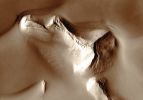
PSP_003464_1380_RED_browse-01.jpgGullies and Dunes in a Crater in Newton Basin (extra-detail mgnf)57 visiteThis extra-detail mgnf (~1 Km across) shows several generations of dunes interacting with the protruding rock.
MareKromium
|
|
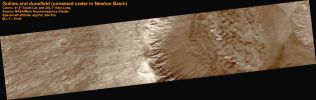
PSP_003464_1380_RED_browse-00.jpgGullies and Dunes in a Crater in Newton Basin (context image)57 visiteThis frame shows gullies associated with distinct layers located at multiple elevations along one crater wall as well as multiple generations of dunes that are eroding or covering a more coherent rock structure. The gullies in this crater appear to originate at the layers that cover a large extent of the slope. Gullies can be seen emanating from layers in two distinct sets, each at a different elevation. Gullies are often, but not always, form near layers.
Many of the gullies seen here have sinuous, or wavy, channels.
The bends are called meanders and, on Earth, meanders form in streams that have sustained and/or repeated flow. Not all of the gullies seen in this image extend the same distance downslope. This could result from differences in water supply, sediment supply, slope angle, and time of formation, among other factors.
Dunes are also visible in this image; they indicate the prevailing wind direction.
What is particularly interesting about this dune field is that there is exposed rock in the middle of it. This rock is either being exposed as the wind moves the dunes away from it or it is being covered. The dunes appear to outline the shape of the rock, which suggests that the rock has been uncovered long enough for dunes to form around it.
As the dunes shift over time, they will probably expose more of the underlying rock.MareKromium
|
|
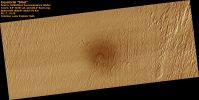
PSP_004030_1855_RED_browse.jpgBlast from the (Very Recent) Past57 visiteIn the center of this image is a very sharp-rimmed impact crater just 35 mt wide.
It lies in a bright, dust-covered region, but is surrounded by a slightly darker spot about 3 Km wide. The impact event created a blast of high winds that disturbed the dust and darkened the spot.
Since dust is constantly settling over the Region, the fact that we can still see the dark region means the impact event occurred of late, perhaps in recent decades. There are many dark streaks on topographic slopes over an even wider region surrounding the dark spot - these could be due to dust avalanches triggered by the impact, either from the air blast or from seismic shaking of the ground.
There are also rays of very small (approx. 1 mt in diameter) secondary craters extending radially outward from the 35-mt crater, created by the impact of rocks ejected from the main crater.
Thus a small impact crater has modified the surface over an area more then 10.000 times greater than that of the crater's interior.MareKromium
|
|
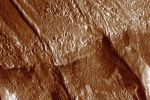
PSP_002620_1410_RED_browse-01.jpgGullies on the edge of Newton Basin (extra-detail mgnf)57 visiteThe gullies start near the top of the wall and can be traced across a break in slope partway down the wall (see here, 750 mt across). This break in slope occurs along the entire portion of the Crater wall in this image. The gullies appear shallower just above the break in slope, and deeper below the slope break.
This suggests that the fluid which eroded and carved out the wall materials forming the gullies, increased in velocity after the slope break, creating a deeper section of the gully.MareKromium
|
|
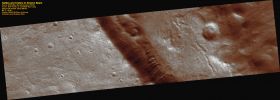
PSP_002620_1410_RED_browse-00.jpgGullies on the edge of Newton Basin (context image)57 visiteThis image shows a portion of two impact craters on the floor of Newton Basin where a smaller crater formed within a earlier larger one.
The larger crater's North rim can be seen diagonally (South-West/North-East) across the image and the smaller crater's north rim is near the right-side of the image.
Along the interior wall of the larger crater, several gullies have incised into the wall of the Crater. MareKromium
|
|

PSP_003252_1425_RED_browse-02.jpgBright Gully Deposit in Terra Sirenum (the "gully" - close-up; false colors)57 visiteThe bright gully deposit has a very fluid-like appearance, and has not been covered by other gullies or debris flows, indicating a young age. The brightness is a mystery; it could be due to minerals formed from water or ice.
Alternatively, the flow that made the gully may have removed a thin coating of relatively darker dust and soil, revealing a brighter substrate.
In any case, this feature is probably indicative of recent flow of water or water-rich material on Mars.MareKromium
|
|
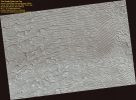
PSP_004820_0940_RED_browse.jpgFingerprint Terrain with Sawtooth Patterns in the South Polar Ice Cap (Natural Colors; credits for the additional process. and color.: Dr Paolo C. Fienga - Lunexit Team)57 visiteThis image shows a portion of the South Polar Ice Cap. The ice you see here is frozen CO2 rather than the frozen water you are used to here on Earth.
Even on Mars, where the temperatures are much lower than on Earth, CO2 ice is a volatile substance. As it is so unstable, large amounts can sublimate very quickly when heated. In this ice cap we can see icy features shrink in size by several meters per year as the ice that makes them up is removed by solar heating. Usually these icy features are almost circular as you get equal amounts of Sunlight from every direction when you are at the Pole.
However, in this location something strange has happened. Instead of the usual circular features we see features that are decidedly linear in shape. These sets of linear features have been dubbed "fingerprint terrain" by Planetary Scientists. They are seen in several locations in this ice cap and usually have a wavelength close to 90 mt (295 feet). It's hard to understand why linear features would form in this sort of environment by sublimation of ice alone.
It is possible that these features are formed instead by atmospheric processes. Either the features are sand dunes covered by a thin covering of frost or they might be made up of loose ice crystals that saltate like sand grains and have collected into ripples.
It would be a huge surprise to find sand dunes in this location, just as you wouldn't expect to see sand dunes on top of the Greenland ice sheet on Earth. To confirm that they are made of CO2 ice, HiRISE will image this location again at the end of the year and compare it to this image to look for changes.
Icy features should show large changes, but sand dunes move much more slowly. MareKromium
|
|
PSP_004847_1745_RED_browse-00.jpgThe "Martian Black Hole"...Again! (context frame)57 visiteVi invitiamo a leggere l'ultimo articolo sull'argomento (pubblicato su TruePlanets) dal titolo "Velvet Underground".MareKromium
|
|
PSP_004739_0935_RED_browse.jpgSouth Pole Residual Cap - Swiss-Cheese Terrain Monitoring (Natural Colors; credits for the additional process. and color.: Dr Paolo C. Fienga - Lunexit Team)57 visitenessun commentoMareKromium
|
|
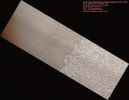
PSP_004778_0945_RED_browse.jpgSouth Pole Residual Cap - Swiss-Cheese Terrain Monitoring (Natural Colors; credits for the additional process. and color.: Dr Paolo C. Fienga - Lunexit Team)57 visitenessun commentoMareKromium
|
|
| 2237 immagini su 187 pagina(e) |
 |
|
|
|
|
148 | |
|
|
|
|





