| Piú viste - Mars Reconnaissance Orbiter (MRO) |
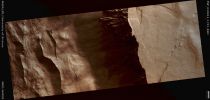
PSP_010013_1725_RED.jpgGreat Exposure of Ganges Chasma Wall and Slump Deposit (possible True Colors; credits: Lunar Explorer Italia)57 visiteMars Local Time: 15:34 (middle afternoon)
Coord. (centered): 7,2° South Lat. and 308,2° East Long.
Spacecraft altitude: 264,3 Km (such as about 165,2 miles)
Original image scale range: 52,9 cm/pixel (with 1 x 1 binning) so objects ~1,59 mt across are resolved
Map projected scale: 50 cm/pixel
Map projection: EQUIRECTANGULAR
Emission Angle: 0,7°
Phase Angle: 60,0°
Solar Incidence Angle: 59° (meaning that the Sun is about 31° above the Local Horizon)
Solar Longitude: 127,2° (Northern Summer)
Credits: NASA/JPL/University of Arizona
Additional process. and coloring: Lunar Explorer ItaliaMareKromium
|
|
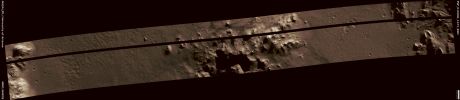
PSP_010006_1475_RED.jpgWestern Half of Central Peak of a large and well-preserved Unnamed Southern Crater (possible True Colors; credits: Lunar Explorer Italia)57 visiteMars Local Time: 15:33 (middle afternoon)
Coord. (centered): 32,0° South Lat. and 140,7° East Long.
Spacecraft altitude: 270,8 Km (such as about 169,3 miles)
Original image scale range: 54,2 cm/pixel (with 1 x 1 binning) so objects ~1,63 mt across are resolved
Map projected scale: 50 cm/pixel
Map projection: EQUIRECTANGULAR
Emission Angle: 20,7°
Phase Angle: 88,3°
Solar Incidence Angle: 73° (meaning that the Sun is about 17° above the Local Horizon)
Solar Longitude: 126,9° (Northern Summer)
Credits: NASA/JPL/University of Arizona
Additional process. and coloring: Lunar Explorer ItaliaMareKromium
|
|
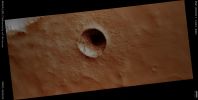
PSP_009917_1665_RED.jpgUnnamed Rayed Crater (natural colors; credits: Lunar Explorer Italia)57 visiteMars Local Time: 15:28 (early afternoon)
Coord. (centered): 13,4° South Lat. and 48,2° East Long.
Spacecraft altitude: 276,5 Km (such as about 172,8 miles)
Original image scale range: 27,7 cm/pixel (with 1 x 1 binning) so objects ~83 cm across are resolved
Map projected scale: 25 cm/pixel
Map projection: EQUIRECTANGULAR
Emission Angle: 22,5°
Phase Angle: 79,7°
Solar Incidence Angle: 62° (meaning that the Sun is about 28° above the Local Horizon)
Solar Longitude: 123,6° (Northern Summer)
Credits: NASA/JPL/University of Arizona
Additional process. and coloring: Lunar Explorer ItaliaMareKromium
|
|
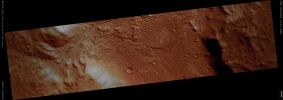
PSP_009992_1615_RED.jpgAl-Qahira Vallis (possible True Colors; credits: Lunar Explorer Italia)57 visiteMars Local Time: 15:36 (middle afternoon)
Coord. (centered): 18,2° South Lat. and 162,9° East Long.
Spacecraft altitude: 260,7 Km (such as about 162,9 miles)
Original image scale range: 52,2 cm/pixel (with 1 x 1 binning) so objects ~1,56 mt across are resolved
Map projected scale: 50 cm/pixel
Map projection: EQUIRECTANGULAR
Emission Angle: 0,2°
Phase Angle: 65,6°
Solar Incidence Angle: 65° (meaning that the Sun is about 25° above the Local Horizon)
Solar Longitude: 126,4° (Northern Summer)
Credits: NASA/JPL/University of Arizona
Additional process. and coloring: Lunar Explorer ItaliaMareKromium
|
|
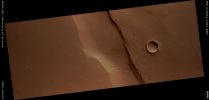
PSP_010054_1765_RED.jpgPlain North-West of Tithonium Chasma (possible True Colors; credits: Lunar Explorer Italia)57 visiteMars Local Time: 15:34 (middle afternoon)
Coord. (centered): 3,6° South Lat. and 268,4° East Long.
Spacecraft altitude: 260,2 Km (such as about 162,6 miles)
Original image scale range: 52,1 cm/pixel (with 1 x 1 binning) so objects ~1,56 mt across are resolved
Map projected scale: 50 cm/pixel
Map projection: EQUIRECTANGULAR
Emission Angle: 0,3°
Phase Angle: 57,8°
Solar Incidence Angle: 58° (meaning that the Sun is about 32° above the Local Horizon)
Solar Longitude: 128,7° (Northern Summer)
Credits: NASA/JPL/University of Arizona
Additional process. and coloring: Lunar Explorer ItaliaMareKromium
|
|

PSP_010047_1745_RED-01.jpgStar-like shaped Hill in Terra Tyrrhena (edm - possible True Colors; credits: Lunar Explorer Italia)57 visite...Pubblichiamo questo extra-detail magnification (edm) girando a Voi la domanda postaci dal nostro Caro Amico "Cano00": questa striscia di puntini (si direbbero dei mini-segmenti scuri) allineati, che cos'è? E' un intrigantissimo rilievo superficiale, oppure è un image-artifact?
Ed in ogni caso: COMPLIMENTI a Cano00 per l'occhio (straordinario) che ha avuto!...MareKromium
|
|
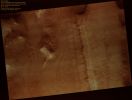
PSP_002545_1430_RED_browse-00~0.jpgJuncture of Two Branches of Dao Vallis (ctx frame - possible True Colors; credits: Lunar Explorer Italia)57 visiteMartian outflow channels are believed to be some of the largest features formed from the catastrophic flooding that scoured the landscape during ancient times. The source of the water likely originated in the subsurface and was somehow disturbed, depressurizing an aquifer, causing a sudden burst of water onto the surface.
This image shows multiple branches of the outflow channel Dao Vallis, which flows towards the West (down), ending near Hellas Basin. Although it is not clear exactly where the water that created these floods ended up, it is possible that Dao Vallis and its neighboring outflow channel, Niger Vallis, deposited water in Hellas Basin and formed a short-lived lake. Within the floor of Dao Vallis is material that appears striped, known as "lineated valley fill".
Valley fill material is thought to be ice-rich material that has flowed or been deposited onto the floor. Several lineations or "flow lines" appear to merge towards the upper left of the scene which supports this idea that the fill materials flowed, similar to slow-moving glacial material on Earth.
Also present in this scene is a mantling deposit which drapes much of the mid-latitudes of Mars. The deposit or "mantle" can be seen on south-facing slopes of positive-relief features, appearing as if its sliding off the walls. The mantle material is thought to be ice-cemented dust that was deposited during times when snowfall occurred on Mars.MareKromium
|
|
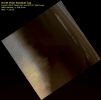
Psp_001470_2665_red~0.jpgNorth Polar Residual Cap (possible natural colors; credits: Lunar Explorer Italia)57 visitenessun commentoMareKromium
|
|

MartianTerminator-TRA_000841_1300_RED.jpgHalf in the light and half in the darkness... (possible True Colors; credis: Lunar Explorer Italia)57 visiteCaption NASA originale:"Image TRA_000841_1300 was taken by the High Resolution Imaging Science Experiment (HiRISE) camera onboard the Mars Reconnaissance Orbiter spacecraft on October 1, 2006. The complete image is centered at 49,7° South Lat. and 154,2° East Long. The range to the target site was 248,4 Km (such as about 155,3 miles).
At this distance the image scale is 99,4 cm/pixel (with 4 x 4 binning) so objects ~298 cm across are resolved. The image shown here has been map-projected to 100 cm/pixel and North is up. The image was taken at a MLT of 15:39 and the scene is illuminated from the West with a solar incidence angle of 87°, thus the Sun was about 3° above the horizon.
At a Solar Longitude of 114,2°, the season on Mars is Northern Summer". MareKromium
|
|

Psp_010744_1840_red.jpgSouthern Margin of Cerberus Palus (Natural Colors; credits: Lunar Explorer Italia)57 visiteMars Local Time: 15:41 (middle afternoon)
Coord. (centered): 4,0° North Lat. and 149,0° East Long.
Spacecraft altitude: 274,8 Km (such as about 171,7 miles)
Original image scale range: 27,5 cm/pixel (with 1 x 1 binning) so objects ~82 cm across are resolved
Map projected scale: 25 cm/pixel
Map projection: EQUIRECTANGULAR
Emission Angle: 4,8°
Phase Angle: 59,7°
Solar Incidence Angle: 55° (meaning that the Sun is about 35° above the Local Horizon)
Solar Longitude: 155,6° (Northern Summer)
Credits: NASA/JPL/University of Arizona
Additional process. and coloring: Lunar Explorer ItaliaMareKromium
|
|

PSP_001501_2280_RED_abrowse-01.jpgThe Viking Lander 2 Landing Site - Gerald Soffen Memorial Station (edm - Natural Colors; credits: Lunar Explorer Italia)57 visiteM.L.T.: 15:14 (early afternoon)
Latitude (centered): 47,7° North and Longitude 134,3° East
Range to target site: 310 Km (approx. 193,8 miles)
Original image scale range: 31 cm/pixel (with 1 x 1 binning) so objects ~93 cm across are resolved
Map projected scale: 25 cm/pixel and North is up
Map projection: EQUIRECTANGULAR
Emission angle: 11,7°
Phase angle: 62,1°
Solar Incidence Angle: 51°, with the Sun about 39° above the Local Horizon
Solar Longitude: 138,7° (Northern Summer) MareKromium
|
|
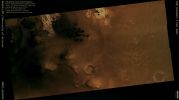
PSP_006820_1760_RED_abrowse~0.jpgPeri-Equatorial "Sand-Patches" on a Crater Floor (MULTISPECTRUM; credits: Lunexit)57 visiteThis image shows part of the floor of a large crater in Arabia Terra, near Mars’ Equator. A notable feature on this crater floor is a region of "Dark Patches" up to about 100 mt (330 feet) across. These Dark Patches sit in an area of connected small ridges and spurs and bury them, filling in the low areas and piling up. In several places light ridge crests protrude through the dark material.
The dark patches appear to be collections of wind-blown sand. Sand on Mars is often dark, likely because it is fragments of a volcanic rock called basalt. (Sand on Earth is most often light-toned quartz). Sand may tend to collect in patches that can ultimately evolve into large dunes if more sand gathers. The patches of sand here are not big enough to form such large structures, but small-scale regular texture due to blowing wind is visible on the surface.
The relatively dark tone which can be seen around the Sand Patches (compared with the surrounding material) is probably due to small amounts of additional sand. In some places this collects at the bottom of troughs.MareKromium
|
|
| 2237 immagini su 187 pagina(e) |
 |
|
|
|
|
147 | |
|
|
|
|





