| Piú viste - Mars Reconnaissance Orbiter (MRO) |

PSP_001916_2220_RED_abrowse.jpgKnobs and Mounds on the Northern Plains (Natural Colors; credits: Dr Paolo C. Fienga - Lunexit Team)58 visiteLight-toned Mounds occur across the image.
The northern part of the image is dominated by small Knobs or Patches, while there are features hundreds of meters across to the South. The larger features frequently have one or more craters and an irregular shape; it has been proposed that these features are Mud Volcanoes, which erupt mud instead of lava.
On Earth, Mud Volcanoes usually form in conditions of tectonic pressurization or rapid burial of sediments.
At high resolution, the Knobs show some fine lineations which may be wind-blown material, but are otherwise very smooth. In between the Mounds, the Surface is rough and rich in Boulders. The few Boulders on the Mounds were likely ejected from nearby Impact Craters.
Information like this from HiRISE images provides useful constraints on the formation and material of these Knobs and Cones.MareKromium
|
|

ESP_016036_1370_RED_abrowse-01.jpgDunes in Noachis Terra (EDM n.1 - Natural Colors; credits: Dr Paolo C. Fienga - Lunexit Team)58 visiteThe Dunes here are linear, thought to be due to shifting wind directions.
In places, each Dune is remarkably similar to the adjacent one, including a reddish (or dust colored) band on the North-Eastern facing slopes.
Furthermore, very large Angular Boulders litter the floor between the Dunes.MareKromium
|
|
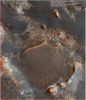
PSP_007454_2020.jpgPossible Phyllosilicates in Mclaughlin Crater (High-Def-3D and Natural Colors; credits: Dr M. Faccin - Lunexit Team)58 visiteAcquisition date: 28 February 2008
Mars Local Time: 14:47 (early afternoon)
Latitude (centered): 21,7° North
Longitude: 337,8° East
Range to target site: approx. 287,5 km (about 179,7 miles)
Original image scale range: 28,8 cm/pixel (with 1 x 1 binning) so objects ~86 cm across are resolved
Map projected scale: 25 cm/pixel and North is up
Map projection: EQUIRECTANGULAR
Emission Angle: 0,2°
Phase (Sun-Target-Spacecraft) Angle: 40,1°
Solar incidence angle: 40° (with the Sun about 50° above the Local Horizon)MareKromium
|
|

ESP_016173_2005_RED_abrowse-1.jpgSmall Shield Volcano with "Summit Caldera" (CTX Frame - Saturated and Enhanced Natural Colors; credits: Dr Paolo C. Fienga - Lunexit Team) 58 visitenessun commentoMareKromium
|
|

PSP_001808_1875_RED_abrowse-01.jpgSlope Streaks in Terra Sabaea (EDM - Natural Colors; credits: Dr Paolo C. Fienga - Lunexit Team)58 visiteThis EDM is a close-up view of the Crater Rim revealing dark and light-toned Slope Streaks. Slope Streaks' formation is among the few known processes currently active on Mars. While their mechanism of formation and triggering is debated, they are most commonly believed to form by downslope movement of extremely dry sand or very fine-grained dust in an almost fluidlike manner (analogous to a terrestrial snow avalanche) exposing darker underlying material.
Other ideas include the triggering of Slope Streaks' formation by possible concentrations of near-Surface ice or scouring of the Surface by running water from aquifers intercepting slope faces, Spring Discharge (perhaps brines) and/or hydrothermal activity.
Several of the Slope Streaks seen here, particularly the 3 longest darker Streaks, show evidence that downslope movement is being diverted around obstacles such as large boulders. Several Streaks also appear to originate at boulders or clumps of rocky material.
In general, the Slope Streaks do not have large deposits of displaced material at their downslope ends and do not run out onto the Crater Floor suggesting that they have little reserve kinetic energy. The darkest Slope Streaks are the youngest and can be seen to cross cut and superpose older and lighter-toned Streaks.
The lighter-toned streaks are believed to be dark streaks that have lightened with time as new dust is deposited on their surface.MareKromium
|
|

PSP_001503_1645_RED_abrowse-01.jpgEroding Layers in an Unnamed Southern Crater (EDM - Natural Colors; credits: Dr Paolo C. Fienga - Lunexit Team)58 visiteThis EDM is approx. 250 meters wide.
Boulders are visible on the Slopes of the Ridges along with thin Dark Layers including the Cap Layer, but they are absent on the Spurs, where the resistant cover has been eroded.
This demonstrates that the Boulders come only from the Dark Layers, and are not embedded in the rest of the Deposit.MareKromium
|
|
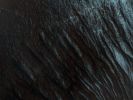
Gullies-Terra_Sirenum-PIA12881.jpgGullies in Terra Sirenum (credits: NASA/JPL-Caltech/University of Arizona)58 visiteThis observation shows part of an Unnamed Crater, located inside the much larger Newton Basin, in the Terra Sirenum Region of Mars.
This Unnamed Crater is approx. 7 Km in diameter (over 4 miles) and some 700 meters (760 yards) deep.
Numerous Gully Systems are visible on the East- and South-facing Walls of the Crater; their characteristics are astonishingly diverse.
This EDM covers an area of nearly 610 x 740 meters (670 x 800 yards). North is up; illumination is from the North-West.
This EDM depicts several Gullies carved in the South-West-facing Wall of the Crater.
These troughs are extremely rectilinear, lack tributaries, and do not seem to have Terminal Fan Deposits: they terminate rather abruptly, some of them in a spatula-like shape.
Their characteristics contrast sharply with those of other Gully Systems located elsewhere in this same Crater, which are sinuous, have numerous tributaries, and show distinct Fan Deposits.MareKromium
|
|
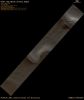
PSP_002804_0930_RED_abrowse.jpgSouth Polar Trough (Natural Colors; credits for the additional process. and color.: Dr Paolo C. Fienga - Lunexit Team)58 visiteThis image is taken in one of the Troughs that are typical within the stack of Martian South Polar Layered Deposits (SPLD).
Viewed at low resolution, sequences of layers of different albedos, or brightnesses, and/or textures can be seen. At full resolution, the different tones and textures can be seen to be due to different shapes and sizes of polygonal fractures, surface knobiness, and surface cover and concentration of frost, often within polygonal fractures.
Faint criss-crossing Troughs and Dimples can be discerned on even the smoothest surfaces. Perhaps the most notable features in the image are the distinct round to heart-shaped to blob-shaped depressions scattered throughout the smooth areas, dubbed "Swiss-Cheese Terrain".
The smooth material is solid CO2 ice representing the uppermost layer of the South Polar Residual Cap. The retention of CO2 ice throughout the year by the Southern Polar Cap is one characteristic that distinguishes it significantly from Mars' North Polar Cap. The Swiss-Cheese depressions are areas in which sublimation of the CO2 ice was initiated at a particular location and spread laterally from that point, creating rounded depressions typically several to 10 meters deep.
In HiRISE images, it is evident that this CO2-rich material is actually comprised of several individual horizontal layers. In this particular location, several images had been acquired over the previous decade by the Mars Orbiter Camera (MOC) at slightly lower resolutions. In a series of those MOC images, the Swiss-Cheese depressions were seen to enlarge radially, or grow over a time period of several years.
Part of the HiRISE imaging campaign includes continued monitoring of these features (at higher resolution) to understand their growth rates and patterns. In turn, we can better comprehend the role of CO2 — the main component of the Martian Atmosphere — in the current Martian Climate Regime.MareKromium
|
|
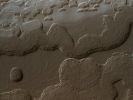
SPLD-PIA13269-PCF-LXTT3.jpgSouth Polar Layered Deposits and Residual Cap (Natural Colors; credits for the additional process. and color.: Dr Paolo C. Fienga - Lunexit Team)58 visiteThis image from NASA's Mars Reconnaissance Orbiter (MRO) shows a variety of surface textures within the South Polar Residual Cap of Mars.
It was taken during the Southern Spring, when the Surface was covered by seasonal CO2 Frost, so that Surface relief is easily seen. Illumination is from the bottom left, highlighting long Troughs at to the right and round pits and irregular Mesas to the left of center.
These unique landforms are common in the South Polar Residual Cap, which is known from previous Mars Global Surveyor images to be eroding rapidly in places. Right of center, SPLDs are exposed on a Sun-facing Scarp. These Deposits are older than the Residual Ice Cap, and the Layers are thought to record climate variations on Mars similar to ice ages on Earth.MareKromium
|
|

PSP_002840_1855_RED_abrowse-00.jpgMeanders in Nanedi Valles (Natural Colors; credits for the additional process. and color.: Dr Paolo C. Fienga - Lunexit Team)58 visiteThis observation shows a portion of Nanedi Valles, an equatorial Martian valley network.
Valley networks are thought to have formed by groundwater sapping either in conjunction with an ice layer to cover the running water or during a past warmer, wetter climate regime on Mars. Glacial activity has also been proposed to form the valley networks.
Groundwater sapping is the leading theory because of the morphology of the valleys. They commonly have approximately constant width along their reaches, as seen here, as well as theater shaped heads, as seen in the tributary valley in the bottom right of the scene. The meandering nature of valleys suggests persistent or repeated flow as required to form meanders in streams on Earth.
The subimage shows a potential remnant channel seen on the floor of Nanedi Valles just below the center of the image. If this is a remnant channel, it suggests that there was either repeated or waning flows in this valley. Winding dunes and abundant impact craters are found throughout the valley, as well as within this putative channel.
Dunes are thought to be transient features on Mars, although no movement has been detected to date. It is interesting to note that some of the dunes are superposed by craters indicating that the dunes were stable long enough for craters to form and not be erased.
It is possible that the craters on top of the dunes are secondary craters that formed as a product of a larger impact. Secondary craters from a single impact are clustered in space and form almost simultaneously, implying that the dunes were stable for a time period—long enough for a single crater, rather than multiple craters, to form.
MareKromium
|
|
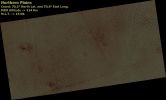
Psp_001490_2505_red.jpgThe Northern Plains (Natural Colors; credits for the additional process. and color.: Dr Paolo C. Fienga - Lunexit Team)58 visiteM.L.T.: 15:06 (early afternoon)
Latitude (centered): 70,5° North
Longitude: 70,6° East
Range to target site: 314 Km (about 194,8 miles)
Original image scale range: 31,4 cm/pixel (with 1 x 1 binning) so objects ~94 cm across are resolved
Map Projected Scale: 25 cm/pixel
Map Projection: POLAR STEREOGRAPHIC
Emission Angle: 5,1°
Phase Angle (Sun-Mars-MRO): 56,5 °
Solar Incidence Angle: 61° (meaning that the Sun is about 29° above the Local Horizon)
Solar Longitude: 138,3° (Northern Summer)MareKromium
|
|
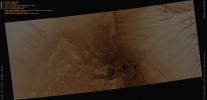
ESP_014287_1685_RED_abrowse-00.jpgNoctis Labyrinthus (Natural Colors; credits for the additional process. and color.: Dr Paolo C. Fienga - Lunexit Team)58 visiteThis image spans the floor and two walls of a pit in Noctis Labyrinthus, a System of deep, steep-walled Valleys on the Western Edge of Valles Marineris.
The Valleys themselves are tectonic features known as "Graben" (---> trench-like features that form in response to extension (or stretching) of the Crust). In the case of Noctis Labyrinthus, volcanic activity in the Tharsis Region may have formed a bulge, which then stretched and fractured the Crust above it.MareKromium
|
|
| 2237 immagini su 187 pagina(e) |
 |
|
|
|
|
145 | |
|
|
|
|





