| Piú viste - Mars Reconnaissance Orbiter (MRO) |

PSP_009162_1570.jpgFresh 5-Kilometer Diameter Rayed Crater (False Colors; credits: Dr M. Faccin)58 visiteThe crater featured in this scene formed on top of ejecta from a nearby rampart crater, located to the North.
The crater’s distinct rim indicates that it is relatively young. There is bright material on many of the crater walls that might be landslides of dust or another bright substance.
The mounds of material on the crater floor probably formed during late stages of crater’s own formation. The crater floor is speckled with even smaller craters.MareKromium
|
|
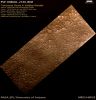
PSP_008681_2550_RED.jpgTransverse Dunes in Vastitas Borealis (natural colors; credits: Lunexit)58 visiteThe Vastitas Borealis Region, or Northern Lowlands, is a large area of low-lying surface that surrounds Mars’ North Pole.
On average, the Region is 4-5 Km lower in elevation than the mean radius of the Planet. How this basin formed is not known, although researchers have postulated that it could have been the result of a very large-scale impact sometime in Mars’ distant past. As of this writing, it is Summer in the Martian Northern Hemisphere, allowing the HiRISE camera to image this Region in full sunlight.
The sinuous landforms are dunes composed of sand that is made of basalt (a volcanic rock) or gypsum (a hydrous sulfate). There is a transition of modified barchanoid (crescent shaped dunes, generally wider than they are long) and transverse chains into star dunes; the winds change a lot in this area. The orientation of the barchanoid and transverse dunes indicate that the winds that formed them blow from the East (right side of image).
In some areas there are a few linear dunes. The light-toned, smaller bedforms are designated Transverse Aeolian Ridges (TARs).
MareKromium
|
|

PSP_009039_1660_RED.jpgCraters in South-Eastern Syria Planum (natural colors; credits: Lunexit)58 visiteThis image shows two landforms that appear similar, but are the result of two very different geologic processes.
These two depressions are craters. The smaller, rounder crater formed when an asteroid collided with Mars. This impact blasted out the pre-existing rocks, forming this quasi-circular crater.
The larger, more irregular-shaped crater is a Pit Crater. These types of craters form through collapse of the ground surface into large underground voids. In this Region of Mars, these underground voids are likely caused by the movement of magma (molten rock) through the subsurface. As the magma moves underground, it forces the rock apart and forms large “caverns.” These voids are structurally unstable and can lead to collapse of the overlying rock, forming pit craters at the surface.
Impact Craters are distinguished from Pit Craters by the presence of a raised rim. Rock blasted out during the impact falls back to the ground and accumulates near the crater, forming this raised rim. Upward warping of the ground during the impact process also contributes to the raised appearance of the crater rim. Since Pit Craters form through collapse, their rims are at the same level, or perhaps slightly lower, than surrounding ground surface.
The Impact Crater has a bright streak extending South-East (toward the upper right). The bright material is dust, deposited downwind of the crater by prevailing winds. Zooming into the streak, small bedforms, presumably composed of dust or dust aggregates, are visible. Similar features are seen in other dusty regions of Mars.MareKromium
|
|

PSP_005410_1115_RED_abrowse.jpgPolar Pit Gullies (MULTISPECTRUM; credits: Lunexit)58 visiteThis image shows Polar Pit Gullies in a depression. The gullies do not appear to have been active recently, as their channels and alcoves are covered with polygonal fractures and ripples that have formed over time. The alcoves contain boulders from eroding layers up-slope. Several of the alcoves extend to the slope rim, suggesting head-ward erosion.
The rest of the scene contains abundant polygonal ground, thought to have formed by processes involving ground ice. This image is at a High Latitude where polygonal terrain is common. This feature is not found in Equatorial Regions, which supports a relationship with ground ice because ground ice is not stable near the equator today.
There are several muted circles on the plains in the lower half of the image; these are possibly relaxed craters. If a crater forms in ice-rich ground, the ice enhances the degradation of the crater and gives the crater a “softened” appearance.MareKromium
|
|

PSP_009114_2645_RED.jpgEroding Dunes in Chasma Boreale (natural colors; credits: Lunexit)58 visiteSand moves along a planetary surface by a process scientists call “saltation”, whereby the individual grains are driven by the wind and bounce forward in short hops. In a process that is not yet completely understood, sheets of saltating sand grains organize themselves into sand dunes, visible in this image as the dark features.
Sand dunes move by having the wind push sand grains up and over the top of the dune where they then slide down to the base. The steep side of the dune that the sand grains slide down is called "slip-face" and it is the constant transport of sand from the downwind side of the dune to the "slip-face" that makes the dune move forward in this direction. HiRISE data allow us to see which side of these dunes has the steeper slope (such as the aforementioned "slip-face"), telling us what direction the dune — and strong near surface winds — are moving.
Yet something else is also happening to these particular dunes. Dark streaks lead away from the dunes toward the lower left of the image. These streaks are caused by sand grains being blown off the dunes and saltating away. This is not ordinarily a cause for concern because in a stable dune, individual grains are constantly added and removed; however, there does not appear to be any influx of sand upwind of these dunes, so they are probably being eroded.
It is also interesting that these streaks do not point in the same direction as the "slip-face". One possible scenario is that the dunes migrated Westward when sand supply was more plentiful. Today, the wind direction has shifted, blowing more toward the South-West, and the influx of new sand has ceased, such that in the future, the dunes will completely erode away. Repeated HiRISE observations will be able to look for changes in the shape and size of these dunes.MareKromium
|
|
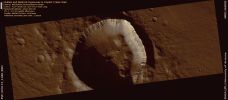
PSP_009155_1480_RED.jpgGullies and Bedrock Exposures in Impact Crater Wall (natural colors; credits: Lunexit)58 visiteThis image shows a rather pristine crater with Gullies and Bedrock Exposures. The Gullies are mostly on the South-Facing (such as the Poleward facing) wall. Some of the gully channels are very sharp, indicating that they have not been modified much since they formed.
Other channels criss-cross each other, demonstrating that there were multiple periods of activity. Scientists do not know how closely these were spaced in time.
The South and East walls of the Crater (upper right of the frame) have very distinct bright layers. These layers are possibly Ancient Bedrock. These walls also have what appear to be bright Landslides.MareKromium
|
|
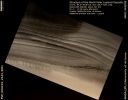
PSP_009293_2645_RED.jpgStructure of the North Polar Layered Deposits (natural colors; credits: Lunexit)58 visiteThe North Polar Layered Deposits on Mars are thought contain a record of global climate changes, similar to ice ages on Earth. This image shows that the geologic history of the NPLD has been complex enough to form angular unconformities.
An angular unconformity represents a gap in the geologic record, where erosion has removed material followed by deposition of more material on the eroded surface. In this image, the angular unconformities are recognized by the truncation, or cutting off of layers, for example right of center and at bottom center.
Also visible in this image are numerous streaks, perhaps caused by recent redistribution of frost by winds.MareKromium
|
|
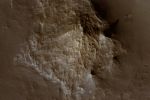
PSP_009161_1450_RED-01.jpgLong Shadows over Ariadnes Colles (edm - natural colors; credits: Lunexit)58 visiteThis edm shows one of the hills in detail.
The hill appears criss-crossed by long fractures and most of them made apparent by the shadows they cast.
The shadows indicate that the fractures “stick out” from their surroundings, and hence that they are more resistant to erosion. In terrestrial environments this occurs when fluids flow along the fractures, leaving behind cementing minerals or when fractures are filled by igneous materials.MareKromium
|
|
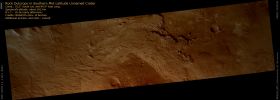
PSP_009151_1465_RED.jpgRock Outcrops in Southern Mid-Latitude Crater (natural colors; credits: Lunexit)58 visiteThis image shows part of the floor of a large Impact Crater in the Southern Hemisphere. The crater lies at the edge of the Hellas Impact Basin; although it is roughly 50 Km across, it is dwarfed by the giant Hellas structure, which has seen a varied and interesting geologic history.
This image captures a diverse range of rocks on the Crater Floor. A small cliff running across the middle of the image marks the edge of one rock unit, but variations in tone or texture in the northern part of the image suggest a varied history of deposition. Exposures of light, intermediate and dark materials may correspond to different types of deposition, or perhaps alteration after the rocks were laid down. Some units appear rich in boulders, suggesting that they are breaking up into blocks, while at other sites there are thin layers.
This diversity indicates a varied geologic history. Hellas Basin is a low Region, and may have once held lakes or seas where sediments could have been deposited.
This site is also just west of Hadriaca Patera, an old volcano. Sediment could also have been deposited by wind, or in streams on the surface. Unraveling the history of the region will require many images to illustrate the diversity of rocks and map out where they occur.MareKromium
|
|
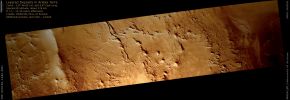
PSP_009180_1840_RED.jpgLayered Deposits within Unnamed Crater in Arabia Terra (natural colors; credits: Lunexit)58 visiteArabia Terra is an area of Mars that has an abundance of Layered Deposits within Impact Craters.
The Region of Arabia has plateau material that is thought to be part of the ancient highland crust that is Noachian in age according to Martian timescale. Thus, the layered deposits may represent some of the earliest eroded and infilled materials on Mars.
In this Unnamed Crater, we see layering exposed along the margins of a scarp-like bench.
The layering is of particular interest because on Earth, they may represent multiple sequences of deposited material or some geologic process (subaerial or subaqueous) that has modified and/or deposited material on the surface in some constant fashion.
If the layered sequences are consistently the same, we can infer that the conditions of their deposition were the same for some period of time. If the layers changed in some way (e.g., thickens and thins), then we can infer that some condition(s) caused this to happen.
From these observations and analyses, scientists can attempt to quantify and reconstruct what the ancient conditions were like in this Region of Mars.MareKromium
|
|
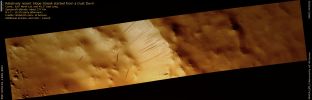
PSP_009192_1890_RED-00.jpgRelatively Recent Slope Streak started from a Dust Devil (ctx frame - natural colors; credits: Lunexit)58 visiteThis Slope Streak occurred in the time between a Viking image of the bottom of this crater (713A57, which saw no streak) and a MOC image (R12/01917, as reported by Schorghofer et al. (2007).
That paper suggested that the Slope Streak may have been caused by a Dust Devil that had passed by (its track is visible in the MOC image). Our HiRISE image shows that there isn’t a small hill or anything at this Slope Streak’s apex, but that the dust devil track really does intersect with the apex. It is likely that the Dust Devil may have caused this Slope Streak.
Dark Slope Streaks are visible in many places on the Martian surface, often where the dust cover is thick.
One explanation for Dark Slope Streaks is that they are little avalanches in the dust. The apexes of Slope Streaks (such as the point where they start from) are often at little hills or ridges on a larger slope, with the thinking that the dust here is already close to being too steep, and then any little perturbation will start one of these tiny avalanches.
Small craters have also been seen at slope streak apexes.MareKromium
|
|
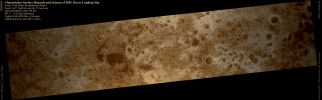
PSP_008825_2040_red.jpgCharacterize Surface Hazards and Science of Possible MSL Rover Landing - Mawrth Vallis (natural colors; credits: Lunexit)58 visitenessun commentoMareKromium
|
|
| 2237 immagini su 187 pagina(e) |
 |
|
|
|
|
142 | |
|
|
|
|





