| Piú viste - Mars Reconnaissance Orbiter (MRO) |

ESP_012075_1015_RED_abrowse.jpgPossible Hydration in High Southern Latitudes' Region (Natural Colors; credits: Lunar Explorer Italia)58 visitenessun commentoMareKromium
|
|
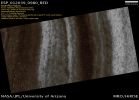
ESP_012039_0980_RED_abrowse.jpgOmega Sublimation Study Area (Natural Colora; credits: Lunar Explorer Italia)58 visitenessun commentoMareKromium
|
|

ESP_012080_0990_RED_abrowse.jpgPossible Hydration in High Southern Latitudes' Region (Natural Colors; credits: Lunar Explorer Italia)58 visitenessun commentoMareKromium
|
|

ESP_011886_1130_RED_abrowse.jpgDark Southern Dunefield (Natural Colors; credits: Lunar Explorer Italia)58 visitenessun commentoMareKromium
|
|

ESP_013049_0950_RED_abrowse.jpgSouth Polar Spiders (Natural Colors; credits: Lunar Explorer Italia)58 visiteThis image is part of an ongoing seasonal monitoring effort in this location in the Southern Polar Region of Mars.
Mars’ South Polar Region changes significantly during the Martian Year. During the Southern Hemisphere’s Winter, the Polar Cap increases dramatically as the lowered temperatures make a large portion of the Atmosphere freeze out into ice.
As Spring approaches and the Polar Region begins to warm once again, the Cap recedes revealing terrains like those visible in this image. The polygonal features in this image are termed “Spiders” and their origin is still unknown (although there are several hypotheses).
One possible hypothesis for the black fan-shaped features is that they may be formed by a geyser-like process. As the Sun heats the ground layer below the Carbon Dioxide ice, the ice on the bottom begins to sublimate, or turn directly from a solid to a gas.
This gas then builds up in pressure as more of it sublimates, until a critical pressure is achieved and it erupts through the ice layer much as a geyser would, spewing the debris that is thought to make up the dark fan shaped features.MareKromium
|
|

ESP_012873_1075_RED_abrowse.jpgPolar Pit (Natural Colors; credits: Lunar Explorer Italia)58 visiteThis image features the North Wall and Floor of a Polar Pit in the Southern Hemisphere. The Pit Wall is sculpted into a row of gullies. Gullies typically have a triangular start upslope, followed by a channel that transported material, and a triangular debris fan downslope.
Polar Pit Gullies might be related to seasonal changes in frost coverage, but their exact origin is currently unknown. The Gullies appear bright because they probably have seasonal frost on them. The Pit Floor contains a field of dark Sand Dunes.
Wind has transported sand across the Martian Surface, and it was deposited in this Pit and formed dunes.
Some of the sand in the Dunes might have come from the gully debris fans or other erosion of the Pit wall. The bright material within the dunes and along the floor is seasonal frost that is probably composed of CO2 and water ice.MareKromium
|
|

ESP_011946_0985_RED_abrowse.jpgSouth Polar "Cryptic Terrain" (Natural Colors; credits: Lunar Explorer Italia)58 visitenessun commentoMareKromium
|
|

ESP_013144_2075_RED_abrowse.jpgCollapse Features on the Flank of Elysium Mons (Natural Colors; credits: Lunar Explorer Italia)58 visiteThis image is of the Flanks of the "Shield Volcano" Elysium Mons. The volcano is considered to be the youngest within the Elysium Mons Province, which also contains the volcanoes Hecates Tholus and Albor Tholus.
Of course, "young" is a relative term. The last eruption of Elysium Mons could well have been a billion years or more ago.
This image shows a series of flat bottomed valleys along the flanks of Elysium Mons. There is considerable debate on exactly how these valleys form. In Hawaii, the classic example of Shield Volcanoes on Earth, similar valleys are carved by prodigious rainfall. While some rain may have fallen in the earliest epochs of Mars' Geologic History, the lack of small drainage networks shows that these Martian Channels were not carved by rain. However, Mudflows and Lava Flows could potentially erode the sides of the Volcano.
An important hint for the origin of the Valleys comes from the Chain of Pits visible in the Northern part of the image. These Pits form as the ground is pulled apart by Marsquakes. Thus it seems that many of these Valleys are first formed by movement along Faults. Then Mud and/or Lava Flows widen the sides of the Valley and give it a flat floor.MareKromium
|
|

ESP_012551_1750_RED_abrowse.jpgSulphate and Clay Strata inside Gale Crater (Natural Colors; credits: Lunar Explorer Italia)58 visitenessun commentoMareKromium
|
|

ESP_011878_1045_RED_abrowse.jpgSouth Polar Features (Natural Colors; credits: Lunar Explorer Italia)58 visiteThe SHARAD (Shallow Subsurface Radar) looks for liquid or frozen water in the first few hundreds of feet (up to 1 kilometer) of Mars' Crust.
SHARAD probes the subsurface using radar waves within a 15- to 25-megahertz frequency band to get the desired, high-depth resolution.
The Radar Wave Return (RWR), which is captured by the SHARAD antenna, is sensitive to changes in the electrical reflection characteristics of rock, sand and any water that may be present in the Surface and Subsurface. Water, like high-density rock, is highly conducting, and has a very strong RWR. Changes in the reflection characteristics of the Subsurface, caused by layers deposited by geological processes in the ancient history of Mars, are also visible.MareKromium
|
|

ESP_011873_1675_RED_abrowse.jpgLayering and Faulting in Candor Chasma (Natural Colors; credits: Lunar Explorer Italia)58 visitenessun commentoMareKromium
|
|
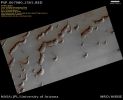
PSP_007080_2565_RED_abrowse.jpgSouth Polar Dunes (Natural Colors; credits: Lunar Explorer Italia)58 visitenessun commentoMareKromium
|
|
| 2237 immagini su 187 pagina(e) |
 |
|
|
|
|
141 | |
|
|
|
|





