| Piú viste - Mars Reconnaissance Orbiter (MRO) |

ESP_011580_1255_RED_abrowse.jpgThe Dunes of Russel Crater (Natural Colors; credits: Lunar Explorer Italia)58 visitenessun commentoMareKromium
|
|
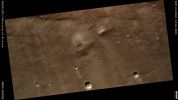
ESP_012692_1810_RED_abrowse.jpgThe "Dusty" Summit of Pavonis Mons (Natural Colors; credits: Lunar Explorer Italia)58 visitePavonis Mons is one of the 3 giant Tharsis Montes Shield Volcanoes. Its Summit rises so far above the Surface that the Atmosphere is extremely thin, even for Mars.
Dust that reaches these heights (for example, during major Dust Storms) is hard to remove, so the upper parts of these Volcanoes are covered by vast deposits of dust. The dust is moved a little by the thin winds, producing ripples and other textures near the limit of HiRISE’s resolution. The fluffy, ripply surface looks “smudged” or out of focus, but by looking at some of the small impact craters you can see that the HiRISE camera is, indeed, properly focused. It’s the surface of Mars that is blurry!
Nota Lunexit: NO. A nostro parere NON è la Superficie di Marte che è "sfuocata" (blurry) e non è neppure la fotocamera dell'Orbiter che è "out of focus". Si tratta, come abbiamo già visto in passato (nelle immagini dei fly-by ravvicinati di alcune Lune Saturniane - Encelado su tutte) di un caso classico di "Sfuocatura da Movimento" (in altre parole: è un mero problema di lunghezza dell'esposizione - ivi: eccessiva -, data la vicinanza del target ripreso in rapporto alla velocità dell'Orbiter rispetto al medesimo). Curioso che i Ragazzi di Pasadena non ci abbiano pensato...
The impact craters also show that the dust is not a thin veneer. Instead, it is a thick coat, at least several meters deep. This mantling of dust hides the details of the Lava Flows and Vents, frustrating volcanologists but delighting those who study dust.
Mars Local Time: 15:23 (early afternoon)
Coord. (centered): 0,9° North Lat. and 246,8° East Long.
Spacecraft altitude: 254,1 Km (such as about 158,8 miles)
Original image scale range: 50,8 cm/pixel (with 1 x 1 binning) so objects ~1,53 mt across are resolved
Map projected scale: 50 cm/pixel
Map projection: EQUIRECTANGULAR
Emission Angle: 2,5°
Phase Angle: 52,4°
Solar Incidence Angle: 55° (meaning that the Sun is about 35° above the Local Horizon)
Solar Longitude: 244,7° (Northern Autumn)
Credits: NASA/JPL/University of Arizona
Additional process. and coloring: Lunar Explorer ItaliaMareKromium
|
|

ESP_012725_2015_RED_abrowse.jpgBranched Features on the Floor of Antoniadi Crater (Natural Colors; credits: Lunar Explorer Italia)58 visitenessun commentoMareKromium
|
|

ESP_012435_2015_RED_abrowse.jpgBranched Features on the Floor of Antoniadi Crater (Natural Colors; credits: Lunar Explorer Italia)58 visiteThe dark branched features in the floor of Antoniadi Crater look like giant ferns, or fern casts. However, these ferns would be several miles in size and are composed of rough rocky materials.
A more likely hypothesis is that this represents a channel network that now stands in inverted relief. The channels may have been lined or filled by indurated materials, making the channel fill more resistant to erosion by the wind than surrounding materials. After probably billions of years of wind erosion the resistant channels are now relatively high-standing. The material between the branched ridges has a fracture pattern and color similar to deposits elsewhere on Mars that are known to be rich in hydrated minerals such as clays.
The inverted channels have short, stubby branches characteristic of formation by groundwater sapping. Spring water seeps into the channels and undercuts overlying layers which collapse, so the channels grow headward. These images tell the story of an ancient wet environment on Mars, where life could have been possible. Ancient Martian life was most likely to consist of microorganisms rather than giant tree ferns.
MareKromium
|
|

ESP_012940_1655_RED_abrowse-01.jpgThe Floor of Eos Chasma (edm - Natural Colors; credits: Lunar Explorer Italia)58 visiteAn Eroded Crater exposes compositional differences below the Surface: the bluish tones are probably fresher, boulder-rich exposures of Basalt and the lighter-toned material near the base of the crater wall may have a different composition.
The bottom of the crater is filled with material that is similarly-toned to the Surface of Eos Chasma, and was likely eroded and transported there by the wind.MareKromium
|
|

ESP_011610_0935_RED_abrowse.jpgSawtooth Pattern in Carbon Dioxide Ice (Natural Colors; credits: Lunar Explorer Italia)58 visitenessun commentoMareKromium
|
|

ESP_012265_0950_RED_abrowse.jpgGiza Region (Natural Colors; credits: Lunar Explorer Italia)58 visitenessun commentoMareKromium
|
|

ESP_012302_0985_RED_abrowse.jpgCryptic Region Type "B" (Natural Colors; credits: Lunar Explorer Italia)58 visitenessun commentoMareKromium
|
|

ESP_011930_1875_RED_abrowse.jpgLong Fissure in Cerberus Fossae (Natural Colors; credits: Lunar Explorer Italia)58 visitenessun commentoMareKromium
|
|

ESP_012202_1390_RED_abrowse.jpgDunes in Western Nereidum Montes (Extremely Enhanced Natural Colors; credits: Lunar Explorer Italia)58 visitenessun commentoMareKromium
|
|

ESP_012853_1480_RED_abrowse-01.jpgTerra Cimmeria (edm - Natural Colors; credits: Lunar Explorer Italia)58 visiteOn the right side of this edm, is a valley filled with dark material and a central, bright ridge. If the valley was carved by liquid water, then this ridge may mark a former stream channel where coarse-grained sediment was deposited, which has survived erosion more effectively than the finer-grained sediment in the valley outside the channel.
Similar "Inverted Channel Deposits" are visible elsewhere on Mars, and some examples in the Southern Highlands have been inferred to contain chloride salts (similar to table salt).
The color and texture of the possible Inverted Channels in this image are similar to those inferred to contain chlorides, which may have been deposited when salty water evaporated.
Considered together, the features in this image attest to a history of water-related activity at this location on Mars.MareKromium
|
|

ESP_012075_1015_RED_abrowse.jpgPossible Hydration in High Southern Latitudes' Region (Natural Colors; credits: Lunar Explorer Italia)58 visitenessun commentoMareKromium
|
|
| 2237 immagini su 187 pagina(e) |
 |
|
|
|
|
140 | |
|
|
|
|





