| Piú viste - Mars Reconnaissance Orbiter (MRO) |
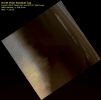
Psp_001470_2665_red~0.jpgNorth Polar Residual Cap (possible natural colors; credits: Lunar Explorer Italia)58 visitenessun commentoMareKromium
|
|
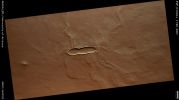
Psp_010661_1780_red.jpgShield Volcano with Leveed Channels in Noctis Fossae (possible Natural Colors; credits: Lunar Explorer Italia)58 visiteMars Local Time: 15:42 (middle afternoon)
Coord. (centered): 1,9° South Lat. and 256,3° East Long.
Spacecraft altitude: 258,3 Km (such as about 161,4 miles)
Original image scale range: 51,7 cm/pixel (with 1 x 1 binning) so objects ~1,55 mt across are resolved
Map projected scale: 50 cm/pixel
Map projection: EQUIRECTANGULAR
Emission Angle: 0,9°
Phase Angle: 56,2°
Solar Incidence Angle: 57° (meaning that the Sun is about 33° above the Local Horizon)
Solar Longitude: 152,2° (Northern Summer)
Credits: NASA/JPL/University of Arizona
Additional process. and coloring: Lunar Explorer ItaliaMareKromium
|
|

ESP_011331_1560_RED_abrowse.jpgTerrain in Eberswalde Crater (possible Natural Colors; credits: Lunar Explorer Italia)58 visiteMars Local Time: 15:54 (middle afternoon)
Coord. (centered): 23,9° South Lat. and 326,8° East Long.
Spacecraft altitude: 258,6 Km (such as about 161,6 miles)
Original image scale range: 25,9 cm/pixel (with 1 x 1 binning) so objects ~78 cm across are resolved
Map projected scale: 25 cm/pixel
Map projection: EQUIRECTANGULAR
Emission Angle: 1,3°
Phase Angle: 60,3°
Solar Incidence Angle: 61° (meaning that the Sun is about 29° above the Local Horizon)
Solar Longitude: 180,4° (Northern Autumn)
Credits: NASA/JPL/University of Arizona
Additional process. and coloring: Lunar Explorer ItaliaMareKromium
|
|

PSP_001501_2280_RED_abrowse-01.jpgThe Viking Lander 2 Landing Site - Gerald Soffen Memorial Station (edm - Natural Colors; credits: Lunar Explorer Italia)58 visiteM.L.T.: 15:14 (early afternoon)
Latitude (centered): 47,7° North and Longitude 134,3° East
Range to target site: 310 Km (approx. 193,8 miles)
Original image scale range: 31 cm/pixel (with 1 x 1 binning) so objects ~93 cm across are resolved
Map projected scale: 25 cm/pixel and North is up
Map projection: EQUIRECTANGULAR
Emission angle: 11,7°
Phase angle: 62,1°
Solar Incidence Angle: 51°, with the Sun about 39° above the Local Horizon
Solar Longitude: 138,7° (Northern Summer) MareKromium
|
|
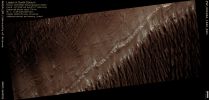
PSP_006984_1840_RED_abrowse~0.jpgLayers in Gordii Dorsum (MULTISPECTRUM; credits: Lunexit)58 visiteThis image shows distinctive differences in the texture of the ground surface in an area of Mars called Gordii Dorsum.
The upper right part of the image contains many subparallel ridges. These ridges are geological features called yardangs (long irregular ridges carved by wind erosion). The lower half of the image is smoother and contains a few small knobs and ridges. This area of Mars contains extensive outcroppings of layered sedimentary rocks that may have formed by the accumulation of sand and dust either blown in by the wind, transported by water, or some combination of processes such as these.
The distinctive surface textures may be due to differences in the rock structure and formation process. Mapping differences in the surface textures such as these may help to reveal how these rocks formed and advance our understanding of the geologic history of Mars.MareKromium
|
|
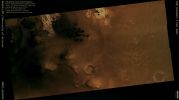
PSP_006820_1760_RED_abrowse~0.jpgPeri-Equatorial "Sand-Patches" on a Crater Floor (MULTISPECTRUM; credits: Lunexit)58 visiteThis image shows part of the floor of a large crater in Arabia Terra, near Mars’ Equator. A notable feature on this crater floor is a region of "Dark Patches" up to about 100 mt (330 feet) across. These Dark Patches sit in an area of connected small ridges and spurs and bury them, filling in the low areas and piling up. In several places light ridge crests protrude through the dark material.
The dark patches appear to be collections of wind-blown sand. Sand on Mars is often dark, likely because it is fragments of a volcanic rock called basalt. (Sand on Earth is most often light-toned quartz). Sand may tend to collect in patches that can ultimately evolve into large dunes if more sand gathers. The patches of sand here are not big enough to form such large structures, but small-scale regular texture due to blowing wind is visible on the surface.
The relatively dark tone which can be seen around the Sand Patches (compared with the surrounding material) is probably due to small amounts of additional sand. In some places this collects at the bottom of troughs.MareKromium
|
|

PSP_005748_1075_RED_abrowse~0.jpgBuried Crater in the SPLD (natural colors; credits: Lunexit)58 visiteThis image of the SPLD shows some of the layers cut off against other layers below and right of center. Geologists call this an “angular unconformity” because the layers do not conform to each other across this boundary.
In this case, the angular unconformity was probably caused by erosion of the SPLD followed by deposition of new SPLD on top of the eroded surface, but faulting could also have caused the observed unconformity.
Near the unconformity is an impact crater, one of dozens found on the SPLD. The presence of these craters implies that the surface of the SPLD has been relatively stable (i.e., little erosion or deposition) in the past few million years.
This is in stark contrast to the NPLD, on which craters are very rare, implying very recent erosion/deposition.MareKromium
|
|

PSP_003492_1405_RED_abrowse~0.jpgUnnamed Southern Mid-Latitude Crater with "unusually bright" Gullies (MULTISPECTRUM; credits: Lunexit)58 visiteThis image shows a Southern Mid-Latitude (unnamed) crater: it has bright landslides on its South-East and West walls, some of which have noticeable boulder tracks where boulders rolled down the slopes.
The most noticeable features of this crater are the gullies on the North wall. A couple of small gullies appear to emanate from an overhang.
The others originate at or near layers up-slope.
The layers are sturdy and resistant from erosion: the layers that appear to be decaying into resolvable boulders, instead of particles easily moved by the wind, are evidence of this.MareKromium
|
|

PIA11809.jpgColumnar Jointing (Natural Colors; credits for the additional process. and color.: Dr Paolo C. Fienga - Lunar Explorer Italia)58 visiteThis image from the High Resolution Imaging Science Experiment (HiRISE) on NASA's Mars Reconnaissance Orbiter shows an exposure of layered rock that exhibits a type of fracturing - called Columnar Jointing - that results when cooling lava contracts.
The observation is cited in a report, "Discovery of Columnar Jointing on Mars", publisged in the February 2009 issue of the journal Geology. The Authors propose that flooding by water was likely what caused a quick cooling of lava to result in this jointing.
The image, taken Oct. 31, 2007, shows a portion of an Unnamed Crater about 16 Km (such as approx. 10 miles) in diameter and centered at 21,52° North Latitude and 184,35° East Long.
Shown here is a section about 1 Km (0,6 mile) wide from the image catalogued by the HiRISE team as PSP_005917_2020. The column-forming fractures resemble textures common on Earth in locations such as the Colombia River Basalt Group and in the Colorado Plateau.MareKromium
|
|

ESP_011765_1780_RED_abrowse-01.jpgRipples in Meridiani Planum (edm - Natural Colors; credits: Lunar Explorer Italia)58 visitenessun commentoMareKromium
|
|

ESP_011648_1730_RED_abrowse-02.jpgOval Mesa on Ganges Mensa (and another "mistery" solved) - Full image, non-map projected and Natural Colors; credits: Lunar Explorer Italia58 visitenessun commentoMareKromium
|
|

PSP_003538_1885_RED_browse.jpgAres Vallis' Cataract (Natural Colors; credits: Lunar Explorer Italia)58 visiteThis image shows a dry cataract within Ares Vallis. A cataract is a large waterfall where there is a high, steep drop. The presence of this large cataract in Ares Vallis confirms that this channel was carved by water, probably in one or many large catastrophic flooding events.
This feature has many of the same characteristics as the cataracts on Earth associated with the flood that carved the Channelled Scablands in Washington State, including horseshoe-shaped headcuts and longitudinal grooves. These grooves in the lower portion of the image lead up to the cataract, with the water flowing from the south to the north in this image. It then flowed down the cataract into the smaller incised channel.
The horseshoe-shaped headcut here is only part of a larger cataract system, and probably formed during the last stage of flooding. The inner channels are now filled with dunes formed by wind blowing along the channel floor.MareKromium
|
|
| 2237 immagini su 187 pagina(e) |
 |
|
|
|
|
138 | |
|
|
|
|





