| Piú viste - Mars Reconnaissance Orbiter (MRO) |

Psp_010345_2150_red.jpgPits in Cyane Fossae (Saturated Natural Colors; credits for the additional process. and color.: Dr Paolo C. Fienga - Lunar Explorer Italia)58 visiteMars Local Time: 15:30 (middle afternoon)
Coord. (centered): 34,4° North Lat. and 239,0° East Long.
Spacecraft altitude: 285,7 Km (such as about 178,6 miles)
Original image scale range: 57,2 cm/pixel (with 1 x 1 binning) so objects ~1,72 mt across are resolved
Map projected scale: 50 cm/pixel
Map projection: EQUIRECTANGULAR
Emission Angle: 0,3°
Phase Angle: 50,5°
Solar Incidence Angle: 50° (meaning that the Sun is about 40° above the Local Horizon)
Solar Longitude: 139,8° (Northern Summer)
Credits: NASA/JPL/University of Arizona
Additional process. and coloring: Lunar Explorer ItaliaMareKromium
|
|
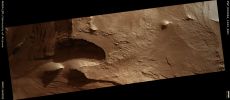
Psp_009684_1695_red.jpgExposure of Light-Toned Layering along Wallrock in Coprates Chasma (possible True Colors; credits: Lunar Explorer Italia)58 visiteMars Local Time: 15:32 (middle afternoon)
Coord. (centered): 10,2° South Lat. and 290,8° East Long.
Spacecraft altitude: 260,8 Km (such as about 163,0 miles)
Original image scale range: 26,1 cm/pixel (with 1 x 1 binning) so objects ~78 cm across are resolved
Map projected scale: 25 cm/pixel
Map projection: EQUIRECTANGULAR
Emission Angle: 2,5°
Phase Angle: 59,7°
Solar Incidence Angle: 62° (meaning that the Sun is about 28° above the Local Horizon)
Solar Longitude: 115,1° (Northern Summer)
Credits: NASA/JPL/University of Arizona
Additional process. and coloring: Lunar Explorer ItaliaMareKromium
|
|
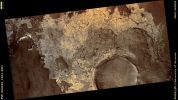
PSP_009945_1835_RED.jpgExhumed Impact Crater in Equatorial Layered Deposits (possible True Colors; credits: Lunar Explorer Italia)58 visiteMars Local Time: 15:30 (middle afternoon)
Coord. (centered): 3,4° North Lat. and 2,9° East Long.
Spacecraft altitude: 273,7 Km (such as about 171,1 miles)
Original image scale range: 27,4 cm/pixel (with 1 x 1 binning) so objects ~82 cm across are resolved
Map projected scale: 25 cm/pixel
Map projection: EQUIRECTANGULAR
Emission Angle: 6,2°
Phase Angle: 59,3°
Solar Incidence Angle: 54° (meaning that the Sun is about 36° above the Local Horizon)
Solar Longitude: 124,7° (Northern Summer)
Credits: NASA/JPL/University of Arizona
Additional process. and coloring: Lunar Explorer ItaliaMareKromium
|
|
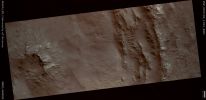
PSP_009749_1995_RED.jpgFresh "Santa Fe Crater" in Chryse Planitia (possible True Colors; credits: Lunar Explorer Italia)58 visiteMars Local Time: 15:25 (early afternoon)
Coord. (centered): 19,4° North Lat. and 312,0° East Long.
Spacecraft altitude: 283,4 Km (such as about 177,1 miles)
Original image scale range: 28,4 cm/pixel (with 1 x 1 binning) so objects ~85 cm across are resolved
Map projected scale: 25 cm/pixel
Map projection: EQUIRECTANGULAR
Emission Angle: 4,0°
Phase Angle: 51,6°
Solar Incidence Angle: 48° (meaning that the Sun is about 42° above the Local Horizon)
Solar Longitude: 117,5° (Northern Summer)
Credits: NASA/JPL/University of Arizona
Additional process. and coloring: Lunar Explorer ItaliaMareKromium
|
|
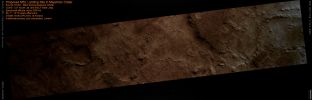
PSP_007704_1765_RED_abrowse~0.jpgProposed MSL Landing Site in Miyamoto Crater (MULTISPECTRUM; credits: Lunexit)58 visiteMiyamoto Crater is located in South-Western Meridiani Planum (and South-West of the Mars Exploration Rover Opportunity Landing Site).
This image shows fairly smooth plains and some areas covered by Windstreaks.
The streaks suggest that wind is an active process here, depositing surface material downwind in this distinctive form. This Landing Site is adjacent to the Hematite-bearing plains unit where the Opportunity Rover sits.
The CRISM instrument has detected Phyllosilicates (Clay Minerals) at this Landing Site, which scientists believe to have formed in the presence of water.
The Mars Science Laboratory rover would investigate the mineral diversity here, which includes Phyllosilicates and Sulfate Minerals.MareKromium
|
|
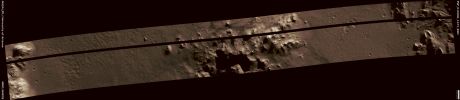
PSP_010006_1475_RED.jpgWestern Half of Central Peak of a large and well-preserved Unnamed Southern Crater (possible True Colors; credits: Lunar Explorer Italia)58 visiteMars Local Time: 15:33 (middle afternoon)
Coord. (centered): 32,0° South Lat. and 140,7° East Long.
Spacecraft altitude: 270,8 Km (such as about 169,3 miles)
Original image scale range: 54,2 cm/pixel (with 1 x 1 binning) so objects ~1,63 mt across are resolved
Map projected scale: 50 cm/pixel
Map projection: EQUIRECTANGULAR
Emission Angle: 20,7°
Phase Angle: 88,3°
Solar Incidence Angle: 73° (meaning that the Sun is about 17° above the Local Horizon)
Solar Longitude: 126,9° (Northern Summer)
Credits: NASA/JPL/University of Arizona
Additional process. and coloring: Lunar Explorer ItaliaMareKromium
|
|
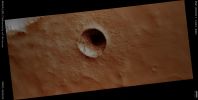
PSP_009917_1665_RED.jpgUnnamed Rayed Crater (natural colors; credits: Lunar Explorer Italia)58 visiteMars Local Time: 15:28 (early afternoon)
Coord. (centered): 13,4° South Lat. and 48,2° East Long.
Spacecraft altitude: 276,5 Km (such as about 172,8 miles)
Original image scale range: 27,7 cm/pixel (with 1 x 1 binning) so objects ~83 cm across are resolved
Map projected scale: 25 cm/pixel
Map projection: EQUIRECTANGULAR
Emission Angle: 22,5°
Phase Angle: 79,7°
Solar Incidence Angle: 62° (meaning that the Sun is about 28° above the Local Horizon)
Solar Longitude: 123,6° (Northern Summer)
Credits: NASA/JPL/University of Arizona
Additional process. and coloring: Lunar Explorer ItaliaMareKromium
|
|
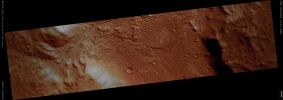
PSP_009992_1615_RED.jpgAl-Qahira Vallis (possible True Colors; credits: Lunar Explorer Italia)58 visiteMars Local Time: 15:36 (middle afternoon)
Coord. (centered): 18,2° South Lat. and 162,9° East Long.
Spacecraft altitude: 260,7 Km (such as about 162,9 miles)
Original image scale range: 52,2 cm/pixel (with 1 x 1 binning) so objects ~1,56 mt across are resolved
Map projected scale: 50 cm/pixel
Map projection: EQUIRECTANGULAR
Emission Angle: 0,2°
Phase Angle: 65,6°
Solar Incidence Angle: 65° (meaning that the Sun is about 25° above the Local Horizon)
Solar Longitude: 126,4° (Northern Summer)
Credits: NASA/JPL/University of Arizona
Additional process. and coloring: Lunar Explorer ItaliaMareKromium
|
|
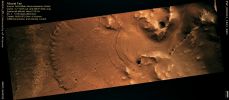
PSP_006941_1825_RED_abrowse~0.jpgAlluvial Fan in Crater East of Maja Valles (MULTISPECTRUM; credits: Lunexit)58 visiteThis image shows a large symmetrical Alluvial Fan at the mouth of a small channel along an unnamed crater. Alluvial fans with a well-defined channel source area are relatively uncommon on Mars.
This fan has a rib-like outer margin and many more terrace-like scarps upslope near the channel mouth. These terraces may indicate the outer margin of sediment deposits during each “pulse” of deposition. Further study of these types of alluvial fans may shed light on past sedimentary environments and conditions on Mars. MareKromium
|
|

Psp_010695_2225_red.jpgFlow near the Central Peak of Moreux Crater (possible True Colors; credits: Lunar Explorer Italia)58 visiteThis image is of a flow feature within Moreux Crater, located at about 42° North Lat. and 44,6° East Long., on the edge of Mars’ Highlands/Lowlands Boundary. The Crater itself is roughly 135 Km in diameter.
During the impact that forms craters, a roughly bowl shaped volume is excavated from the Martian Crust. In craters larger than about 7 Km in diameter, a Central Peak (or Mound) forms on the floor of the crater. This image focuses on a portion of the Moreux Central Peak that apparently broke off and slid away, forming a type of Giant Landslide.
Interesting hummocks, swirls and ridges are found on the surface of the Landslide. There are also distinct, almost circular depressions of unknown origin near the foot of the flow.
Both light and dark toned dunes later formed on this landform.
§§§
Mars Local Time: 15:43 (middle afternoon)
Coord. (centered): 42,0° North Lat. and 44,7° East Long.
Spacecraft altitude: 322,4 Km (such as about 201,5 miles)
Original image scale range: 32,2 cm/pixel (with 1 x 1 binning) so objects ~97 cm across are resolved
Map projected scale: 25 cm/pixel
Map projection: EQUIRECTANGULAR
Emission Angle: 22,5°
Phase Angle: 35,7°
Solar Incidence Angle: 58° (meaning that the Sun is about 32° above the Local Horizon)
Solar Longitude: 153,6° (Northern Summer)
Credits: NASA/JPL/University of Arizona
Additional process. and coloring: Lunar Explorer ItaliaMareKromium
|
|
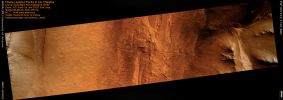
PSP_007219_1720_RED_abrowse-00~0.jpgFinely-Layered Rocks in Ius Chasma (context-frame - MULTISPECTRUM; credits: Lunexit)58 visiteThe high resolution of HiRISE allows us to see the many Fine Layers, or Strata, of Rock Outcrops all over Mars. This image shows a portion of Ius Chasma in the western portion of the large Valles Marineris Canyon System.
The Outcrop of Rock in the center of the image is about 5,5 Km across. Similar light-toned Strata are observed elsewhere in the canyon system and the CRISM instrument has shown that they often contain sulfate salts. The presence of Sulfate Salts indicate that water once interacted with this area, possibly as fluids that migrated through pre-existing rocks or as shallow evaporating pools of water.MareKromium
|
|
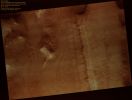
PSP_002545_1430_RED_browse-00~0.jpgJuncture of Two Branches of Dao Vallis (ctx frame - possible True Colors; credits: Lunar Explorer Italia)58 visiteMartian outflow channels are believed to be some of the largest features formed from the catastrophic flooding that scoured the landscape during ancient times. The source of the water likely originated in the subsurface and was somehow disturbed, depressurizing an aquifer, causing a sudden burst of water onto the surface.
This image shows multiple branches of the outflow channel Dao Vallis, which flows towards the West (down), ending near Hellas Basin. Although it is not clear exactly where the water that created these floods ended up, it is possible that Dao Vallis and its neighboring outflow channel, Niger Vallis, deposited water in Hellas Basin and formed a short-lived lake. Within the floor of Dao Vallis is material that appears striped, known as "lineated valley fill".
Valley fill material is thought to be ice-rich material that has flowed or been deposited onto the floor. Several lineations or "flow lines" appear to merge towards the upper left of the scene which supports this idea that the fill materials flowed, similar to slow-moving glacial material on Earth.
Also present in this scene is a mantling deposit which drapes much of the mid-latitudes of Mars. The deposit or "mantle" can be seen on south-facing slopes of positive-relief features, appearing as if its sliding off the walls. The mantle material is thought to be ice-cemented dust that was deposited during times when snowfall occurred on Mars.MareKromium
|
|
| 2237 immagini su 187 pagina(e) |
 |
|
|
|
|
137 | |
|
|
|
|





