| Piú viste - Mars Reconnaissance Orbiter (MRO) |

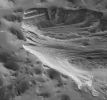
Craters-Unnamed_Crater_in_Terra_Sirenum_12m-00.jpgCrater in Terra Sirenum (1)58 visiteThe largest number of gullies on Mars occur on the walls of southern hemisphere craters. During southern winter, many of the gullied walls are in shadow. It has been known for many years from Mars Global Surveyor Mars Orbiter Camera images that frost forms on these shadowed slopes and that differences in the amount or nature of the frost deposits highlight the gully floors and deposits. Such differences may occur because the materials are of different particle sizes, or have other differing attributes that affect their thermophysical properties. To investigate this phenomenon, CTX acquired this image of a crater at 39.3°S, 136.5°W, where gullies were known to display frost during winter. To see the gullies, download the image and view it in an image processing program, as they are nearly invisible in the normal contrast image.
|
|

TRA_000830_1440_IRB-1.jpgNiger Vallis (1)58 visiteThis image shows a portion of the floor of Niger Vallis, an ancient Martian outflow channel. Niger Vallis originates on the flanks of the volcano Hadriaca Patera, and empties into the Hellas impact basin. Outflow channels are observed in many regions of the planet, and may have been carved by brief eruptions of liquid water from beneath the surface. Since Niger Vallis formed, impacts have cratered the channel floor, and fine-grained wind-blown debris has been transported across the surface, eroding and burying all but the freshest craters. The curved ridge in the scene may be the remnant of a large crater rim. At the high resolution of this image, a pattern of parallel dunes and ripples can be seen, as well as individual boulders as large as two meters across.
Image TRA_000830_1440 was taken by the High Resolution Imaging Science Experiment (HiRISE) camera onboard the Mars Reconnaissance Orbiter spacecraft on September 30, 2006. The full image shown below is centered at -35.5 degrees latitude, 92.1 degrees East longitude. The range to the target site was 255 km (159 miles). At this distance the image scale is 51 cm/pixel (with 2 x 2 binning) so objects ~153 cm across are resolved. The image shown here has been map-projected to 50 cm/pixel and north is up. The image was taken at a local Mars time of 3:35 PM and the scene is illuminated from the west with a solar incidence angle of 77.5 degrees, thus the sun was about 12.5 degrees above the horizon. At a solar longitude of 113.8 degrees, the season on Mars is Northern Summer / Southern Winter.
|
|

TRA_000840_2750_IRB-004.jpgChasma Boreale (4)58 visitenessun commento
|
|

TRA_000840_2750_IRB-007.jpgChasma Boreale (6)58 visitenessun commento
|
|
Juventae_Chasma_12m-00.jpgFeatures of Juventae Chasma (1)58 visiteCaption NASA originale:"This image shows a mound of layered rock within the large depression Juventae Chasma (3,5° South Lat. and 61,9° West Long.) known from data from the Omega spectrometer on the Mars Express mission to have sulfate minerals mixed within it. The clear expression of layering in the CTX image and the potential for correlation with MRO-CRISM hyper-spectral data open the possibility of relating specific beds to specific compositions, indicating the nature of the depositional environment and subsequent alteration".
|
|

Craters-Unnamed_Crater_with_Gullies.jpgGullies, from MRO58 visitenessun commentoMareKromium
|
|

Craters-Holden_Crater-03.jpgThe beautiful "Holden Crater" (3)58 visitenessun commentoMareKromium
|
|

Elysium_Planitia-Tra_000867_1875_red-00.jpgElysium Planitia (CTX Frame - False Colors)58 visiteA low, sinuous tectonic ridge ("wrinkle ridge") can be seen in the South-East (lower left) and a rough-textured flow (lava?) fills the North-West (upper right) part of the image. Terraces that may have been carved by floodwaters are visible on the Southeastern side of the contact between the wrinkle ridge and the flow.
On the Northwestern side of this contact, the flow itself has a banded appearance reminiscent of contour lines or bathtub rings. It may be that long ago, when the flow was mobile, its surface level dropped, leaving these bands as indicators of how high it once stood. Alternatively, the bands could be buried terraces draped by the rough-textured flow. Relatively straight and narrow dunes (about 10 mt wide) have marched across the surface of the flow, and a thin layer of light-toned dust blankets the region. A dark spot about 100 mt in diameter on the left side of the image is probably where a cluster of small impacts blew away the dust, revealing the darker shade of the underlying surface.MareKromium
|
|

Northern_Plains-Psp_001380_2520_red-01.jpgAnother "Frozen Lake" in the Northern Plains? (2 - EDM - False Colors; credits for the additional process. and color.: Dr Paolo C. Fienga - Lunexit Team)58 visitenessun commentoMareKromium
|
|

Terra_Sirenum-PIA09101-01.jpgSeasonal frost in Terra Sirenum (according to Lunexit)58 visitenessun commentoMareKromium
|
|

Psp_001401_1850_red-3.jpgThe "Bridges" of Arabia Terra (2) extra-detail mgnf58 visiteC'è poco da commentare in questo dettaglio: osservate Voi stessi la conformazione, la configurazione e la posizione di questi indecifrabili rilievi e poi provate a maturare una opinione al riguardo.
A nostro avviso, NON siamo davanti ad image-artifacts nè a rilievi soggetti ad una forma di distorsione dell'immagine dovuta al tipo di angolo visuale adottato da MRO (e quindi rilievi "regolari" che appaiono "distorti" in seguito ad un effetto ottico).
La Verità, al momento, è che siamo in presenza di rilievi peculiari di Marte e, di fatto, non solo inesplicabili, ma anche totalmente ignorati (almeno in via "ufficiale") dalle maggiori Agenzie Spaziali.
|
|

PSP_001483_1545_RED-more_lakes.jpgThe "Dirty Lakes" of Solis Planum (False Colors)58 visiteLe immagini sino ad oggi ottenute dalla Sonda NASA "Mars Reconnaissance Orbiter" posseggono una qualità visiva semplicemente straordinaria: un fatto evidente ed incontestabile (altro che le orribili mistificazioni ESA-Mars Express!). Ed è proprio grazie a questa qualità che, un passo alla volta, stiamo incominciando a vedere Marte davvero come nessuno mai lo aveva visto prima. Un Marte sempre più affascinante, enigmatico e...vivo!
Dopo il Lago Gelato di Vastitas Borealis e dopo gli altri tre Laghi che riteniamo di aver individuato nelle Pianure Nordiche, ecco un frame su cui riflettere.
Anche in questa immagine, infatti, riteniamo di aver individuato, sul fondo di svariati crateri, la presenza di "qualcosa" che non pare proprio essere sabbia, o terriccio o, comunque, il prodotto di un semplice accumulo di sabbie e polveri.
Osservate Voi stessi: sul fondo di alcuni crateri (specie quelli posizionati alla Vostra Sx) c'è qualcosa che evidenzia una tessitura morbida e semi-trasparente. Non stiamo parlando certamente nè di sabbie, nè di polveri ultrasottili. Stiamo parlando, con ogni probabilità, di "acque fangose" (e quindi torbide o "sporche", come le abbiamo noi stessi - scherzosamente - definite). Acque ancora liquide, molto probabilmente, che ci sembra facile individuare anche grazie alla contemporanea presenza, sulla medesima porzione di territorio, di crateri che, invece, sono chiaramente "vuoti" oppure che vedono la presenza sui loro fondi delle ormai caratteristiche "dunette fangose" che già abbiamo visto MOLTO da vicino studiando i Crateri Endurance e Victoria.
Ora guardate il tutto ancora una volta Voi stessi e poi, se volete, diteci che cosa ne pensate...MareKromium
|
|
| 2237 immagini su 187 pagina(e) |
 |
|
|
|
|
136 | |
|
|
|
|





