| Piú viste - Mars Reconnaissance Orbiter (MRO) |
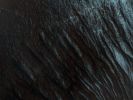
Gullies-Terra_Sirenum-PIA12881.jpgGullies in Terra Sirenum (credits: NASA/JPL-Caltech/University of Arizona)59 visiteThis observation shows part of an Unnamed Crater, located inside the much larger Newton Basin, in the Terra Sirenum Region of Mars.
This Unnamed Crater is approx. 7 Km in diameter (over 4 miles) and some 700 meters (760 yards) deep.
Numerous Gully Systems are visible on the East- and South-facing Walls of the Crater; their characteristics are astonishingly diverse.
This EDM covers an area of nearly 610 x 740 meters (670 x 800 yards). North is up; illumination is from the North-West.
This EDM depicts several Gullies carved in the South-West-facing Wall of the Crater.
These troughs are extremely rectilinear, lack tributaries, and do not seem to have Terminal Fan Deposits: they terminate rather abruptly, some of them in a spatula-like shape.
Their characteristics contrast sharply with those of other Gully Systems located elsewhere in this same Crater, which are sinuous, have numerous tributaries, and show distinct Fan Deposits.MareKromium
|
|

ESP_016288_2610_RED_abrowse.jpgHigh Northern Latitudes (possible Natural Colors; credits: Dr Paolo C. Fienga - Lunexit Team)59 visitenessun commentoMareKromium
|
|

Noachis_Terra-PIA13074.jpgNoachis Terra (Natural Colors; credits for the additional process. and color.: Dr Paolo C. Fienga - Lunexit Team)59 visiteThis observation shows Gullies in a semi-circular Trough in Noachis Terra. The Gullies are observed to face all directions.
It is interesting to note that the Gully Morphology seen here depends on the orientation of the Gullies. The morphology differences are most pronounced on the sunlit slope, with the Gullies facing South (down) being more deeply incised than those facing the West. It is unknown what caused the different Gully Morphologies, but there are several possibilities.
Gullies are proposed to form at locations determined by the availability of a forming liquid (thought to be water) and/or the amount of insolation the Slope receives, among other factors. It is possible that the deeper Gullies experienced more erosional events or that their erosional events were more effective for undetermined reasons. It is also possible that the Gullies formed at different times such that they did not have the same amount of water -- either for an individual flow or total -- available to them. Also, the underlying topography could make the Gullies appear relatively more incised without this actually being the case.
The majority of the Gullies on both sides of the Trough appear to originate at a boulder-rich layer visible in the subimage. The layer appears dark on the sunlit slope because the boulders sticking out from the slopes cast shadows. If these Gullies formed by water from the Subsurface, then it is possible that this layer is a permeable layer that conducted water to the Surface.
The layer is deteriorating and traveling down slope in the form of Boulders. These Boulders can clearly be seen in the alcoves of the Gullies on both sides of the Trough.MareKromium
|
|

PSP_001936_1370_RED_abrowse-01.jpgScarp and Channels in a Crater in Terra Cimmeria (Natural Colors; credits: Dr Paolo C. Fienga - Lunexit Team)59 visitenessun commentoMareKromium
|
|
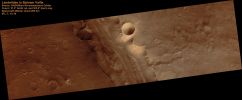
PSP_003605_2015_RED_browse~0.jpgLandslides along the Walls of Bahram Vallis (Absolute Natural Colors; credits for the additional process. and color.: Dr Paolo C. Fienga - Lunexit Team)59 visiteLandslides are one of the most spectacular mass wasting features on Mars in terms of their areal extent and volume. Some of the best preserved landslides are in the Valles Marineris canyon system, but that's not the only place we see evidence for landslides.
This image of Bahram Vallis, a valley along the edges of the circum-Chyrse Basin, has large mounds of material at the base of the valley floor. These deposits of material are different from those deposits seen at Valles Marineris. They do not have a "ribbed" surface of transverse ridges. They also do not have a semi-circular distal margin giving it a lobate appearance and they have not travelled for many kilometers away from their source region like most Valles Marineris landslides do.
These particular deposits have the characteristic shape of rotational landslides or slumps on Earth where material along the entire wall slumps down and piles debris at the base of the slope, much like a person who slumps down the back of a chair. Right at the cliff edge at the top of the slope, the shape of the area where the valley wall gave way to a landslide is not straight, but rather curved or semi-circular. This is typical of large landslides where the failure area has an arcuate "crown" shape. The fact that landslides have occurred here indicates that the valley walls are not stable and the materials respond to Martian gravity with mass movements.
Scientists studying landslides can use these images along with topographic data to model how the wall failed, which can give clues to the nature of the materials (type, strength, etc.) in this region. Another consequence of landslide activity in Bahram Vallis is that the overall width of the valley will increase over time. MareKromium
|
|

PSP_002840_1855_RED_abrowse-00.jpgMeanders in Nanedi Valles (Natural Colors; credits for the additional process. and color.: Dr Paolo C. Fienga - Lunexit Team)59 visiteThis observation shows a portion of Nanedi Valles, an equatorial Martian valley network.
Valley networks are thought to have formed by groundwater sapping either in conjunction with an ice layer to cover the running water or during a past warmer, wetter climate regime on Mars. Glacial activity has also been proposed to form the valley networks.
Groundwater sapping is the leading theory because of the morphology of the valleys. They commonly have approximately constant width along their reaches, as seen here, as well as theater shaped heads, as seen in the tributary valley in the bottom right of the scene. The meandering nature of valleys suggests persistent or repeated flow as required to form meanders in streams on Earth.
The subimage shows a potential remnant channel seen on the floor of Nanedi Valles just below the center of the image. If this is a remnant channel, it suggests that there was either repeated or waning flows in this valley. Winding dunes and abundant impact craters are found throughout the valley, as well as within this putative channel.
Dunes are thought to be transient features on Mars, although no movement has been detected to date. It is interesting to note that some of the dunes are superposed by craters indicating that the dunes were stable long enough for craters to form and not be erased.
It is possible that the craters on top of the dunes are secondary craters that formed as a product of a larger impact. Secondary craters from a single impact are clustered in space and form almost simultaneously, implying that the dunes were stable for a time period—long enough for a single crater, rather than multiple craters, to form.
MareKromium
|
|

PSP_002922_1725_RED_abrowse-00.jpgGlacier-like Flow on Arsia Mons (CTX frame - Natural Colors; credits for the additional process. and color.: Dr Paolo C. Fienga - Lunexit Team)59 visiteThis observation shows a "Glacier-like Flow" in a Depression located on the flanks of Arsia Mons.
Arsia Mons is one of the large Martian Volcanoes that sits near the Equator on the Tharsis Rise. Downslope is towards the upper right of CTX frame, and the Flow is in this direction. It is interesting to note that the Depression is not directly radial from the Volcano's Peak, but rather oriented approximately 45° away, along the Flanks of the Volcano.
The pitted texture of the material suggests that sublimation is occurring or has occurred. The Surface Temperature and Pressure on Mars are such that water in ice-rich material can easily sublimate leaving behind a depression where the volatiles were removed.MareKromium
|
|

PSP_001970_1655_RED_abrowse.jpgLandslide in Coprates Chasma (Natural Colors; credits for the additional process. and color.: Dr Paolo C. Fienga - Lunexit Team)59 visiteThis observation shows a Landslide in the Coprates Chasma Region of Valles Marineris that occurred when a large unstable area of rock broke away from the Cliffs that can be seen on the right side of the frame. This mass of falling rock broke into many small pieces as it slid downhill and came to rest at the base of the Cliff, forming the Lobate (curved) Mound visible on the left part of the image.
The smooth textured Ripples that can be seen in the central part of the frame are Sand Dunes. Sand Dunes form as wind-blown particles roll across the Surface and accumulate. Since the air on Mars is very thin, Sand Dunes take much longer to form on Mars than they do on Earth.
The presence of large Sand Dunes - along with many small Impact Craters - on top of this Landslide indicates that movement of the slide occurred a very long time ago; perhaps hundreds of millions of years.
This Landslide was probably caused by a strong Marsquake, but a nearby (significant) impact could have generated a deep shock-wave that was sufficiently strong to cause it. Alternatively, movement along nearby Faults may have triggered the Landslide.
The Valles Marineris Region is cut by many Faults and in fact contains many more Landslides such as this one. Some scientists believe that these Landslides represent a record of seismic activity in this area.
It is obvious that a better understanding of the history of seismic activity in this specific Region may help scientists to predict the likelihood that Marsquakes still occur on the Planet.MareKromium
|
|

PSP_001910_2215_RED_abrowse-00.jpgUnnamed Crater in Utopia Planitia (Natural Colors; credits for the additional process. and color.: Dr Paolo C. Fienga - Lunexit Team)59 visiteThis observation shows an Unnamed Impact Crater located in Utopia Planitia; this Crater is more than 10 Km (6,25 miles) in diameter and approx. 700 meters (765 yards) deep. Different features in and around this Crater may indicate the presence of fluid beneath the Surface.
Linear features radiating outward from the Crater's Rim are evident. Closer examination shows these features are formed by rocks and finer soils that are located along a straight line; technically, they are "Spokes" produced immediately after the impact by very fast outward-moving materials ejected from the contact-zone. Because these Ejecta came from deep under the Crater, their composition will tell us what type of rocks are under the Surface.
A MOC context image of this Crater shows its Ejecta Materials form an elevated "Pedestal," shaped like a pancake. The Pedestal is approx. 20 Km (about 12,5 miles) in diameter. "Pedestal craters" such as this may have formed because ice beneath the Surface melted when the impact occurred.MareKromium
|
|
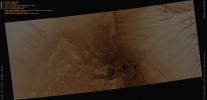
ESP_014287_1685_RED_abrowse-00.jpgNoctis Labyrinthus (Natural Colors; credits for the additional process. and color.: Dr Paolo C. Fienga - Lunexit Team)59 visiteThis image spans the floor and two walls of a pit in Noctis Labyrinthus, a System of deep, steep-walled Valleys on the Western Edge of Valles Marineris.
The Valleys themselves are tectonic features known as "Graben" (---> trench-like features that form in response to extension (or stretching) of the Crust). In the case of Noctis Labyrinthus, volcanic activity in the Tharsis Region may have formed a bulge, which then stretched and fractured the Crust above it.MareKromium
|
|

PSP_003180_0945_RED_abrowse-02.jpgSouth Polar Dust Fans (EDM n.2 - Natural Colors; credits for the additional process. and color.: Dr Paolo C. Fienga - Lunexit Team)59 visitenessun commentoMareKromium
|
|

PSP_003180_0945_RED_abrowse-00.jpgSouth Polar Dust Fans (CTX Frame - Natural Colors; credits for the additional process. and color.: Dr Paolo C. Fienga - Lunexit Team)59 visiteDuring the long and dark night of Martian Winter at the South Pole, CO2 in its solid form ("dry ice") accumulates and forms the so-called "Seasonal South Polar Cap". Afterwards, as the Sun comes up in the Spring, the ice evaporates in a complex way.
This observation shows Dark Dust being blown across the Seasonal South Polar Cap. The dust comes from the Surface beneath the ice: it either starts at spots bare of ice, or it's possible that it's lofted from below the ice in geyser-like plumes.
Local winds blow the dust from its source, forming a long Fan. When the wind changes direction, a new Fan is formed pointing in the new direction In this image we can see that the wind has blown in a number of directions.
These data will be used to study - among other things - the Weather Patterns near the South Pole.MareKromium
|
|
| 2237 immagini su 187 pagina(e) |
 |
|
|
|
|
135 | |
|
|
|
|





