| Piú viste - Mars Reconnaissance Orbiter (MRO) |
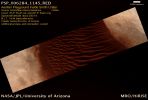
PSP_006284_1145_RED_abrowse-00.jpgLarge Dunefield inside Smith Crater (MULTISPECTRUM; credits: Lunexit)58 visiteThis image shows a Dark Dunefield in Smith Crater. The dark color of the dunes indicates that they are probably made of basaltic sand, a dark volcanic rock that is common on Mars. This is in contrast to dunes on Earth, which are dominated by quartz, a rare mineral on Mars.
The dunes here are “transverse dunes” that, based on analogy with similar features on Earth, form by winds that blow in a direction perpendicular to the crests. However, Secondary ripples on top of the dunes are oriented at right angles; that indicates a second wind regime that has redistributed the sand after the original dunes formed. The multiple orientations of the dunes may be partly caused by their location within the crater, whose own topography can act to redistribute regional wind patterns.
The dark streaks on the lighter terrain outside of the Dunefield are interpreted as DD tracks, where mini-tornadoes reveal darker ground beneath the bright dust of the surface.
Some long DD Tracks are visible in the southern part of the dune field and climb onto the troughs of the transverse dunes. There are also a few faded tracks at the northern part of the dune field.MareKromium
|
|

Weather-PIA10672.gifClear Skies over the Northern Regions (GIF-Movie; credits: NASA)58 visiteScientists are anticipating clear skies when NASA's Phoenix Mars Lander arrives on the north polar plains of the Red Planet Sunday, May 25, 2008.
This orbital view of the north polar region of Mars, where NASA's Phoenix Mars Lander will land, shows clear skies as of May 22, 2008. Mission planners are always on the lookout for dust storms in daily weather updates like this one, provided by the Mars Color Imager on NASA's Mars Reconnaissance Orbiter. Based on current conditions, they are predicting good weather when Phoenix arrives May 25, 2008.
Temperature profiles, used to calculate atmospheric density, are also updated on a regular basis, provided by the Mars Climate Sounder, another instrument on the Mars Reconnaissance Orbiter. Atmospheric density was well within expectations as of May 22, 2008. Mission planners will continue to receive updates on weather and atmospheric conditions prior to landing.
The animated orbital view shows recent weather conditions from May 16 to May 22, 2008, as tracked by the Mars Color Imager on NASA's Mars Reconnaissance Orbiter. A cloud of dust kicked up by Martian winds traveled from west to east between May 19 and May 22, 2008, passing over Phoenix's landing site. The dust cloud was about 500 kilometers (300 miles) from head to tail and made the skies somewhat hazy. Since then, the dust has been replaced by clear skies, indicating that Phoenix will not land in any dust clouds, which are a common occurrence in the northern latitudes of Mars.
MareKromium
|
|

PSP_005620_1210_RED_abrowse.jpgSouthern Alcoves (MULTISPECTRUM; credits: Lunexit)58 visiteThis image shows the West Wall of a Southern Hemisphere Crater. The scene is covered in Dust Devil Tracks which appear as dark wispy features.
Dust Devils are small-scale funnels that move across the surface kicking up dust as they go, thus leaving trails. The Crater is covered in small polygons in many locations. These polygons are probably related to periglacial processes; for example, temperature cycling of ice-rich material or sublimation, when gases trapped under the surface escape causing the remaining terrain to collapse to form pits.
Also in this Crater are several Gullies on the Southern Wall. These Gullies have very wide alcoves/source regions. It is unknown what is responsible for different Gully Alcove shapes and morphologies.MareKromium
|
|

PSP_008426_2595_RED_abrowse-02.jpgPolygons, Crater Layers, and Defrosting Dunes (edm n. 2 - MULTISPECTRUM-2; credits: Lunexit)58 visiteAnother feature of interest is the Sublimating Polygons that have very small ripples on top of them. Polygons are created from a freeze-thaw processes similar to features on Earth that undergo annual contraction of the Permafrost Regolith.MareKromium
|
|
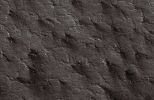
PSP_003520_1010_RED_abrowse-01.jpgSouth Polar Spiders (edt - MULTISPECTRUM-2; credits: Lunexit)58 visitenessun commentoMareKromium
|
|
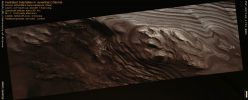
PSP_007126_1755_RED_abrowse.jpgFeatures of Juventae Chasma (MULTISPECTRUM; credits: Lunexit)58 visiteQuesta località è stata analizzata da molti Anomaly Hunters per via dell'esistenza di un PRESUNTO terrazzamento ripreso dalla Sonda Mars Express; un Terrazzamento che avrebbe dovuto (di)mostrare l’esistenza di una possibile cava (ergo di un'Opera Artificiale).
Bene: eccoVi dunque una nuova immagine di Juventae Chasma, questa volta ottenuta dalla sonda MRO e finalmente ad Alta Definizione.
Basterebbe lasciar parlare l’immagine, che più di mille parole può (chissà, forse purtroppo) per smentire una tale e colossale svista da parte della corrente complottista che vide nella elaborazione digitale ESA la prova provata dell'esistenza di una miniera laddove non c'è null'altro se non l'Opera della Natura (intrigante e selvaggiamente ammiccante, MA SEMPRE E SOLO NATURA!).
È verissimo che solo chi fa sbaglia, ma se è vero che a volte si sbaglia anche a non fare, cogliamo questa occasione per analizzare meglio la base di partenza di questa vicenda.
Tutto è nato dalle parole che troviamo nel libro dell’Ing. Piccaluga (che salutiamo) il quale, dopo aver teorizzato che tali pareti siano lavorate in modo troppo simmetrico e regolare per essere "naturale", mostra come controprova (anzi, come “prova che non avrei mai voluto trovare”) il frame Mars Global Surveyor MOC2-433.
Parafrasando il testo dell’Ingegnere, questo frames MGS, pur riprendendo la sagoma del sito, non mostra più i terrazzamenti; la cava è diventata un rilievo assolutamente piatto (e naturale), e quindi non resta che “prendere atto che l’immagine è stata contraffatta completamente (…) non c’è altra spiegazione”.
Ma attenzione: occorre precisare che ci sono anche altre due ipotesi da considerare: o i terrazzamenti sono stati aggiunti dall’ESA (!), o i lavori, la scritta e la cava sono stati eseguiti nell’arco di un anno (la pseudo foto ESA è del 26 marzo 2004).
Insomma, il sito artificiale è troppo evidente, la corrente liberale dell’ESA ha deciso di “lasciare al loro destino la NASA ed i suoi ingannevoli trucchi fotografici” e, per il Caro Ingegnere, “rimane inaccettabile che un Ente tanto prestigioso possa aver operato in modo così scorretto”.
Parole dure, forse condivise da altri Scrittori ed Appassionati, ma anche ingannevoli, come le "pseudo-foto" dell'ESA.
E si, INGANNEVOLI, poichè - diremmo capziosamente - lo scenario sopra delineato non contempla una terza (e diremmo ESSENZIALE) possibilità: l’errore umano dello Scrittore. La "svista", insomma...
Non entrando nel merito delle analisi che mostrerebbero la presunta cava (qui ben visibile come mai...) visto la difficoltà di analisi dei frames orbitali e della loro intrinseca ambiguità (tutti possono vederci tutto ed il suo contrario) dobbiamo evidenziare la svista riferita al frame Mars Global Surveyor come mezzo di prova.
Ebbene quel frame mostra - semplicemente - un altro rilievo, nulla di più… E comunque quel frame sarebbe stato realmente anomalo qualora avesse effettivamente mostrato i terrazzamenti in questione, semmai.
Non solo: la “scorretta NASA”, in realtà e sempre con la sonda MGS, aveva già mostrato (e ben prima dell’ESA!) proprio il rilievo controverso ora in questione: eccovi date e seriali, per Vostra opportuna informazione
16 Ottobre 2000 frame M12-00299
30 Settembre 2003 frame E23- 01035 (con un bel dettaglio della inesistente miniera)
27 Settembre 2004 frame R12-00618
13 Aprile 2006 frame S05-01549
Che dire quindi?
Lasciando la parola ancora al Caro Ingegnere leggiamo che “resto, fino a prova contraria, fermo nella convinzione che gli Americani abbiano cancellato le tracce di un sito artificiale (…) la mia sincera speranza è che ci sia una spiegazione a quanto osservato”.
Giusto.
Speriamo quindi di aver fatto una cosa gradita a TUTTI mostrandoVi svariati, possibili e PLAUSIBILI spunti, scenari e riferimenti i quali, nel loro insieme, costituiscano un'adeguato back-ground per un'auspicabile - e, nei confronti della Ricerca e dei Ricercatori del Futuro (Ricerca e Ricercatori con la "R" maiuscola...) - opportuna ed onesta “errata corrige”.
O no?!?MareKromium
|
|

PSP_006952_1870_RED_abrowse~0.jpgDark Dunefield in West Arabia Terra (MULTISPECTRUM and Yellow/Orange Filters ON; credits: Lunexit)58 visiteThis image shows dunes in an unnamed crater in the west Arabia Terra Region.
The rim of the crater lies to the South of the image (Sx)and a dark, toned field of Barchan Sand Dunes rests on the crater floor in the Northern portion of the observation.
Barchan Dunes are commonly found on Earth, and are generally crescent-shaped with a steep slip face bordered by horns oriented in the downwind direction. Barchan Dunes form by unidirectional winds and are good indicators of the dominant wind direction. In this case, the strongest winds blew approximately North to South.
These dunes are most likely composed of basaltic sand that has collected on the bottom of the crater.
Superimposed on their surface are smaller secondary dunes which are commonly seen on terrestrial dunes of this size. Many smaller and brighter bed forms — most likely small dunes or granule ripples — also cover the substrate between the larger dark dunes. The dark dunes overlie the small bright bed forms indicating that the darker dunes formed more recently.
MareKromium
|
|

PIA10140-DarkFans~0.jpgBright Streaks and Dark Fans (MULTISPECTRUM; credits: Lunexit)58 visiteIn a Region of the South Pole known informally as "Ithaca", numerous Fans of dark frost form every Spring. HiRISE collected a time lapse series of these images, starting at Ls = 185 and culminating at Ls = 294. "Ls" is the way we measure time on Mars: at Ls = 180 the Sun passes the Equator on its way South; at Ls = 270 it reaches its maximum subsolar latitude and Summer begins.
We believe that the bright streaks are fine frost condensed from the gas exiting the vent. The conditions must be just right for the bright frost to condense. MareKromium
|
|

Mawrth_Vallis-The_Waterfall-CC.gifZooming on the "Waterfall" - Mawrth Vallis (GIF-Movie, by Carlo Contu)58 visiteAcquisition date: January, 04, 2008
Local Mars Time: 14:19
Latitude: 23,0° North
Longitude: 341,6° East
Range to target site: 309,9 Km
Original image scale range: 31 cm/pixel (with 1 x 1 binning) so objects ~93 cm across are resolved
Map projected scale: 25 cm/pixel and North is up
Map projection: EQUIRECTANGULAR
Emission angle: 22,7°
Phase angle: 60,1°
Solar incidence angle: 38°, with the Sun about 52° above the horizonMareKromium
|
|
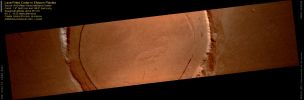
Psp_008753_1880_red.jpgLava-filled Crater in Elysium Planitia (natural colors; credits: Lunexit)58 visiteElysium Planitia is a part of the Martian Lowlands that has been repeatedly covered by vast floods of lava. This image shows an older Impact Crater that has been filled by one of the youngest of those lava floods.
Only sections of the circular rim of the Crater remain uncovered. The lava surface consists of ridged plates that have rafted apart with smoother lava filling between the plates. The ridges formed as the solidifying lava crust was crumpled by compression, and the gaps between the plates formed as the crust was pulled apart. Similar compression and extension of lava crust has been observed in the largest lava flows in Iceland.
The most puzzling aspect of this image is that the lava in the floor of the Crater appears to have sunk down compared to its surroundings. This happened after a thick crust had formed on the lava. The most likely explanation is that the last molten lava inside the flow drained away through a now buried gap in the crater rim.
A final point of interest are the small circular cones visible near the center of the Crater. These formed when ground water (or ice) was turned to steam by the heat of the lava flow. This steam exploded through the flow, producing the small cratered cones.MareKromium
|
|

PSP_008963_1650_RED-01.jpgMER Spirit Rover at Martian Mid-Winter (edm - natural, but enhanced, colors; credits: Lunexit)58 visitenessun commentoMareKromium
|
|
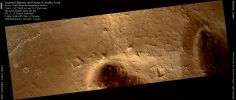
Psp_008982_1965_red.jpgLayered Deposits in Arabia Terra Region (natural colors; credits: Lunexit)58 visiteThis image shows the floor of an Unnamed Impact Crater in Arabia Terra that has Layered Deposits. There are many craters in this Region, where layering is observed.
These layers are often exposed along the sides of large isolated mounds, small knobs and mesas, and other positive relief features. In some cases, the layering is expressed as narrow sinuous ridge-like structures along crater floors.
The presence of Layered Deposits is of particular interest because these materials are not likely to be related to the impact event, but rather post-impact infill of the Crater. Modification of the Deposits has now revealed layers of material.
HiRISE and other instruments onboard the Mars Reconnaissance Orbiter may provide more clues to the origin of the these deposits.MareKromium
|
|
| 2237 immagini su 187 pagina(e) |
 |
|
|
|
|
133 | |
|
|
|
|





