| Piú viste - Mars Reconnaissance Orbiter (MRO) |

ESP_014103_2485_RED_abrowse.jpgMonitoring of Phoenix Landing Site (Natural Colors; credits: Lunexit)59 visitenessun commentoMareKromium
|
|
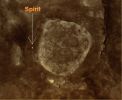
Home_Plate-PIA12205.jpgSpirit at Home Plate59 visiteIn this view from orbit, the pale circular shape in the center is a low plateau called "Home Plate", about 80 meters (about 260 feet) across. The bright dot just to the left of Home Plate at the 9 o'clock position is NASA's MER Spirit. North is toward the top.
The view is a portion of an image taken on June 13, 2009, by the High Resolution Imaging Science Experiment (HiRISE) camera on NASA's Mars Reconnaissance Orbiter. At that date, Spirit had been embedded for more than a month in a patch of soft soil called "Troy".
During the subsequent 3 months, Spirit studied the unusually layered soil at the site while engineers used test rovers at NASA's Jet Propulsion Laboratory to assess possible maneuvers for getting Spirit away from Troy.
The site is at 14,6° South Latitude and 175,5° East Longitude. Home Plate is in the inner basin of the Columbia Hills range, inside Mars' Gusev Crater. Spirit has been exploring the Columbia Hills and nearby features since January 2004.MareKromium
|
|

ESP_013954_1780_RED_abrowse-00~0.jpgVictoria Crater (CTX Frame - Natural Colors; credits: Lunexit)59 visiteThis image has an interesting perspective because of the oblique viewing geometry. In addition, the Tracks left by the Opportunity Rover are visible just North of Victoria.MareKromium
|
|
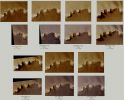
ESP_013954_1780_RED_abrowse-03~0.jpgFading Rover-Tracks near Victoria Crater59 visiteIn this composite image, we show a close-up of the Rover Tracks, as well as 6 previous HiRISE views acquired since June 2007, shortly after Opportunity’s drive.
The span encompasses over a full Mars year, from Southern Spring to the following Summer. Both the Natural Color images at the top of each sequence and the False Color below show a progressive fading of the Tracks over time.
It seems that the Tracks were initially fairly red and then become bluer; this curious effect of color-change might have been due to the weight of the Rover which caused its wheels to push dark granules of rocks and dust into the relatively bright and orangish Martian Soil.
Since then, dark sand has blown out of Victoria and partially covered the Tracks, darkening the Surface.MareKromium
|
|
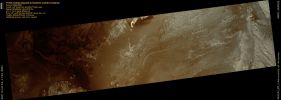
ESP_014154_1730_RED_abrowse.jpgFerric Oxide-Rich Deposit in East Candor Chasma (Natural Colors; credits: Lunexit)59 visitenessun commentoMareKromium
|
|

ESP_014351_1995_RED_abrowse.jpgSanta Fé Crater (Natural Colors; credits: Lunexit)59 visitenessun commentoMareKromium
|
|
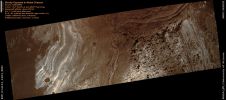
ESP_014141_1665_RED_abrowse.jpgPossible Blocky Deposits in Melas Chasma (Natural Colors; credits: Lunexit)59 visitenessun commentoMareKromium
|
|

ESP_014436_0920_RED_abrowse-00.jpgIcy Impact (CTX Frame - Natural Colors; credits: Lunexit)59 visiteA thick (approx. 3 Km or a little less than 2 miles) sequence of ice and dust, stacked like a layer cake, covers the South Pole of Mars. Impact craters that form here experience slightly different processes of modification and degradation than those that form in rocky areas.
One example of such a process is sublimation. Most of the material that makes up an icy crater is volatile, meaning it can melt or sublimate (change directly from a solid to a gas) if heated. Sublimation is more common on Mars because of its thin and dry Atmosphere.
Crater walls facing the Sun receive more direct light than their surroundings, and are therefore more easily warmed. If the ice in the walls sublimates, the rim structure of the crater becomes degraded.MareKromium
|
|

ESP_014353_1685_RED_abrowse-01.jpgLight-Toned Deposits in Noctis Labyrinthus (EDM - Natural Colors; credits: Lunexit)59 visiteCRISM observations of this Region of the Noctis Labyrinthus formation have shown indications of Iron-bearing Sulfates and Phyllosilicate (such as "clay" ----> argilla) minerals.
HiRISE observations have revealed exposed layers which are possibly the sources of the signatures seen by CRISM.
In this image, the layering can be seen on the right side of the image.
On the lower left, instead, a large Dunefield which covers other beds can also be seen.MareKromium
|
|
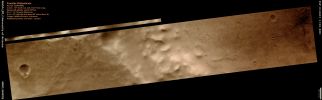
ESP_014447_1720_RED_abrowse.jpgPossible Phillosilicate (Natural Colors; credits: Lunexit)59 visitenessun commentoMareKromium
|
|
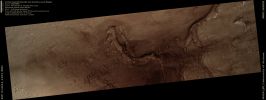
ESP_014414_2205_RED_abrowse.jpgEroded Layered Deposits near Ismenius Lacus Region (Natural Colors; credits: Lunexit)59 visitenessun commentoMareKromium
|
|

ESP_014417_0940_RED_abrowse.jpgSouth Polar Residual Cap Monitoring (Natural Colors; credits: Lunexit)59 visitenessun commentoMareKromium
|
|
| 2237 immagini su 187 pagina(e) |
 |
|
|
|
|
132 | |
|
|
|
|





