| Piú viste - Mars Reconnaissance Orbiter (MRO) |

ESP_013089_2040_RED_abrowse.jpgTooting Crater (Natural Colors; credits: Lunar Explorer Italia)59 visiteThis image is of the Ejecta Blanket of the Tooting Crater in the Northern Hemisphere of Mars.
Tooting is a "rampart" crater that is roughly 29 Km (about 18 miles) in diameter and appears to be one of the youngest craters of this size.
A "rampart crater" is one where the material ejected from the crater during impact forms lobes that end with a low ridge, or rampart. One indication of Tooting Crater's youth is its ratio of depth to width.
As a crater ages, the walls of the crater will tend to erode and debris will accumulate in the crater's floor making its apparent depth less, while also making its width larger.
One of the major features of Tooting Crater are its multiple ejecta layers that build a sequence of ramparts. The shapes of these ramparts suggest that the ejected material acted as a fluid (like mud) as it moved across the surface.
Most researchers think that such fluid ejecta indicates that there was ice in the ground when the crater formed.MareKromium
|
|
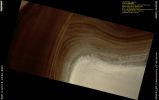
PSP_010374_2650_RED_abrowse.jpgNorth Polar Layers (Natural Colors; credits: Lunar Explorer Italia)59 visitenessun commentoMareKromium
|
|

ESP_013348_1185_RED_abrowse-00.jpgDunefield in Noachis Terra (ctx frame - Natural Colors; credits: Lunar Explorer Italia)59 visiteThis Dunefield is on the floor of a small crater in Noachis Terra, a Region located in the Southern Hemisphere of Mars.
The slip faces of the Dunes have multiple directions, indicating that there were several wind directions and changes in wind strength when the Dunes formed. The dominant Dune type are Transverse Dunes (oriented perpendicular to the prevailing wind direction), with modified Barchans (crescent-shaped dunes) in the Northern Region of the Field and incipient Linear Dunes in the Southern Region.
The bright material scattered throughout the Dune Troughs are outcrops of underlying bedrock.
The left side (Sx) of the image clearly displays a mass of Dark Dust Devil Tracks.
Dust Devils are wind funnels that suck up dust as they travel over the surface exposing the dark sandy substrate.MareKromium
|
|

ESP_012584_1265_RED_abrowse-00.jpg"Hot Surprise" in Nia Vallis (ctx frame - Natural Colors; credits: Lunexit)59 visiteImmagini orbitali come questa, nel 99,99% dei casi passano del tutto inosservate ma, come Voi sapete (e come noi abbiamo - da tempo - imparato), spesso le più grosse sorprese si annidano tra le pieghe dei frames - apparentemente - meno intriganti.
In fondo, che cosa ci mostra di particolare questo frame? Si tratta della Regione Marziana di Nia Vallis (siamo nelle medie Latitudini dell'Emisfero Australe di Marte, intorno alle coordinate 53° Sud e 323° Est) ed il dettaglio colto dagli occhi della Sonda MRO ci mostra quelli che sembrano residui di antiche (ed ormai del tutto estinte) attività fluviali su una superficie rocciosa e ricca di macigni di dimensioni medio-piccole. Nulla di più.
Eppure, una volta che il nostro Dr Faccin ha "scansionato" il frame nella sua versione JP2000, qualcosa è emersa.
Qualcosa che vedrete nel prossimo frame...MareKromium
|
|

ESP_013368_1885_RED_abrowse.jpgSmall and (relatively) fresh Impact Crater in Cerberus Palus (Natural Colors; credits: Lunexit)59 visiteThis observation shows a Lava Plain near the Martian Equator. The Lava is superposed by a small, fresh Impact Crater that is itself surrounded by boulders that were ejected from the Surface when the impact occurred.
There are dunes on the Crater Floor, indicating that the Crater has been present long enough on the Plain so that the wind has blown fine material into it and then formed small dunes.MareKromium
|
|
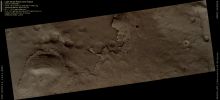
PSP_009523_2165_RED_abrowse.jpgLight-Toned Rock and Scarps (Natural Colors; credits: Lunexit)59 visitenessun commentoMareKromium
|
|

ESP_013545_1110_RED_abrowse-01.jpgSouthern Dust Devil (EDM - Natural Colors; credits: Lunexit)59 visitenessun commentoMareKromium
|
|
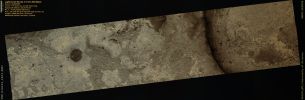
PSP_010222_1815_RED_abrowse.jpgLight-Toned Rock and Dunes in Meridiani Planum (Natural Colors; credits: Lunexit)59 visiteNote Lunexit: in questo frame, un esempio di come il processing in Natural Colors (cioè i colori che percepirebbe un essere umano il quale si trovasse in loco) possa condurre a risultati radicalmente differenti rispetto al processing in (possible) True Colors (frame precedente).
ATTENZIONE: entrambi i processing sono veritieri (nel senso di eseguiti "A Regola d'Arte" e senza alterazioni intenzionali dei dati), eppure i colori che si vedono sono PROFONDAMENTE diversi!
E' - anche - per questo motivo che la diatriba sui "Colori Veri" di un Mondo (un qualsiasi Mondo) è intrinsecamente complessa, contraddittoria e, per certi versi, anche fuorviante - oltre che, a nostro avviso, tendenzialmente infinita...).
Pensateci sopra...MareKromium
|
|

ESP_013751_1115_RED_abrowse.jpgDD Tracks in Thyles Rupes (Natural Colors; credits: Lunexit)59 visiteThe Dark Streaks are a result of a Surface-Atmosphere interaction that creates thermally-driven Vortices. These Martian Vortices are giant Dust Devils that “vacuum” the bright Surface dust revealing the darker Subsurface rock.
This image was taken in the late Southern Summer and shows that the Dust Devil direction of movement changes with the winds as the season progresses from Spring to Fall. Dust Devils are sensitive to changes in low-speed ambient winds and will follow the dominant daytime wind direction.
The direction of the Vortex is visible by the scallop pattern that is left behind as a Dust Devil will erase the front part of the circular track as it follows the wind.MareKromium
|
|

ESP_014126_2120_RED_abrowse.jpgNorthern Crater with Windstreak (Natural Colors; credits: Lunexit)59 visitenessun commentoMareKromium
|
|

ESP_012625_1720_RED_abrowse.jpgSulfate Strata in Ius Chasma (Natural Colors; credits: Lunexit)59 visite...Ed ora, dato che al peggio ed al ridicolo non c'è mai fine, ci aspettiamo che qualcuno trovi una "Scritta", da qualche parte, che indichi questi depositi di Solfati...MareKromium
|
|
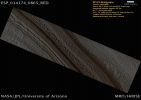
ESP_014174_0865_RED_abrowse.jpgSouth Polar Layered Deposits' (SPLD) Stratigraphy (Natural Colors; credits: Lunexit)59 visitenessun commentoMareKromium
|
|
| 2237 immagini su 187 pagina(e) |
 |
|
|
|
|
131 | |
|
|
|
|





