| Piú viste - Mars Reconnaissance Orbiter (MRO) |

ESP_011966_1700_RED_abrowse-00.jpgUplift in Oudemans Crater (Natural Colors; credits: Lunar Explorer Italia)59 visiteMars Local Time: 15:47 (middle afternoon)
Coord. (centered): 9,7° South Lat. and 268,6° East Long.
Spacecraft altitude: 258,7 Km (such as about 161,7 miles)
Original image scale range: 25,9 cm/pixel (with 1 x 1 binning) so objects ~ 78 cm across are resolved
Map projected scale: 25 cm/pixel
Map projection: EQUIRECTANGULAR
Emission Angle: 2,4°
Phase Angle: 58,3°
Solar Incidence Angle: 56° (meaning that the Sun is about 34° above the Local Horizon)
Solar Longitude: 209,4° (Northern Autumn)
Credits: NASA/JPL/University of Arizona
Additional process. and coloring: Lunar Explorer ItaliaMareKromium
|
|
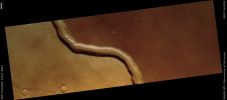
PSP_010404_1925_RED_abrowse.jpgArnus Vallis (Natural Colors; credits: Lunar Explorer Italia)59 visiteMars Local Time: 15:31 (middle afternoon)
Coord. (centered): 12,5° North Lat. and 70,0° East Long.
Spacecraft altitude: 281,5 Km (such as about 176,0 miles)
Original image scale range: 28,2 cm/pixel (with 1 x 1 binning) so objects ~ 84 cm across are resolved
Map projected scale: 25 cm/pixel
Map projection: EQUIRECTANGULAR
Emission Angle: 15,7°
Phase Angle: 66,4°
Solar Incidence Angle: 51° (meaning that the Sun is about 39° above the Local Horizon)
Solar Longitude: 142,0° (Northern Summer)
Credits: NASA/JPL/University of Arizona
Additional process. and coloring: Lunar Explorer ItaliaMareKromium
|
|
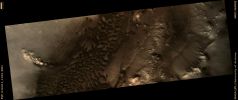
PSP_010413_1920_RED_abrowse.jpgMigrating Dunefield (Natural Colors; credits: Lunar Explorer Italia)59 visiteMars Local Time: 15:37 (middle afternoon)
Coord. (centered): 11,8° North Lat. and 185,9° East Long.
Spacecraft altitude: 280,9 Km (such as about 175,5 miles)
Original image scale range: 28,1 cm/pixel (with 1 x 1 binning) so objects ~ 84 cm across are resolved
Map projected scale: 25 cm/pixel
Map projection: EQUIRECTANGULAR
Emission Angle: 3,4°
Phase Angle: 49,6°
Solar Incidence Angle: 53° (meaning that the Sun is about 37° above the Local Horizon)
Solar Longitude: 142,4° (Northern Summer)
Credits: NASA/JPL/University of Arizona
Additional process. and coloring: Lunar Explorer ItaliaMareKromium
|
|
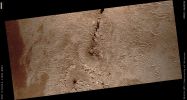
PSP_010414_1900_RED_abrowse.jpgVolcanic Vent near Athabasca Valles (Natural Colors; credits: Lunar Explorer Italia)59 visiteMars Local Time: 15:32 (middle afternoon)
Coord. (centered): 9,6° North Lat. and 157,3° East Long.
Spacecraft altitude: 286,1 Km (such as about 178,8 miles)
Original image scale range: 28,6 cm/pixel (with 1 x 1 binning) so objects ~ 86 cm across are resolved
Map projected scale: 25 cm/pixel
Map projection: EQUIRECTANGULAR
Emission Angle: 15,8°
Phase Angle: 67,1°
Solar Incidence Angle: 52° (meaning that the Sun is about 38° above the Local Horizon)
Solar Longitude: 142,4° (Northern Summer)
Credits: NASA/JPL/University of Arizona
Additional process. and coloring: Lunar Explorer ItaliaMareKromium
|
|
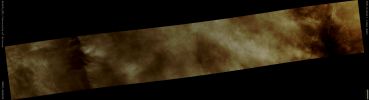
PSP_010417_1460_RED_abrowse.jpgUnnamed Crater in Hellas Planitia (Natural Colors; credits: Lunar Explorer Italia)59 visiteMars Local Time: 15:49 (middle afternoon)
Coord. (centered): 33,5° South Lat. and 83,0° East Long.
Spacecraft altitude: 260,8 Km (such as about 163,0 miles)
Original image scale range: 52,2 cm/pixel (with 1 x 1 binning) so objects ~ 1,57 mt across are resolved
Map projected scale: 50 cm/pixel
Map projection: EQUIRECTANGULAR
Emission Angle: 9,3°
Phase Angle: 66,2°
Solar Incidence Angle: 73° (meaning that the Sun is about 17° above the Local Horizon)
Solar Longitude: 142,5° (Northern Summer)
Credits: NASA/JPL/University of Arizona
Additional process. and coloring: Lunar Explorer ItaliaMareKromium
|
|

SouthPolarSpiders-PIA11858.jpgStarburst Spiders (Natural Colors; credits: Lunar Explorer Italia)59 visiteCaption NASA:"Mars' Seasonal Cap of Carbon Dioxide (CO2) ice has eroded many beautiful terrains as it sublimates (meaning that goes directly from ice to vapor) every Spring.
In the region where the High Resolution Imaging Science Experiment (HiRISE) camera on NASA's Mars Reconnaissance Orbiter took this image, we see Troughs (---> canali) that form a Starburst Pattern (---> disegno a forma di stella che esplode). In other areas these Radial Troughs have been refered to as "Spiders", simply because of their shape. In this Region the pattern looks more dendritic as channels branch out numerous times as they get further from the center.
The Troughs are believed to be formed by gas flowing beneath the seasonal ice to openings where the gas escapes, carrying along dust from the surface below. The dust falls to the surface of the ice in fan-shaped deposits.
This image, covering an area of about 1 Km (approx. 0,6 mile) across, is a portion of the HiRISE observation catalogued as ESP_011842_0980, and taken on Feb. 4, 2009.
The observation is centered at 81,8° South Latitude and 76,2° East Longitude. MLT was 16:56 and the scene is illuminated from the West with a Solar Incidence Angle of 78° (meaning that the Sun was about 12° above the Local Horizon).
At a Solar Longitude of 203,6°, the season on Mars is Northern Autumn".MareKromium
|
|

ESP_011345_0950_RED_abrowse.jpgSmall Fan-like Surface Features on the South Polar Perennial Cap (Natural Colors; credits: Lunar Explorer Italia)59 visiteMars Local Time: 17:54 (late afternoon)
Coord. (centered): 84,8° South Lat. and 339,3° East Long.
Spacecraft altitude: 247,7 Km (such as about 154,8 miles)
Original image scale range: 99,1 cm/pixel (with 1 x 1 binning) so objects ~ 2,97 mt across are resolved
Map projected scale: 1 mt/pixel
Map projection: EQUIRECTANGULAR
Emission Angle: 0,9°
Phase Angle: 88,7°
Solar Incidence Angle: 89° (meaning that the Sun is about 1° above the Local Horizon)
Solar Longitude: 181,0° (Northern Autumn)
Credits: NASA/JPL/University of Arizona
Additional process. and coloring: Lunar Explorer ItaliaMareKromium
|
|

ESP_011403_1905_RED_abrowse.jpgCone at the Source of Athabasca Valles (Natural - but strongly enhanced - Colors; credits: Lunar Explorer Italia)59 visiteMars Local Time: 15:50 (middle afternoon)
Coord. (centered): 10,2° North Lat. and 157,4° East Long.
Spacecraft altitude: 278,4 Km (such as about 174,0 miles)
Original image scale range: 27,8 cm/pixel (with 1 x 1 binning) so objects ~ 84 cm across are resolved
Map projected scale: 25 cm/pixel
Map projection: EQUIRECTANGULAR
Emission Angle: 7,7°
Phase Angle: 50,7°
Solar Incidence Angle: 58° (meaning that the Sun is about 32° above the Local Horizon)
Solar Longitude: 183,6° (Northern Autumn)
Credits: NASA/JPL/University of Arizona
Additional process. and coloring: Lunar Explorer ItaliaMareKromium
|
|
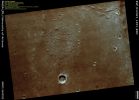
ESP_012425_1455_RED_abrowse.jpgUnusually-looking "Circular Surface Feature" (possible True Colors; credits: Dr G. Barca)59 visiteThis circular feature is a collection of hills, with some connected by ridges. The circularity suggests that perhaps there was once an impact crater here that was subsequently filled with material which was somehow more resistant to erosion than the landscape around it. Over time, as erosion stripped away the ground, the fill material was left standing higher (although it has clearly been eroded as well).
Nota Lunexit: si tratta di un "Exhumed Crater", ossìa di un cratere prima ricoperto da detriti e sedimenti e poi, a seguito di azioni prevalentemente eoliche (un vero e proprio scorticamento del suolo), è stato riportato - parzialmente - alla luce. Lo scorticamento che evidenzia il cratere sepolto è indice del fatto che i materiali i quali lo avevano ricoperto erano più resistenti e stabili dei materiali che circondano il cratere stesse (i quali, appunto, sono stati smossi dai venti). Un fenomeno similare, ma relativo ai canali, dà luogo ai cosiddetti "Inverted Channels", di cui si è già parlato in passatoMareKromium
|
|

ESP_012270_2035_RED_abrowse.jpgFlood-Carved Rock in Olympica Fossae (Natural Colors; credits: Lunar Explorer Italia)59 visiteThis HiRISE image is part of the Olympica Fossae in the Tharsis Region of Mars.
Tharsis is most famous for being the home of the four largest Volcanoes in the Solar System. However, the Region also hosts a variety of other geologic features formed as the ground deformed under the tremendous weight of the Volcanoes.
Most of the Fissures (or “Fossae”) in the Region are primarily places where the ground was pulled apart. However, the Olympica Fossae are somewhat different. They are oriented at an angle to the other Fissures suggesting that some other process was important in their formation.
A close-up image reveals that erosion by one or more catastrophic floods may have played a key role.
The teardrop shaped islands and the parallel ridges are rock left standing after the flood erosion. However, the deepest depression running basically East-West through the middle of the image was probably caused by tectonic extension, not flood erosion. This juxtaposition of tectonic and flood-carved valleys is visible elsewhere on Mars, suggesting that it may be common for the tectonic fracturing to release copious volumes of subterranean water.MareKromium
|
|

ESP_011664_2015_RED_abrowse-00.jpgAt the base of Olympus Mons... (ctx frame - Natural Colors; credits: Lunar Explorer Italia)59 visiteThis image is located at the foot of the largest volcano of the Solar System: Olympus Mons.
The entire scene is covered with a multitude of Lava Flows. Most of the Flows consisted of relatively sticky lava that froze after flowing for only a short distance (often less than 1 Km, or about 1/2 a mile). However, a few of the Flows were more fluid and actually drained out of their Channels, leaving Troughs with distinct levees. These “Channelized” Flows extend out of the HiRISE image so they must be at least several kilometers (a few miles) long.
In all likelihood, both the short and long Lava Flows have very similar chemical compositions.
Based on experience with Lava Flows on Earth, the Channelized Flows were probably fed by more vigorous eruptions. That is, the Lava Flow was fed so quickly that the lava traveled a long distance before it solidified. With the shorter flows, a slow dribble of lava froze before going more than the equivalent of a few city blocks.MareKromium
|
|

ESP_012435_2015_RED_abrowse.jpgBranched Features on the Floor of Antoniadi Crater (Natural Colors; credits: Lunar Explorer Italia)59 visiteThe dark branched features in the floor of Antoniadi Crater look like giant ferns, or fern casts. However, these ferns would be several miles in size and are composed of rough rocky materials.
A more likely hypothesis is that this represents a channel network that now stands in inverted relief. The channels may have been lined or filled by indurated materials, making the channel fill more resistant to erosion by the wind than surrounding materials. After probably billions of years of wind erosion the resistant channels are now relatively high-standing. The material between the branched ridges has a fracture pattern and color similar to deposits elsewhere on Mars that are known to be rich in hydrated minerals such as clays.
The inverted channels have short, stubby branches characteristic of formation by groundwater sapping. Spring water seeps into the channels and undercuts overlying layers which collapse, so the channels grow headward. These images tell the story of an ancient wet environment on Mars, where life could have been possible. Ancient Martian life was most likely to consist of microorganisms rather than giant tree ferns.
MareKromium
|
|
| 2237 immagini su 187 pagina(e) |
 |
|
|
|
|
129 | |
|
|
|
|





