| |

| Piú viste - Mars Reconnaissance Orbiter (MRO) |

Psp_001700_2505_red-01.jpgThe "Frozen Lake" of Vastitas Borealis...is not a Lake, according to NASA (EDM - Enhanced Natural Colors; credits for the additional process. and color.: Dr Paolo C. Fienga - Lunexit Team)59 visiteThis EDM shows the Dunes and Frost boundary up-close. The Frost is largely absent over the Dunes and is more stable over the ground that does not have dune-shaped landforms.
|
|

Psp_001697_1390_red.jpgUnnamed (and yet beautiful) Crater with Gullies in Terra Sirenum59 visiteThis image shows part of an unnamed crater, itself located inside the much larger Newton Crater, in Terra Sirenum. This unnamed crater is approx. 7 Km in diameter (over 4 miles) and some 700 mt (about 760 yards) deep.
Numerous gully systems are visible on the East- and South-facing walls of the crater; their characteristics are astonishingly diverse, though.
These troughs are extremely rectilinear, lack tributaries and do not seem to have terminal fan deposits: they terminate rather abruptly, some of them in a spatula-like shape. Their characteristics contrast sharply with those of gully systems elsewhere in this same crater, which are sinuous, have numerous tributaries and show distinct fan deposits.
HiRISE is unveiling the large diversity exhibited by Martian Gully Systems, thanks to its HR, stereo and color capabilities. These diverse types of gullies observed may have been produced by different mechanisms. Current leading hypotheses explaining the origin of gullies include erosion from seepage or eruption of water from a subsurface aquifer, melting of ground ice, or surface snow; and dry landslides. MareKromium
|
|

Psp_001503_2180_red-02.jpgTricks of the Light, Tricks of the Surface... (extra-detail mgnf - 3)59 visitenessun commento
|
|
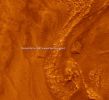
Psp_002098_2220_red-01.jpgMantles and Flows in Moreux Crater, with a "small" Surface Anomaly (EDM - False Colors)59 visiteSegnalataci dal Dr Barca (ottimo "occhio"!), la possibile Anomalìa di Superficie si sostanzia in una traccia di colore scuro che ci appare incongrua, nella sua direzione, rispetto alle altre fratture (anche modeste) della superficie ripresa, rispetto alla generale direzione assunta da dune e ripples e rispetto a tutte le altrei stratificazioni visibili.
Di che si tratta? Potrebbe essere un image-artifact (la definizione del frame, sebbene eccellente, non è tale da consentirci di escludere l'ipotesi del vizio fotografico), così come potrebbe trattarsi di una recente frattura del suolo (magari di origine sismica) o anche di uno "scalino" roccioso (un layer sedimentario parzialmente esumato).
Certo, se fossimo degli Eso-Archeologi illuminati ed immaginifici, ci saremmo già diretti verso l'ipotesi (decidete Voi se è "esotica" o meno) della "possibile evidenza di una struttura superficiale artificiale".
Ma noi non siamo Eso-Archeologi.
E, purtroppo, non siamo neppure illuminati ed immaginifici, però...però, se proprio dovessimo "azzardare"...diremmo che il rilievo scuro, in questo frame, potrebbe anche essere un'ombra. Di che cosa? Beh, questo "azzardatelo" Voi!...
|
|
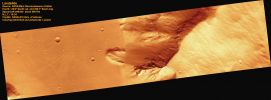
PSP_003516_1540_RED_browse.jpgLarge (and VERY Old) Landslide Deposit59 visiteThis HiRISE image is centered on a large landslide which formed the large lobe at the base of the steep slope. This is material which was transported in a massive rock-slide.
The landslide has several ridge-and-trough lineations in the direction of the flow. These occur in similar landslides on Earth as well. Comparing these features on Mars with similar examples on Earth helps geologists better understand how they work on both Planets.
In this case, the slide is relatively old.
The material has many impact craters superimposed. The steep slope, which was the source of the landslide, has undergone further erosion, so the landslide source area is no longer clear. MareKromium
|
|
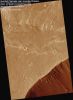
PSP_003223_1755_RED_browse.jpgInverted Channels Near Juventae Chasma59 visiteThis image shows several long, sinuous features on the plains near Juventae Chasma. These features have been explained as former stream channels now preserved in inverted relief.
Inverted relief occurs when a formerly low-lying area becomes high-standing. For instance, depressions may become filled with lava that is more resistant to erosion. In the case of stream channels, there are several possible reasons why the channel might stand out in inverted relief. The streambed may contain larger rocks, which remain while fine material is blown away by the wind, or it could be cemented by some chemical precipitating from flowing water.
These features are old, since several impact craters cut the ridges. They provide important information about past processes on Mars. Understanding how streams could have formed is an important issue in understanding the history of water on Mars.MareKromium
|
|
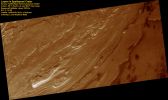
PSP_003442_1215_RED_browse-00.jpgLayers in Spallanzani Crater (context image)59 visiteThis image shows light-toned layered deposits along the floor of Spallanzani crater, a 72 Km (about 45 mile) diameter crater located just South-East of Hellas Planitia.
These layered deposits may be remnant sediments once deposited within the crater. Mechanisms for sediment deposition include windblown debris, airfall volcanic ash, or sediments that accumulated in a lake on the crater floor.
The slopes are covered in debris, and not fallen plates or blocks from the plateau edge.
This suggests that the layers are composed of weak materials that are protected by a stronger, more coherent surface.
The crater is named after the 18th Century Italian biologist, Lazzaro Spallanzani (1729-1799).
MareKromium
|
|
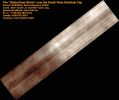
PSP_004353_0935_RED_browse.jpgThe "Global Dust Storm" over the South Polar Residual Cap59 visiteA dust storm has been raging on Mars, hampering the ability of the HiRISE team to carry out a seasonal monitoring campaign.
An area of the Southern Seasonal Polar Cap was selected in December 2006 for repeated imaging, to observe the sublimation (evaporation) of the seasonal Carbon Dioxide Polar Cap through Southern Spring.
Images collected as the season progressed show channels carved by escaping gas and fans of dust blown by the wind. This campaign has been stymied however by the arrival of a Martian dust storm. In this image the surface is completely obscured by the dust in the air.MareKromium
|
|

PSP_004324_1060_RED_browse.jpgPolygons on South Polar Layered Deposits59 visiteThis image shows an exposure of south polar layered deposits, thought to record recent global climate changes on Mars.
The layers were probably laid down over the past few million years over a large area near the south pole, then eroded to show the layering visible in this image.
The layers appear brighter where their slopes are steeper and facing the Sun.
Within the brighter, steeper part of the layered deposits, a network of polygonal fractures is visible. The polygons outlined by the fractures are typically a few hundred meters (approx. 1000 feet) across, and traverse layer boundaries. Such polygonal fractures are seen on Earth in places where ground ice is present, and previous Mars orbiters have found evidence for abundant ground ice in the south polar region of Mars. So it is not surprising to see polygonal fractures here; what is unusual is that they cross layer boundaries, apparently unaffected by the changes in slope across them.
This suggests that the polygonal fractures formed after the scarp exposing the south polar layered deposits was formed by erosion. This indicates, possibly, that the scarp has been stable for some time, allowing the polygonal fractures to form.
MareKromium
|
|
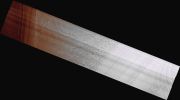
PSP_004664_0955_RED_browse.jpgOutcrops of Layers in the South Polar Layered Deposits59 visiteThis image spans a section of the South Polar Layered Deposits (SPLD). The SPLD are composed of layers of water ice mixed with impurities (probably mostly dust). The most similar terrestrial analog to the SPLD are ice sheets, like those covering most of Greenland and Antarctica.
The materials of ice sheets are deposited by freezing of atmospheric water vapor on dust particles and precipitation of those water/dust particles (snow), by direct condensation (freezing) of atmospheric water vapor onto the surface, and by fallout of dust. Together, these processes cause an ice sheet to undergo accumulation (build-up). Ablation (removal of material, also called erosion) of an ice sheet can also occur. If more accumulation happens than ablation, the ice sheet grows; if reversed, the ice sheet shrinks, as is the case for many of Earth’s glaciers due to global warming. Each year, the amount of accumulation and ablation varies, so layers of different thicknesses and different amounts of impurities (dust) will be deposited onto the ice sheet.
Volcanic eruptions anywhere on the planet can also potentially spew ash high into the atmosphere, where it can travel great distances and fall onto an ice sheet surface. Later accumulations of water ice can then trap this volcanic ash as a layer within the ice sheet. Thus, layers in an ice sheet can originate through a variety of means and occur at a variety of scales (thicknesses).
This particular image is interesting because many layers are exposed and because more than one outcrop (exposure of layering) is visible—at the top of the image and at the bottom. You can imagine the outcrops at the top and bottom of the image as if you are looking down on a staircase. The approximately horizontal lines are the edges of the layers (the risers), and the flat areas between them are the layer surfaces (the flat parts of the steps). The middle of the image is the top of the staircase. At the bottom, the staircase of layers goes down again.
The layers in this image are on the scale of meters (several to tens of feet) in thickness and are much thicker than one might expect from annual accumulation (which might be about 0.5 millimeters per year, or 0.02 inch per year). So the layers we see in this image may be packages of thinner, annual layers. The reason that we can distinguish between different packages of annual layers (in other words, the reason that we can see layering at this scale) is because the rates of accumulation and ablation change not only yearly, but also on much longer time scales. Imagine drilling into the SPLD and looking at the walls of the hole with a microscope. Within the large-scale layering we see in this image, we might see annual accumulation layers, dusty layers created during large dust storms, and maybe even volcanic ash layers.MareKromium
|
|

PSP_003252_1425_RED_browse-02.jpgBright Gully Deposit in Terra Sirenum (the "gully" - close-up; false colors)59 visiteThe bright gully deposit has a very fluid-like appearance, and has not been covered by other gullies or debris flows, indicating a young age. The brightness is a mystery; it could be due to minerals formed from water or ice.
Alternatively, the flow that made the gully may have removed a thin coating of relatively darker dust and soil, revealing a brighter substrate.
In any case, this feature is probably indicative of recent flow of water or water-rich material on Mars.MareKromium
|
|

PSP_003948_0935_RED_browse.jpgSouth Pole Residual Cap (Swiss-Cheese Terrain Monitoring)59 visiteLike Earth, Mars has concentrations of water ice at both Poles. Because Mars is so much colder however, Carbon Dioxide (CO2) ice is deposited at high latitudes in the Winter and is removed in the Spring, analogous to winter-time water ice/snow on Earth.
Around the South Pole there are areas of this CO2 ice that do not disappear every Spring, but rather survive Winter after Winter; this persistent CO2 ice is called the "South Pole Residual Cap".
The retention of CO2 ice throughout the year by the Southern Polar Cap is one characteristic that distinguishes it significantly from Mars' North Polar Cap.
As can be seen in this HiRISE image of the south pole residual cap, relatively high-standing smooth material is broken up by circular, oval, and blob-shaped depressions. This patterned terrain is called "swiss cheese" terrain. The high-standing areas are carbon dioxide ice with thicknesses of several to approximately 10 meters. The depressions are thought to be caused by the removal of this carbon dioxide ice by sublimation (the change of a material from solid directly to gas). As most depressions seem to have relatively flat floors, there is likely some layer below, possibly made of water ice, that cannot be as easily removed by sublimation. Complicated shapes arise when neighboring growing depressions intersect.
A previous Mars imaging system, the Mars Orbiter Camera (MOC), took images of the same places on the south pole residual cap every year for many years, and showed that there are annual changes taking place within it. By looking at different sizes and shapes of depressions in an image such as this, and by comparing images of the same place from year to year, the development of "swiss cheese" terrain can be described. The sublimation process may begin as a small, shallow depression in a smooth surface. This depression then deepens until reaching the resistant layer below, and continues to expand laterally in all directions, creating the generally round depressions we see today. Different heights and thicknesses of smooth areas, and different depths of depressions, may indicate that multiple episodes of accumulation and sublimation have occurred.
This is one of the locations previously monitored at lower resolution by MOC. With the high resolution and repeat-imaging capability of HiRISE, we intend to continue monitoring and better measure the amount of expansion of the depressions over one or more Mars years. This is one of the locations specifically targeted by HiRISE for this purpose.
Knowing the amount and rate of carbon dioxide removal can give us a better idea of the role of carbon dioxide (the main component of the Martian atmosphere) in polar and atmospheric processes, of current environmental and climatic conditions, and of how Mars climate may be changing.
In HiRISE images such as this one, it is evident on the slopes of the large, especially high mesa just above the center of the image that the carbon dioxide-rich material may be constructed of several individual horizontal layers. However, it also appears that as erosion eats into the mesa, pieces of a stronger mesa surface layer break off and are left strewn on the mesa slopes, where they may give the appearance of layering.
An interesting feature in this HiRISE image is the crisscrossing network of faint ridges and troughs on the upper smooth terrain. These may also be complexly involved in the sublimation and deposition of carbon dioxide ice. MareKromium
|
|
| 2237 immagini su 187 pagina(e) |
|
|
|
|
|
127 | |
|
|
|
|
|
|





