| Piú viste - Mars Reconnaissance Orbiter (MRO) |

Craters-Becquerel_Crater_mound_6m-04.jpgBeautiful Becquerel Crater (5)59 visitenessun commento
|
|

TRA_000828_2495_IRB-2.jpgPolygonal Terrain (2)59 visiteImage TRA_000828_2495 was taken by the High Resolution Imaging Science Experiment (HiRISE) camera onboard the Mars Reconnaissance Orbiter spacecraft on September 30, 2006. The complete image is centered at 69,3° North Latitude and 130,2° East Longitude. The range to the target site was 315 Km (199 miles). At this distance the image scale is 32 cm/pixel (with 1 x 1 binning) so objects ~96 cm across are resolved. The images shown here has been map-projected to 75 cm/pixel and North is up. The image was taken at a local Mars time of 3:01 PM and the scene is illuminated from the West with a solar incidence angle of 53,4°, thus the Sun was about 35,1° above the horizon. At a Solar Longitude of 113,7°, the season on Mars is Northern Summer / Southern Winter.
|
|

TRA_000840_2750_IRB-005.jpgChasma Boreale (5)59 visitenessun commento
|
|

TRA_000840_2750_IRB-008.jpgChasma Boreale (7)59 visitenessun commento
|
|

TRA_000828_1805_IRB-04.jpgYardangs in Medusae Fossae (4)59 visitenessun commento
|
|
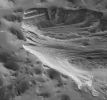
Juventae_Chasma_12m-00.jpgFeatures of Juventae Chasma (1)59 visiteCaption NASA originale:"This image shows a mound of layered rock within the large depression Juventae Chasma (3,5° South Lat. and 61,9° West Long.) known from data from the Omega spectrometer on the Mars Express mission to have sulfate minerals mixed within it. The clear expression of layering in the CTX image and the potential for correlation with MRO-CRISM hyper-spectral data open the possibility of relating specific beds to specific compositions, indicating the nature of the depositional environment and subsequent alteration".
|
|

Craters-Holden_Crater-04.jpgThe beautiful "Holden Crater" (4)59 visitenessun commentoMareKromium
|
|

Craters-Holden_Crater-01.jpgThe beautiful "Holden Crater" (1)59 visitenessun commentoMareKromium
|
|

Hesperia_Planitia-TRA_000882_1595_RED-01.jpg"Fresh" Crater and unusual surface details in Hesperia Planitia (EDM - Extremely Enhanced and Saturated Natural Colors; credits for the additional process. and color.: Dr Paolo C. Fienga - Lunexit Team)59 visiteIl rilievo la cui albedo è tale da renderlo visibile anche in un'area ombreggiata (Sx del frame) non è risolvibile e, purtroppo, rimane inesplicabile; il rilievo posto a Dx, invece, lo risolviamo, applicando un ultra-detail mgnf, in un "boulder colonnare" (una surface feature spettacolare e molto rara, ma non necessariamente una Surface Anomaly in senso tecnico.
Semmai, ci domandiamo "da dove" possa provenire il boulder colonnare in oggetto e la nostra ipotesi è che potrebbe trattarsi di un ejecta.
|
|

Elysium_Planitia-Tra_000867_1875_red-01.jpgFresh Crater Cluster in Elysium Planitia (EDM - False Colors)59 visiteImage TRA_000867_1875 was taken by the High Resolution Imaging Science Experiment (HiRISE) camera onboard the Mars Reconnaissance Orbiter spacecraft on October 3, 2006. The complete image is centered at 7,4° North Latitude and 157,3 East longitude. The range to the target site was 274,6 Km (171,6 miles).
At this distance the image scale ranges from 54,9 cm/pixel (with 2 x 2 binning) to 109,9 cm/pixel (with 4 x 4 binning).
The image has been map-projected to 50 cm/pixel and north is to the right.
The image was taken at a Local Mars Time of 3:26 PM and the scene is illuminated from the West with a solar incidence angle of 52°, thus the Sun was about 38° above the horizon.
At a Solar Longitude of 115,1°, the season on Mars is Northern Summer.MareKromium
|
|

Northern_Plains-Psp_001380_2520_red-01.jpgAnother "Frozen Lake" in the Northern Plains? (2 - EDM - False Colors; credits for the additional process. and color.: Dr Paolo C. Fienga - Lunexit Team)59 visitenessun commentoMareKromium
|
|

Terra_Sirenum-PIA09101-01.jpgSeasonal frost in Terra Sirenum (according to Lunexit)59 visitenessun commentoMareKromium
|
|
| 2237 immagini su 187 pagina(e) |
 |
|
|
|
|
126 | |
|
|
|
|





