| Piú viste - Mars Reconnaissance Orbiter (MRO) |
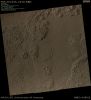
PSP_001456_2010_RED_abrowse.jpgFlood-carved Canyon in Kasei Valles (Natural Colors; credits: Lunexit)60 visiteThis HiRISE image shows a wonderfully complex surface on the floor of this ancient Flood-carved Canyon.
The floor of this Canyon, now, does not show any kind of landform that scientists expect to see from the occurrence of flood erosion phenomena.
Instead, it appears that the floor of the valley has been covered, after the inundation that first designed it, by another flow made by some very dense material that also contained huge ridged plates.
Some of the plates are more than 1 Km (0,6 miles) across. The ridges appear to have formed when the solid crust on the flow crumpled; the plates are pieces of the crust that were rafted apart.
Actually, very large Lava Flows can produce a surface like this, but also water-ice and frozen mud can create similar features.MareKromium
|
|
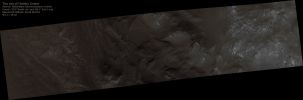
PSP_003710_1530_RED_browse~0.jpgHolden Crater's Rim (Natural Colors; credits: Lunexit)60 visiteThe formation of the approximately 150 Km diameter Holden Crater interrupted the Northward flowing Uzboi Vallis Channel System. Relief associated with the Rim of Holden effectively blocked the Channel.
HiRISE image PSP_003710_1530 covers the portion of Holden Crater's Rim where it was overtopped by water that had backed up in Uzboi Vallis to the South. Water flowing over the Rim in multiple locations eventually focused on a single Channel that then cut deeply into the Rim.
After the impounded water drained into the Crater, the steep Wall on the East side of the main Channel collapsed in a Landslide that remains visible along the Floor.
Several Outcroppings of variably bright material are visible in the scar produced by the Slide. MareKromium
|
|

ESP_014423_1040_RED_abrowse.jpgSouth Polar Region (Natural Colors; credits: Dr Paolo C. Fienga - Lunexit Team)60 visiteSomewhere in this patterned landscape, less than 1000 Km (about 600 miles) from the South Pole of Mars, a treasure may be hiding.
In January 1999, NASA launched a rocket containing the Mars Polar Lander (MPL), an exploration vehicle with a weather station and a subsurface probe designed to search for water ice, towards the Layered Terrain near the Martian South Pole. The layers are thought to be a sequence of alternating dust-rich and dust-poor ice deposited by the seasonal advance and retreat of the South Polar Ice Cap and could be an important record of climate on the Red Planet.
On 3 December 1999, just before the Lander entered the Martian Atmosphere, MPL went silent. Investigations propose the most likely cause of the mission failure is that the Spacecraft’s computers misinterpreted the release of the Lander’s legs in preparation for descent as touch-down on the Martian Surface, causing descent engines to shut off when the lander was still 40 meters (130 feet) above ground.
However, no one knows for sure.
An immediate search began for the remains of the MPL using images from Mars Global Surveyor. HiRISE is continuing the search with high resolution images of the area in which MPL could, most likely, have crash-landed. MareKromium
|
|
ESP_015962_1695_RED_abrowse-01.jpgRelatively fresh Impact Crater (EDM n.1 - Natural Colors; credits: Dr Paolo C. Fienga - Lunexit Team)60 visitenessun commentoMareKromium
|
|
ESP_016022_1420_RED_abrowse-01.jpgThe Floor of Hellas Basin (EDM - Natural Colors; credits: NASA/JPL and Dr Paolo C. Fienga - Lunexit Team)60 visitenessun commentoMareKromium
|
|
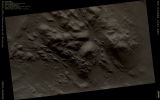
PSP_010888_2030_RED_abrowse.jpgMojave Crater's Floor and Central Uplift (Natural Colors; credits: Dr Paolo C. Fienga - Lunexit Team)60 visiteThis observation shows a portion of the Central Uplift structure in Mojave Crater.
Central Uplifts are a typical feature of large Impact Craters on Earth, Moon and Mars; craters larger than 6 or 7 Km in diameter on Mars typically form this mountain-like peak in the central portion of the crater interior.
This Peak consists of rocks originating from several kilometers beneath the pre-impact surface.
Mojave has a very prominent Central Uplift as it has a diameter of about 60 Km (apprx. 37 miles). In this image, boulders as large as about 15 meters (50 feet) across have been eroded from the massive uplifted rock and have rolled downslope. Fine-grained debris has also collected in the topographic lows, and has been shaped by the wind into Dunes and Ripples.
Notably absent from this image are the striking Drainage Channels and Alluvial Fans that are abundant on the wall-terraces and ejecta of Mojave Crater (see PSP_001415_1875). These features were likely formed by Surface Runoff of liquid water, which may have been released from the Subsurface during the impact event that formed Mojave.
Previously, it had been suggested that a brief, torrential downpour over Mojave Crater delivered the water. However, Mars Orbiter Camera's (MOC) images of Mojave's Central Uplift have previously shown no evidence for Surface Runoff, and the higher resolution of this HiRISE image confirms that this part of the Crater appears untouched by liquid water.
So the question remains: by what means was the water, in the form of Runoff, supplied to Mojave? This question, in addition to several others regarding this phenomenon, are currently being investigated by the HiRISE team and their collaborators.MareKromium
|
|
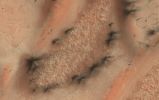
ESP_016032_2600_RED_abrowse-02.jpgNorthern Spring (EDM - Natural Colors; credits: NASA/JPL/Univ. of Arizona)60 visitenessun commentoMareKromium
|
|

Volcanoes-Olympus_Mons-PIA12992.jpgOlympus' Edge (Extremely Enhanced Absolute Natural Colors; credits for the additional process. and color.: Dr Paolo C. Fienga - Lunexit Team)60 visiteThis image covers the Northern Edge of the largest Volcano of the Solar System: Olympus Mons.
The margin of Olympus Mons is defined by a massive Cliff which is several kilometers tall. At this location, the Cliff is nearly 7 Km (about 23.000 feet) tall.
The Cliff exposes the guts of the volcano, revealing interbedded hard and soft layers. The hard layers are Lava and the soft layers may be Dust (from large Dust Storms) or Volcanic Ash.
The High Resolution Imaging Science Experiment (HiRISE) camera on NASA's Mars Reconnaissance Orbiter recorded this image on March 2, 2010.
Most scientists think the the Cliffs formed by Landslides. This collapse is driven by the weight of the huge volcano exceeding the strength of the rocks it is built of.
This image covers a swath of ground about 1 Km (such as approx. two-thirds of a mile) wide. It is a portion of HiRISE observation ESP_016886_2030, which is centered at 22,95° North Lat. and 224,76° East Long. The season on Mars is Northern-Hemisphere Spring.
Other image products from this observation are available at http://hirise.lpl.arizona.edu/ESP_016886_2030.MareKromium
|
|
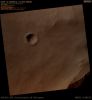
ESP_018094_1720_RED_abrowse.jpgRelatively recent Impact Crater in Meridiani Planum (Absolute Natural Colors; credits: Dr Paolo C. Fienga - Lunexit Team)60 visiteThe approximately 650-mt (2135 foot) diameter Crater in this image is relatively fresh, as evidenced by its sharp Rim and unmodified shape. Ejecta appears on top of pre-existing craters, and stands out against the background, again indicating relative youth.
However, there is something else interesting about the ejecta for this Crater: it is butterfly-shaped, with much more expansive ejecta along one axis, and much less along the other one.
Butterfly-shaped ejecta indicate that the body that caused the crater struck Mars at an oblique (or very shallow) angle. When this happens, the crater shape may be elliptical, although round craters can result from oblique impacts, too. During an oblique impact, much more ejecta is thrown out perpendicular to the direction of impact, and relatively little material is ejected along the impactor's trajectory.
Oblique impacts are relatively rare, and so a fresh, oblique impact like this one is an attractive target.MareKromium
|
|

PSP_001936_1370_RED_abrowse-01.jpgScarp and Channels in a Crater in Terra Cimmeria (Natural Colors; credits: Dr Paolo C. Fienga - Lunexit Team)60 visitenessun commentoMareKromium
|
|
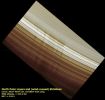
Psp_001488_2665_red.jpgNorth Polar Layers and WInd-caused Striations (Natural Colors; credits for the additional process. and color.: Dr Paolo C. Fienga - Lunexit Team)60 visitenessun commentoMareKromium
|
|

Dunes-PIA13268-PCF-LXTT.jpgDunes in Richardson Crater (EDM - Natural Colors; credits for the additional process. and color.: Dr Paolo C. Fienga - Lunexit Team)60 visiteThis observation from NASA's Mars Reconnaissance Orbiter (MRO) is a view of the Sand Dunefield in Richardson Crater, still partually covered with seasonal frost.
This EDM is a close-up view of defrosting patterns on the Dunes. The frost is a combination of frozen CO2 and some water ice that covers the Dunes in the Winter and Spring. As the seasonal frost sublimes away, odd features such as spots, fans, and streaks form.
Small dark streaks on the dune slip-face slopes may be where recent avalanches of sand, or perhaps wind, has moved the dark sand underlying the frost, or where frost has been removed to expose the sand. Alternatively, the dark streaks may be patches of coarse-grained ice that are clear enough so that the dark material below the ice is visible.
The slip-faces indicate the general direction of sand transport.
It has been hypothesized that the Dark Spots and Fans may be "geysers" or "cold gas jets" that form when sublimation processes trap gas at the bottom of the ice. The gas is released through cracks in the ice, entraining dust from below the ice and scattering it onto the Surface to form the Dark Spots and Fans.MareKromium
|
|
| 2237 immagini su 187 pagina(e) |
 |
|
|
|
|
124 | |
|
|
|
|





