| Piú viste - Mars Reconnaissance Orbiter (MRO) |
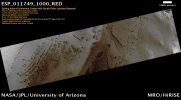
ESP_011749_1000_RED_abrowse.jpgSpring View of Unnamed Crater with South Polar Layered Material (Natural Colors; credits: Lunar Explorer Italia)60 visitenessun commentoMareKromium
|
|

ESP_012562_1545_RED_abrowse.jpgLight-Toned Rugged Intercrater Area in Viking Images 637A36 and 635A94 (Natural Colors; credits: Lunar Explorer Italia)60 visitenessun commentoMareKromium
|
|

Craters-Victoria_Crater-PIA12167.jpgVictoria Crater (Natural Colors; credits: Lunexit)60 visiteThis image of Victoria Crater in the Meridiani Planum Region of Mars was taken by the High Resolution Imaging Science Experiment (HiRISE) camera on NASA's Mars Reconnaissance Orbiter at more of a sideways angle than earlier orbital images of this feature.
The camera pointing was 22° East of straight down, yielding a view comparable to looking at the landscape out an airplane window. East is at the top. The most interesting exposures of geological strata are in the steep walls of the Crater, difficult to see from straight overhead.
Especially prominent in this oblique view is a bright band near the top of the Crater wall.
Earlier HiRISE images of Victoria Crater supported the exploration of this Crater by NASA's Opportunity Rover and contributed to joint scientific studies. Opportunity explored the Rim and interior of this 800-meter-wide (about 0,5-mile-wide) Crater from September 2006 through August 2008.
The Rover's on-site investigations indicated that the bright band near the top of the Crater wall was formed by diagenesis (chemical and physical changes in sediments after deposition). The bright band separates bedrock from the material displaced by the impact that dug the Crater.
This view is a cutout from a HiRISE exposure taken on July 18, 2009. Some of Opportunity's Tracks are still visible to the North of the Crater (left side of this cutout).
Full-frame images from this HiRISE observation, catalogued as ESP_013954_1780, are at http://hirise.lpl.arizona.edu/ESP_013954_1780.
The full-frame image is centered at 2,1° South Latitude and 354,5° East Longitude. It was taken at 2:31 p.m. Local Mars Time. The scene is illuminated from the West with the Sun about 49° above the Local Horizon (therefore the S.I.A. was about 41°).MareKromium
|
|

PSP_010222_1815_RED_abrowse.jpgLight-Toned Rock and Dunes in Meridiani Planum (Natural Colors; credits: Lunexit)60 visiteNote Lunexit: in questo frame, un esempio di come il processing in Natural Colors (cioè i colori che percepirebbe un essere umano il quale si trovasse in loco) possa condurre a risultati radicalmente differenti rispetto al processing in (possible) True Colors (frame precedente).
ATTENZIONE: entrambi i processing sono veritieri (nel senso di eseguiti "A Regola d'Arte" e senza alterazioni intenzionali dei dati), eppure i colori che si vedono sono PROFONDAMENTE diversi!
E' - anche - per questo motivo che la diatriba sui "Colori Veri" di un Mondo (un qualsiasi Mondo) è intrinsecamente complessa, contraddittoria e, per certi versi, anche fuorviante - oltre che, a nostro avviso, tendenzialmente infinita...).
Pensateci sopra...MareKromium
|
|
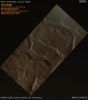
PSP_006980_2610_RED_abrowse~0.jpgChasma Boreale (Natural Colors; credits: Lunexit)60 visitenessun commentoMareKromium
|
|
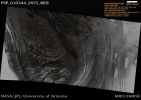
PSP_010344_2655_RED_abrowse.jpgScarp-fed Dark Dunes and NPLD (Natural Colors; credits: Lunexit)60 visiteMultiple levels within the North Polar Layered Deposits (NPLD) are visible in this HiRISE image.
The NPLD are a stack of dusty water-ice layers that are thought to record information about past Martian climates in the same way that Ice-Caps on the Earth record variations in our climate. These Martian layers are visible in the walls of troughs and scarps eroded into the stack.
One such scarp-face is visible on the far left of the full image and decreases in height from left to right.
Scientists continue to debate the length of time required to accumulate this stack of layers with estimates ranging from a few million years to about a billion years. Although we don’t yet know which layer corresponds to which time in Mars’ History, we can still use these layers to try to understand how the climate has changed over this period.
The topmost layers, which are the most recent (far left of the image), are brighter and appear gray-ish in this Natural Color view. They are interpreted to be a mixture of water ice and dust. The lower layering is more complex and appears to be a mixture of bright whiteiish layers (that we think are ice) and dark blue-ish layers (which we think are mostly sand).
A large pit in the center of the image penetrates deeply into this stack of layers and shows these alternating sandy and icy layers extending to depths of hundreds of meters (about 1000 feet).
Erosion of the dark sandy layers releases sandy material which collects into dunes such as the linear example that stretches across the middle of this image.MareKromium
|
|

ESP_014126_2120_RED_abrowse.jpgNorthern Crater with Windstreak (Natural Colors; credits: Lunexit)60 visitenessun commentoMareKromium
|
|

ESP_012625_1720_RED_abrowse.jpgSulfate Strata in Ius Chasma (Natural Colors; credits: Lunexit)60 visite...Ed ora, dato che al peggio ed al ridicolo non c'è mai fine, ci aspettiamo che qualcuno trovi una "Scritta", da qualche parte, che indichi questi depositi di Solfati...MareKromium
|
|
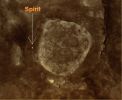
Home_Plate-PIA12205.jpgSpirit at Home Plate60 visiteIn this view from orbit, the pale circular shape in the center is a low plateau called "Home Plate", about 80 meters (about 260 feet) across. The bright dot just to the left of Home Plate at the 9 o'clock position is NASA's MER Spirit. North is toward the top.
The view is a portion of an image taken on June 13, 2009, by the High Resolution Imaging Science Experiment (HiRISE) camera on NASA's Mars Reconnaissance Orbiter. At that date, Spirit had been embedded for more than a month in a patch of soft soil called "Troy".
During the subsequent 3 months, Spirit studied the unusually layered soil at the site while engineers used test rovers at NASA's Jet Propulsion Laboratory to assess possible maneuvers for getting Spirit away from Troy.
The site is at 14,6° South Latitude and 175,5° East Longitude. Home Plate is in the inner basin of the Columbia Hills range, inside Mars' Gusev Crater. Spirit has been exploring the Columbia Hills and nearby features since January 2004.MareKromium
|
|

ESP_013954_1780_RED_abrowse-02.jpgVictoria Crater (EDM - Natural Colors; credits: Lunexit)60 visiteVictoria Crater was explored by Opportunity Rover for more than a Mars year; HiRISE images have supported surface exploration and contributed to joint scientific studies.
HiRISE stereo data were used to measure slopes and help select safe paths for the intrepid Rover. The most interesting exposures of geologic strata are in the steep walls of the Crater, difficult to image from the overhead perspective of orbiting spacecraft like MRO. However, MRO can point to the sides, and did so in this case to get a better view of layers in the West-facing and sunlit slopes of the Crater.
Especially prominent is a bright band near the top of the Crater Wall, interpreted by some MER scientists as having formed by diagenesis (chemical and physical changes in sediments after deposition). This bright band separates the bedrock from the impact ejecta deposits of Victoria Crater.MareKromium
|
|

ESP_013954_1780_RED_abrowse-00~0.jpgVictoria Crater (CTX Frame - Natural Colors; credits: Lunexit)60 visiteThis image has an interesting perspective because of the oblique viewing geometry. In addition, the Tracks left by the Opportunity Rover are visible just North of Victoria.MareKromium
|
|

ESP_014176_1810_RED_abrowse.jpgCentral Uplift of an Unnamed Impact Crater (Natural Colors; credits: Lunexit)60 visitenessun commentoMareKromium
|
|
| 2237 immagini su 187 pagina(e) |
 |
|
|
|
|
122 | |
|
|
|
|





