| |

| Piú viste - Mars Reconnaissance Orbiter (MRO) |
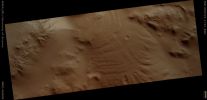
Psp_009729_1735_red.jpgTerraced Fan in Aeolis Planum Region (possible True Colors; credits: Lunar Explorer Italia)60 visiteThis image shows the South-Western Region of a degraded crater’s floor, located near the Equator. The high-standing ridge near the left side of the scene is a terrace that slumped off the crater’s rim (located to the far left of this frame, but out of the image). The bumpy terrain near the bottom of the image is also material that has slumped off the crater rim.
The center of the image contains a terraced fan. The fan emanates from a valley (not pictured, located in the lower part of the scene) that intersects the crater’s south rim, which suggests that the valley might have transported fluid, likely water, into the crater. If this happened, then the fan marks where the flow deposited its sediment.
Mars Local Time: 15:29 (early afternoon)
Coord. (centered): 6,5° South Lat. and 141,2° East Long.
Spacecraft altitude: 266,7 Km (such as about 166,7 miles)
Original image scale range: 26,7 cm/pixel (with 1 x 1 binning) so objects ~80 cm across are resolved
Map projected scale: 25 cm/pixel
Map projection: EQUIRECTANGULAR
Emission Angle: 6,2°
Phase Angle: 63,8°
Solar Incidence Angle: 59° (meaning that the Sun is about 31° above the Local Horizon)
Solar Longitude: 116,8° (Northern Summer)
Credits: NASA/JPL/University of Arizona
Additional process. and coloring: Lunar Explorer ItaliaMareKromium
|
|

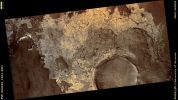
Psp_009731_2165_red.jpgPeriglacial Modification of a Fairly Fresh Crater in Utopia Planitia (possible True Colors; credits: Lunar Explorer Italia)60 visiteMars Local Time: 15:19 (early afternoon)
Coord. (centered): 36,0° North Lat. and 80,7° East Long.
Spacecraft altitude: 295,3 Km (such as about 184,6 miles)
Original image scale range: 29,5 cm/pixel (with 1 x 1 binning) so objects ~89 cm across are resolved
Map projected scale: 25 cm/pixel
Map projection: EQUIRECTANGULAR
Emission Angle: 8,4°
Phase Angle: 53,4°
Solar Incidence Angle: 45° (meaning that the Sun is about 45° above the Local Horizon)
Solar Longitude: 116,8° (Northern Summer)
Credits: NASA/JPL/University of Arizona
Additional process. and coloring: Lunar Explorer ItaliaMareKromium
|
|
PSP_009945_1835_RED.jpgExhumed Impact Crater in Equatorial Layered Deposits (possible True Colors; credits: Lunar Explorer Italia)60 visiteMars Local Time: 15:30 (middle afternoon)
Coord. (centered): 3,4° North Lat. and 2,9° East Long.
Spacecraft altitude: 273,7 Km (such as about 171,1 miles)
Original image scale range: 27,4 cm/pixel (with 1 x 1 binning) so objects ~82 cm across are resolved
Map projected scale: 25 cm/pixel
Map projection: EQUIRECTANGULAR
Emission Angle: 6,2°
Phase Angle: 59,3°
Solar Incidence Angle: 54° (meaning that the Sun is about 36° above the Local Horizon)
Solar Longitude: 124,7° (Northern Summer)
Credits: NASA/JPL/University of Arizona
Additional process. and coloring: Lunar Explorer ItaliaMareKromium
|
|
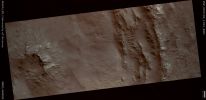
PSP_009749_1995_RED.jpgFresh "Santa Fe Crater" in Chryse Planitia (possible True Colors; credits: Lunar Explorer Italia)60 visiteMars Local Time: 15:25 (early afternoon)
Coord. (centered): 19,4° North Lat. and 312,0° East Long.
Spacecraft altitude: 283,4 Km (such as about 177,1 miles)
Original image scale range: 28,4 cm/pixel (with 1 x 1 binning) so objects ~85 cm across are resolved
Map projected scale: 25 cm/pixel
Map projection: EQUIRECTANGULAR
Emission Angle: 4,0°
Phase Angle: 51,6°
Solar Incidence Angle: 48° (meaning that the Sun is about 42° above the Local Horizon)
Solar Longitude: 117,5° (Northern Summer)
Credits: NASA/JPL/University of Arizona
Additional process. and coloring: Lunar Explorer ItaliaMareKromium
|
|

PSP_006806_2215_RED_abrowse~0.jpgRelict Glacial Landform in Deuteronilus Mensae (MULTISPECTRUM; credits: Lunexit)60 visiteThis image shows remnant raised margins and other interior structures of a lobate flow feature emanating the mouth of an alcove along a mesa in Deuteronilus Mensae.
This region of Mars has many features called “lobate debris aprons” that spread out below the scarps of polygonal mesas. Many of the debris aprons have what appear to be lineations or grooves that are parallel to their movement direction indicating flow of the materials.
The flow may be due to the presence of ice in the material. Recent data from the Shallow Radar instrument (SHARAD) on the Mars Reconnaissance Orbiter Spacecraft has indicated a large reservoir of subsurface ice in the Deuteronilus Mensae Region that supports the observational evidence of surface flow.MareKromium
|
|

Psp_010434_1575_red.jpgFan at Valley Mouth (possible True Colors; credits: Lunar Explorer Italia)60 visiteThis image shows the intersection of a Valley with the floor of a large Impact Crater. The Valley appears to have transported sediment that was deposited on the Crater Floor when the flow slowed. As the Eastern side of the lobate deposit appears to have been sheared off, it is possible that continuing flow from the valley eroded into its own deposits.
The deposit is noticeably different in color from the crater floor, indicating that the Valley transported different sediments. Since the large crater is shallow, likely due to infilling, this suggests that multiple sources of sediment and perhaps multiple deposition processes have affected the geology at this site.
The deposited material in the lobe at the Valley Mouth displays some interesting textural features. Small boulders are commonly present on its surface. This may demonstrate relatively energetic deposition as in a flash flood, although it is possible that the boulders are superimposed debris from later impact craters.
The Southern End of the deposit is also fracturing into blocks or slabs. These could be relics of old mud cracks, or of thermal contraction cracks formed in Permafrost.
§§§
Mars Local Time: 15:42 (middle afternoon)
Coord. (centered): 22,4° South Lat. and 336,3° East Long.
Spacecraft altitude: 259,3 Km (such as about 162,1 miles)
Original image scale range: 25,9 cm/pixel (with 1 x 1 binning) so objects ~78 cm across are resolved
Map projected scale: 25 cm/pixel
Map projection: EQUIRECTANGULAR
Emission Angle: 2,6°
Phase Angle: 68,2°
Solar Incidence Angle: 66° (meaning that the Sun is about 24° above the Local Horizon)
Solar Longitude: 143,2° (Northern Summer)
Credits: NASA/JPL/University of Arizona
Additional process. and coloring: Lunar Explorer ItaliaMareKromium
|
|
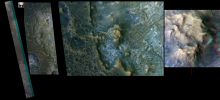
PSP_001454_2030_zoom3d-00.jpgLayered Terrain Near Mawrth Valles Phyllosilicates (High-Def-3D - false colors; credits: DR M. Faccin)60 visite...Un'incredibile ricostruzione in High-Def-3D (realizzata dal Dr Faccin) di uno dei paesaggi più intriganti e suggestivi di Marte: Mawrth Vallis.
Indossate gli occhialini e poi guardate: Vi sembrerà di "volare" su Marte, a 284 Km di quota, aggrappati al nostro "Amico" Mars Reconnaisance Orbiter!
Mars Local Time: 15:27 (early afternoon)
Coord. (centered): 22,8° North Lat. and 341,7° East Long.
Spacecraft altitude: 284,1 Km (such as about 177,6 miles)
Original image scale range: 28,4 cm/pixel (with 1 x 1 binning) so objects ~85 cm across are resolved
Map projected scale: 25 cm/pixel
Map projection: EQUIRECTANGULAR
Emission Angle: 1,3°
Phase Angle: 47,6°
Solar Incidence Angle: 49° (meaning that the Sun is about 41° above the Local Horizon)
Solar Longitude: 136,9° (Northern Summer)
Credits: NASA/JPL/University of Arizona
Additional process.: Dr Marco FaccinMareKromium
|
|

Psp_010589_1510_red.jpgLayered Deposits North of Hellas Basin (Natural Colors; credits: Lunar Explorer Italia)60 visiteMars Local Time: 15:47 (middle afternoon)
Coord. (centered): 28,7° South Lat. and 65,5° East Long.
Spacecraft altitude: 258,4 Km (such as about 161,5 miles)
Original image scale range: 51,7 cm/pixel (with 1 x 1 binning) so objects ~1,55 mt across are resolved
Map projected scale: 50 cm/pixel
Map projection: EQUIRECTANGULAR
Emission Angle: 0,3°
Phase Angle: 68,8°
Solar Incidence Angle: 69° (meaning that the Sun is about 21° above the Local Horizon)
Solar Longitude: 149,3° (Northern Summer)
Credits: NASA/JPL/University of Arizona
Additional process. and coloring: Lunar Explorer ItaliaMareKromium
|
|

ESP_011292_1720_RED_abrowse.jpgLayering at Ganges Chasma (possible Natural Colors; credits: Lunar Explorer Italia)60 visiteMars Local Time: 15:42 (middle afternoon)
Coord. (centered): 8,1° South Lat. and 307,5° East Long.
Spacecraft altitude: 258,6 Km (such as about 161,6 miles)
Original image scale range: 28,7 cm/pixel (with 1 x 1 binning) so objects ~86 cm across are resolved
Map projected scale: 25 cm/pixel
Map projection: EQUIRECTANGULAR
Emission Angle: 25,4°
Phase Angle: 81,1°
Solar Incidence Angle: 56° (meaning that the Sun is about 34° above the Local Horizon)
Solar Longitude: 178,7° (Northern Autumn)
Credits: NASA/JPL/University of Arizona
Additional process. and coloring: Lunar Explorer ItaliaMareKromium
|
|

PSP_001501_2280_RED_abrowse-01.jpgThe Viking Lander 2 Landing Site - Gerald Soffen Memorial Station (edm - Natural Colors; credits: Lunar Explorer Italia)60 visiteM.L.T.: 15:14 (early afternoon)
Latitude (centered): 47,7° North and Longitude 134,3° East
Range to target site: 310 Km (approx. 193,8 miles)
Original image scale range: 31 cm/pixel (with 1 x 1 binning) so objects ~93 cm across are resolved
Map projected scale: 25 cm/pixel and North is up
Map projection: EQUIRECTANGULAR
Emission angle: 11,7°
Phase angle: 62,1°
Solar Incidence Angle: 51°, with the Sun about 39° above the Local Horizon
Solar Longitude: 138,7° (Northern Summer) MareKromium
|
|
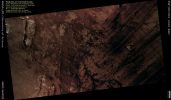
PSP_007095_2020_RED_abrowse~0.jpgInverted Dendritic Stream Channels in Antoniadi Crater (MULTISPECTRUM; credits: Lunexit)60 visiteThis observation is centered within Antoniadi Crater. This crater, even prior to the MRO mission, was identified as a likely ancient lake (now dry) that was supplied by both surface water and ground water.
The image provides further tantalizing evidence of a water-rich past. Most of the flat parts of the image have a polygonal texture, which commonly forms when mud dries. In the center of the image are branched (“dendritic”) features that connect Southward to a larger trunk-shaped landform; the branches resemble stream channels on Earth. Unlike active channels with water, these features are “inverted”, or elevated above the surrounding terrain.
Again, in analogy with such features seen on our Planet, these probably formed when materials deposited by the streams, such as coarse gravel, or chemical cementation after removal of the water, caused the channel bottoms to become resistant. Over time, natural erosion from wind and other processes left the inverted channels elevated above the surrounding terrain.
The branched features are probably remnants of small tributary streams that fed the larger trunk-shaped stream. It appears that the inverted streams lie on top of, and are therefore younger, than the polygons. This area may have first had a lake that later dried to form the polygons, followed by episodes of stream flow and erosion.MareKromium
|
|
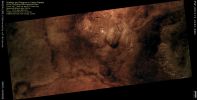
PSP_007173_2245_RED_abrowse-00~0.jpgScallops and Polygons in the Utopia Planitia Region (context frame - MULTISPECTRUM; credits: Lunexit)60 visiteThis image shows a portion of the Utopia Planitia, marked by polygonal features bounded by cracks and depressions in the mantle that possess scalloped edges.
Scalloped pits are typical features of the Martian mid-latitude mantle. Their presence has led to hypotheses of the removal of subsurface material, possibly interstitial ice, by sublimation (ice going directly from the solid state to the gas state). Their formation most likely involves development of oval- to scalloped-shaped depressions that may coalesce together, leading to the formation of large areas of pitted terrain. Scalloped pits typically have a steep pole-facing scarp and a gentler equator-facing slope.
On the surface surrounding the scalloped depressions is a polygonal pattern of fractures. This is commonly associated with scalloped terrain, and indicates that the surface has undergone stress, potentially caused by subsidence (sinking), desiccation (drying out), or thermal contraction. These polygon features are similar to permafrost polygons that form in polar and high alpine regions on Earth by seasonal-to-annual contraction of the subsoil. On Earth, such polygon features are indicative of the presence of ground ice.MareKromium
|
|
| 2237 immagini su 187 pagina(e) |
|
|
|
|
|
121 | |
|
|
|
|
|
|





