| Piú viste - Mars Reconnaissance Orbiter (MRO) |
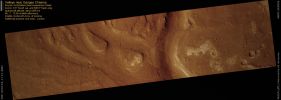
Psp_009578_1715_red.jpgValleys Near Ganges Chasma (natural colors; credits: Lunexit)60 visiteSeveral valleys as well as light-toned material are visible in this HiRISE image of a portion of Allegheny Vallis along the Plains West of Ganges Chasma.
The main valley, which starts in a pit called Ophir Cavus and extends for 155 Km into Ganges Chasma, is visible in the center of the image from left to right. Smaller and shallower valleys can be seen mostly to the north (Sx) of the image.
The observation that there are several valleys here suggests that water flowed for some extended period of time or multiple times in order to change direction and produce different valleys.
Light-toned material is visible on the upper surfaces of the plains but not inside the valleys, perhaps because smaller amounts of water could interact with the lava plains at these higher elevations, while in the valleys larger amounts of flowing water eroded and removed the plains unit. The light-toned nature on the upper surfaces could have resulted from chemical alteration of the lava plains or deposition of evaporites as the water disappeared and left behind minerals once carried in the water.MareKromium
|
|
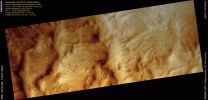
Psp_009548_1420_red.jpgEnigmatic Terrain in Hellas Planitia (Saturated Natural Colors; credits for the additional process. and color.: Dr Paolo C. Fienga - Lunexit Team)60 visiteHellas Planitia is the low-lying plain on the floor of the Hellas Basin, an ancient impact crater over 2000 Km wide. This Basin includes the lowest point on the surface of Mars.
A variety of unusual landforms occur on the floor of the basin due to the low elevation. One hypothesis is that Hellas may once have held lakes or seas, possibly with thick ice that might account for some of these features.
This image shows a small portion of Western Hellas, in a Region of "Enigmatic Ridges".
These ridges form an intricate pattern, enclosing kilometer-wide depressions. These strange features are still not well-understood; one possibility is that they formed in lake-bottom sediments when ice covering the lake touched bottom and shoved wet, loose material to the side.
This HiRISE image reveals that the ridges contain many boulders; sediments deposited on the bottom of a lake might be fine-grained, although they may have hardened to rock later. The image also shows lineations, probably outcropping layers, running between the large ridges.
Because the resolution of HiRISE images is sufficient to see details such as the abundance of boulders and the presence of thin sedimentary layers, images of this and other poorly-understood terrains will be important in interpreting the geological and climatological history of Mars.
This observation is part of a stereo pair along with PSP_007834_1420.MareKromium
|
|

North_Polar_Features-Layers-MRO-PCF-LXTT.jpgNon-Conformities (Absolute Natural Colors; credits for the additional process. and color.: Dr Paolo C. Fienga - Lunexit Team)60 visiteCaption NASA:"How did these layers of red cliffs form on Mars? No one is sure. The Northern Ice Cap on Mars is nearly divided into two by a huge division named Chasma Boreale. No similar formation occurs on Earth. Pictured here, several dusty layers leading into this deep chasm are visible. Cliff faces, mostly facing left but still partly visible from above, appear dramatically reddish. The light areas are likely water ice. This image spans about 1 Km near the North of Mars, and the elevation drop from right to left is over one kilometer. One hypothesis relates the formation of Chasma Boreale to underlying volcanic activity".MareKromium
|
|
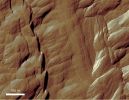
PSP_009927_1750_RED_abrowse-01.jpgExposed Layers in Gale Crater (EDM- Enhanced Natural Colors; credits: Lunexit)60 visiteThis edm is a small portion of a HiRISE image detailing the fine-scale layering evident in the upper mound. The layered deposits can be divided into 2 types: a lower mound with near-horizontal, flat layers, and an upper mound with more numerous, thinner layers (some of which have greater degree of tilt than the lower layers).
The origin of these thin, repetitive layers is unknown, but they likely reflect environmental changes that occurred while the layers were being deposited.
Today, erosion by wind scour has shaped them into the stair-step pattern that is reminiscent of parts of the American South-West.MareKromium
|
|
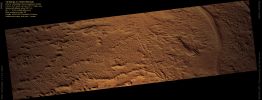
PSP_009966_1735_RED_abrowse-00.jpgInverted Channels and Yardangs in Aeolis Mensae (ctx frame - natural colors; credits: Lunexit)60 visiteThis image shows wind-eroded Layered Deposits in Aeolis Mensae. Aeolis Mensae is located close to the Volcanic Region of Elysium Planitia and near the boundary of the high-standing, heavily cratered Southern Hemisphere and the low, sparsely-cratered plains that cover most of the Northern Hemisphere of Mars.
MareKromium
|
|
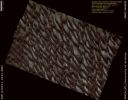
PSP_010071_2615_RED.jpgGypsum-rich Dunes in Olympia Undae Region (natural colors; credits: Lunexit)60 visiteIn this enhanced-natural color image are dunes within the largest collection of dunes on Mars, Olympia Undae, near the margin of the North Polar Layered Deposits, Planum Boreum.
This section of Olympia Undae is particularly interesting because the dunes are rich in Gypsum (---> Gesso), a mineral that forms in the presence of water. The material comprising these dunes is thought to have eroded from geologic units near the base of the NPLD, but these units have poor to no gypsum content.
Therefore, water likely affected these dunes after the sand had eroded out from the NPLD. Several ideas have been proposed to explain the formation of Gypsum, including hydrothermal (hot water) activity and melting of water-ice in the NPLD.
While gypsum dunes on Earth (for example, at White Sands, New Mexico) are white (the color of Gypsum), these Martian Dunes are dark due to the presence of basaltic grains that lower the brightness of the dunes.
CRISM, another instrument on MRO, has found that the crests of the dunes are the most Gypsum-rich. So, what is the bright, polygonally-fractured material in the low spaces between the dunes?
Perhaps it is Polar Ice lying beneath, desiccated (dried) gypsum material whose fine grain size makes it difficult for CRISM to detect, or something else altogether.MareKromium
|
|
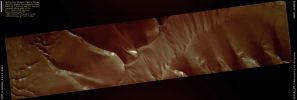
PSP_010090_1255_RED.jpgSpring over Russel Crater (natural colors; credits: Lunexit)60 visiteSpring is already starting to show its influence at the Russell Crater field of sand dunes. Channels down the face of the largest dune show dark spots where the sublimation of the seasonal carbon CO2 Ice Cap has begun.
This active process (where ice evaporates directly to gas) dislodges loose material, leaving dark streaks down steep slopes. The process starts when the Sun peeks above the horizon at the end of Antarctic Night.
Bright streaks may be loose frost cascading down steep slopes.MareKromium
|
|
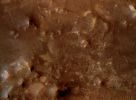
PSP_010206_1975_RED_abrowse-01.jpgAncient Bedrock and Megabreccia in Nili Fossae region (edm - possible True Colors; credits: Lunexit)60 visiteThis edm shows a rock type known as Megabreccia, composed of numerous differently colored blocks, each up to 40 meters (130 feet) across, arranged in a seemingly disorganized array.
Megabreccia forms when an energetic event, such as formation of an impact crater, breaks up pre-existing rocks and jumbles their fragments. Megabreccia is found in some of the most ancient rocks exposed on the Martian Surface.MareKromium
|
|
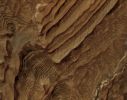
PSP_004078_2015_RED_browse-01.jpgLayered Rocks within Becquerel Crater (enhanced natural colors; credits: Lunar Explorer Italia)60 visiteRhythmic bedding in sedimentary bedrock within Becquerel Crater on Mars is suggested by the patterns in this image from the High Resolution Imaging Science Experiment (HiRISE) camera on NASA's Mars Reconnaissance Orbiter.
Three dimensional analysis based on stereo pairs of images confirmed the regularity of repetition in the thickness of the beds. In the left half of this image, some of the rhythm is apparent as a series of bundles of about 10 individual layers per bundle. By corresponding to a known 10-to-one pattern in changes in the tilt of Mars' Rotation Axis, this pattern suggests the periodicity in the rock layers results from cyclical changes in the Planet's tilt.
This view covers an area about 1150 meters (0,7 miles) wide. Individual layers in the scence average 3,6 meters (12 feet) thick. The view is presented in enhanced natural colors emphasizing the differing compositions of surface material. Sand trapped in relative low points in the terrain appears grey-blueish. Sedimentary rocks appear brown.
Faulting apparent in the image suggests that the deposits are hardened rock, not softer material. Tilting of the layers in different ways and the surface topography made the three-dimensional analysis necessary for determining the thickness of layers.
This image is a portion of the HiRISE image catalogued as PSP_004078_2015, taken on June 10, 2007.
The location of the imaged area is at 22° North Latitude, 352° East Longitude, within the Arabia Terra Region.MareKromium
|
|
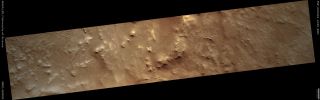
Psp_009442_2030_red.jpgAntoniadi Crater (possible True Colors; credits: Lunar Explorer Italia)60 visiteMars Local Time: 15:22 (early afternoon)
Coord. (centered): 22,9° North Lat. and 53,5° East Long.
Spacecraft altitude: 282,0 Km (such as about 176,2 miles)
Original image scale range: 56,4 cm/pixel (with 1 x 1 binning) so objects ~1,69 mt across are resolved
Map projected scale: 50 cm/pixel
Map projection: EQUIRECTANGULAR
Emission Angle: 0,3°
Phase Angle: 46,1°
Solar Incidence Angle: 46° (meaning that the Sun is about 44° above the Local Horizon)
Solar Longitude: 106,5° (Northern Summer)
Credits: NASA/JPL/University of Arizona
Additional process. and coloring: Lunar Explorer ItaliaMareKromium
|
|
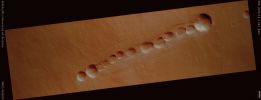
PSP_009712_1785_RED.jpgPit-Chain in South-Western Pavonis Mons (possible True Colors; credits: Lunar Explorer Italia)60 visiteMars Local Time: 15:30 (middle afternoon)
Coord. (centered): 1,4° South Lat. and 245,1° East Long.
Spacecraft altitude: 254,6 Km (such as about 159,1 miles)
Original image scale range: 50,9 cm/pixel (with 1 x 1 binning) so objects ~1,53 mt across are resolved
Map projected scale: 50 cm/pixel
Map projection: EQUIRECTANGULAR
Emission Angle: 0,5°
Phase Angle: 56,9°
Solar Incidence Angle: 56° (meaning that the Sun is about 34° above the Local Horizon)
Solar Longitude: 116,2° (Northern Summer)
Credits: NASA/JPL/University of Arizona
Additional process. and coloring: Lunar Explorer ItaliaMareKromium
|
|

PSP_009710_2590_RED.jpgRelatively Fresh Ice-Patch near the North Polar Layered Deposits (possible True Colors; credits: Lunar Explorer Italia)60 visiteMars Local Time: 14:57 (early afternoon)
Coord. (centered): 78,7° North Lat. and 285,2° East Long.
Spacecraft altitude: 323,6 Km (such as about 202,2 miles)
Original image scale range: 32,4 cm/pixel (with 1 x 1 binning) so objects ~97 cm across are resolved
Map projected scale: 25 cm/pixel
Map projection: EQUIRECTANGULAR
Emission Angle: 11,8°
Phase Angle: 50,0°
Solar Incidence Angle: 60° (meaning that the Sun is about 30° above the Local Horizon)
Solar Longitude: 116,1° (Northern Summer)
Credits: NASA/JPL/University of Arizona
Additional process. and coloring: Lunar Explorer ItaliaMareKromium
|
|
| 2237 immagini su 187 pagina(e) |
 |
|
|
|
|
120 | |
|
|
|
|





