| Piú viste - Mars Reconnaissance Orbiter (MRO) |
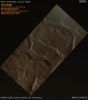
PSP_006980_2610_RED_abrowse~0.jpgChasma Boreale (Natural Colors; credits: Lunexit)60 visitenessun commentoMareKromium
|
|
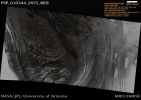
PSP_010344_2655_RED_abrowse.jpgScarp-fed Dark Dunes and NPLD (Natural Colors; credits: Lunexit)60 visiteMultiple levels within the North Polar Layered Deposits (NPLD) are visible in this HiRISE image.
The NPLD are a stack of dusty water-ice layers that are thought to record information about past Martian climates in the same way that Ice-Caps on the Earth record variations in our climate. These Martian layers are visible in the walls of troughs and scarps eroded into the stack.
One such scarp-face is visible on the far left of the full image and decreases in height from left to right.
Scientists continue to debate the length of time required to accumulate this stack of layers with estimates ranging from a few million years to about a billion years. Although we don’t yet know which layer corresponds to which time in Mars’ History, we can still use these layers to try to understand how the climate has changed over this period.
The topmost layers, which are the most recent (far left of the image), are brighter and appear gray-ish in this Natural Color view. They are interpreted to be a mixture of water ice and dust. The lower layering is more complex and appears to be a mixture of bright whiteiish layers (that we think are ice) and dark blue-ish layers (which we think are mostly sand).
A large pit in the center of the image penetrates deeply into this stack of layers and shows these alternating sandy and icy layers extending to depths of hundreds of meters (about 1000 feet).
Erosion of the dark sandy layers releases sandy material which collects into dunes such as the linear example that stretches across the middle of this image.MareKromium
|
|

ESP_013958_1170_RED_abrowse.jpgDD Tracks in Aonia Terra (Natural Colors; credits: Lunexit)60 visiteThroughout this entire image in Aonia Terra, it is possible to make out regular polygonally shaped patterns. Here on Earth, wherever ice-rich permafrost occurs (soil which stays frozen throughout the year), the ground may crack and form similar patterns to those we see on Mars.
Despite remaining below freezing, changes in seasons and ground temperature cause significant thermal-contraction stress, enough so that the terrain fractures into a honeycomb network of subsurface cracks.
Criss-crossed dark paths wind throughout this Region. Dust Devils, turbulent whirlwinds fueled by rising ground-warmed Atmosphere, track across the Surface, stripping the ground of bright surface dust as they go. Comparable to miniature tornadoes, they efficiently transport Surface Materials on Mars. Left in their passing is the darker coarse-grained soil underneath.
In this image, the Sun is low on the horizon; the shadows make it easier to see the scattered rocks and boulders.
Sometimes, these boulders occur in rings, the remnants of an ancient impact whose crater has since eroded to a flat surface. The boulders are left behind, illustrating where the form of the crater once stood.MareKromium
|
|

ESP_014114_0935_RED_abrowse.jpgSouth Polar Residual Cap Monitoring (Natural Colors; credits: Lunexit)60 visitenessun commentoMareKromium
|
|

ESP_013954_1780_RED_abrowse-02.jpgVictoria Crater (EDM - Natural Colors; credits: Lunexit)60 visiteVictoria Crater was explored by Opportunity Rover for more than a Mars year; HiRISE images have supported surface exploration and contributed to joint scientific studies.
HiRISE stereo data were used to measure slopes and help select safe paths for the intrepid Rover. The most interesting exposures of geologic strata are in the steep walls of the Crater, difficult to image from the overhead perspective of orbiting spacecraft like MRO. However, MRO can point to the sides, and did so in this case to get a better view of layers in the West-facing and sunlit slopes of the Crater.
Especially prominent is a bright band near the top of the Crater Wall, interpreted by some MER scientists as having formed by diagenesis (chemical and physical changes in sediments after deposition). This bright band separates the bedrock from the impact ejecta deposits of Victoria Crater.MareKromium
|
|
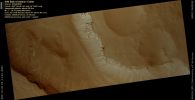
ESP_014178_1330_RED_abrowse.jpgNorth-Western Side of Asimov Crater (Natural Colors; credits: Lunexit)60 visitenessun commentoMareKromium
|
|
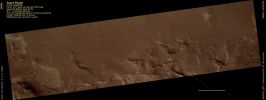
ESP_014404_1275-GB-LXT-00.jpgArgyre Planitia (Natural Colors; credits: Lunexit)60 visitenessun commentoMareKromium
|
|
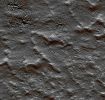
ESP_014282_0930_RED_abrowse-01.jpgSpiders (EDM - Natural Colors; credits: Lunexit)60 visiteIl bizzarro dettaglio segnalatoci dal nostro Amico e Partner, Dr Gualtiero la Fratta, non sembra risolversi in un qualcosa di agevolmente definibile: in attesa di processare la porzione di frame in oggetto dal formato JP2, quindi, possiamo solo fare due supposizioni.
La prima (razionale), in virtù della quale si può dire che stiamo osservando un image-artifact; la seconda (un pò più immaginifica) che ci suggerisce la possibilità per cui il rilievo bizzarro che si distingue davanti a noi potrebbe risolversi in due fratture lineari della supercfiie le quali - tutto sommato - potrebbero costituire due "bocche" di un medesimo geyser - di dimensioni davvero modestissime.MareKromium
|
|
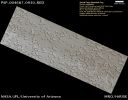
PSP_004687_0930_RED_abrowse.jpgSouth Polar Residual Cap Monitoring (Natural Colors; credits: Lunexit)60 visiteAs on Earth, the seasonal frost caps of Mars grow and recede each year. But seasonal frost on Mars is composed of Carbon Dioxide Ice (also known as Dry Ice), not water ice as on our Planet.
Near the South Pole of Mars, the seasonal CO2 frost never completely disappears, leaving a residual ice cap of CO2 ice throughout the Summer. This HiRISE image shows part of the South Polar Residual Cap, with many shallow Pits dubbed "Swiss Cheese Terrain". Because the Sun is always low in the sky at this latitude, the steep walls of the Pits receive more solar energy than the high-standing, flat areas between the Pits.
This causes the walls of the Pits to retreat several meters per year as Sunlight causes the CO2 ice to evaporate directly to gas, a process called "sublimation".
In some depressions, ridges or blocks of material a couple of meters (several feet) across are visible at the base of the depression walls, likely fallen from the walls during the sublimation and retreat process. At this rate, the layer of Carbon Dioxide ice could completely disappear in about 100 years from now, if not replenished.
Nota Lunexit: interessanti annotazioni. Peccato che la maggiore implicazione da esse derivante (quote: "...lo strato di CO2 che ricopre la Regione Sud Polare di Marte SCOMPARIRA' entro 100 anni da oggi, se non reintegrato...") non è stata minimamente toccata.
Stile NASA, of course. Nihil sub Sole novi, quindi...MareKromium
|
|

ESP_014417_1975_RED_abrowse-00.jpgChrise Planitia (Natural Colors; credits: Lunexit)60 visitenessun commentoMareKromium
|
|

PSP_002184_2005_RED_browse-1.jpgOn the Edge of Olympus (Natural Colors; credits: Lunexit)60 visiteOlympus Mons, the largest volcano in the Solar System, has a mysterious halo (or "Aureole") of material on its Western and Northern Sides. There have been many ideas about how this feature may have formed over the years, but the hypothesis that this is a giant landslide deposit has gained favor.
Many large volcanoes on the Earth collapse under their own weight, so it seems reasonable that Olympus Mons would do the same. The edge of the Aureole is seen on the left (North) part of the image.
It is interesting that the main part of the Aureole seems sunk down compared to the edge. It is possible that the ridge along the outer margin of the Aureole formed as the flow turned around after pushing uphill for a ways. Imagine a giant wave of rock pushing up onto the "beach" and then receding. It might leave a deposit like this.
Alternatively, glaciers push up a ramp of rock at their fronts.
After they retreat, the ridge of rock is left at the furthest extent of the glacier. These are called "Terminal Moraines" by geologists.MareKromium
|
|
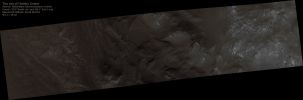
PSP_003710_1530_RED_browse~0.jpgHolden Crater's Rim (Natural Colors; credits: Lunexit)60 visiteThe formation of the approximately 150 Km diameter Holden Crater interrupted the Northward flowing Uzboi Vallis Channel System. Relief associated with the Rim of Holden effectively blocked the Channel.
HiRISE image PSP_003710_1530 covers the portion of Holden Crater's Rim where it was overtopped by water that had backed up in Uzboi Vallis to the South. Water flowing over the Rim in multiple locations eventually focused on a single Channel that then cut deeply into the Rim.
After the impounded water drained into the Crater, the steep Wall on the East side of the main Channel collapsed in a Landslide that remains visible along the Floor.
Several Outcroppings of variably bright material are visible in the scar produced by the Slide. MareKromium
|
|
| 2237 immagini su 187 pagina(e) |
 |
|
|
|
|
119 | |
|
|
|
|





