| Piú viste - Mars Reconnaissance Orbiter (MRO) |
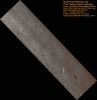
PSP_004673_0935_RED_browse.jpgSouth Pole Residual Cap - Swiss-Cheese Terrain Monitoring (Natural Colors; credits for the additional process. and color.: Dr Paolo C. Fienga - Lunexit Team)60 visitenessun commentoMareKromium
|
|

PSP_004959_0865_RED_browse.jpgPolygonal Fracturing of South Polar Layered Deposits60 visiteThis image shows the South Polar Layered Deposits, with curving layer outcrops caused by erosion of valleys into the Deposits.
On closer inspection, polygonal (mostly rectangular) fractures are visible, mostly near the center of the image. Polygonal fractures are also observed in the North Polar Layered Deposits, but typically on a much smaller scale.
Here in the South, the fractures cross layer boundaries, while in the North the fractures are usually confined to a single layer.
Therefore, the fractures in the South Polar Layered Deposits formed after the surface was eroded to the configuration seen here, probably due to expansion and contraction of water ice below the surface.MareKromium
|
|
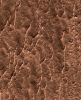
PSP_003639_1345_RED_browse-01.jpgDebris Apron South of Euripus Mons (extra-detail mgnf - possible natural colors; elab. Lunexit)60 visiteA closer view of the upper portion of the image (see here), reveals that rough sharp scalloped ridges are particularly prominent.
This scalloping may have resulted from sublimation of ice below the surface.MareKromium
|
|

PSP_005813_2150_RED_abrowse.jpgUnusual Depression near Elysium Mons (MULTISPECTRUM; elab. Lunexit)60 visiteThis unusual depression and the associated concentric rings are situated within an area thought to have been deposited as a mud flow. Due to the lack of a distinctive, raised rim or other impact-related features, this crater is thought to have formed by the loss of material below the surface and subsequent collapse, rather than by an impact from space.
The exact mechanism for the loss of material is not fully understood, although the missing material was likely water in some form. This feature is near a large volcano, so perhaps there were explosive magma-water interactions that violently removed the water and some magma, followed by surface collapse. Or, less violently, there could have been simple melting of subsurface ice and then collapse of the surface into the resulting void. The rays emanating from the depression suggest some amount of violence before the surface collapse that sprayed material far from the depression.
Some aspects of this and other, nearby features are similar to the collapse pits associated with Grímsvötn volcano in Iceland, which erupts beneath an ice-cap. However, there are no rays formed during the eruptions at Grímsvötn.
MareKromium
|
|

Phobos_Deimos-PIA10117.jpgCRISM Views Phobos and Deimos60 visiteThese 2 images taken by the Compact Reconnaissance Imaging Spectrometer for Mars (CRISM) show Mars' 2 small moons, Phobos and Deimos, as seen from the MRO's low orbit around Mars. Both images were taken while the spacecraft was over Mars' night side, with the spacecraft turned off its normal nadir-viewing geometry to glimpse the moons. The image of Phobos, shown at the top, was taken at 01:19 UTC on October 23, 2007 (19:19 EDT on Oct. 22), and shows features as small as 400 mt (1320 feet) across. The image of Deimos, shown at the bottom, was taken at 20:16 UTC (00:16 EDT) on June 7, 2007, and shows features as small as 1,3 Km (0,8 miles) across.
Both CRISM images were taken in 544 colors covering 0.36-3.92 micrometers and are displayed at twice the size in the original data for viewing purposes.
Phobos and Deimos are about 21 and 12 Km (13,0 and 7,5 miles) in diameter and orbit Mars with periods of 7 hours, 39,2 minutes and 1 day, 6 hours, 17,9 minutes respectively. Because Phobos orbits Mars in a shorter time than Mars' 24 hour, 37.4-minute rotational period, to an observer on Mars' surface it would appear to rise in the West and set in the East. From Mars' surface, Phobos appears about one-third the diameter of the Moon from Earth, whereas Deimos appears as a bright star. The moons were discovered in 1877 by the astronomer Asaph Hall, and as satellites of a planet named for the Roman God of War, they were named for Greek mythological figures that personify fear and terror.
The first spacecraft measurements of Phobos and Deimos, from the Mariner 9 and Viking Orbiter spacecraft, showed that both moons have dark surfaces reflecting only 5 to 7% of the sunlight that falls on them. The first reconstruction of the moons' spectrum of reflected sunlight was a difficult compilation from 3 different instruments, and appeared to show a flat, grayish spectrum resembling carbonaceous chondrite meteorites. Carbonaceous chondrites are primitive carbon-containing materials thought to originate in the outer part of the Asteroid Belt. This led to a commonly held view among planetary scientists that Mars' moons are primitive asteroids captured into Martian orbit early in the Planet's history. More recent measurements have shown that the moons are in fact relatively red in their color, and resemble even more primitive D-type asteroids in the outer Solar System.
Those ultra-primitive bodies are also thought to contain carbon as well as water ice, but to have experienced even less geochemical processing than many carbonaceous chondrites.
The version of the CRISM images shown here were constructed by displaying 0.90, 0.70, and 0.50 micrometer wavelengths in the red, green, and blue image planes. This is a broader range of colors than is visible to the human eye, but it accentuates color differences. Both moons are shown with colors scaled in the same way.
Deimos is red-colored like most of Phobos. However, Phobos' surface contains a second material, grayer-colored ejecta from a 9-Km (5,6-mile) diameter crater.
This crater, called Stickney, is located at the upper left limb of Phobos and the grayer-colored ejecta extends toward the lower right.
These CRISM measurements are the first spectral measurements to resolve the disk of Deimos, and the first of this part of Phobos to cover the full wavelength range needed to assess the presence of iron-, water-, and carbon-containing minerals.MareKromium
|
|

PSP_004965_0980_RED_abrowse-01.jpgSouth Polar Layered Deposits (SPLD; extra-detail mgnf - MULTISPECTRUM; credits: Lunexit)60 visiteThe exposure of South Polar Layered Deposits shown here also appears to be partly covered by additional debris.
The layers appear to have been offset by a fault near the upper right corner.
The faulting and burial visible here complicates the interpretation of the climate history of Mars based on observations of layering.MareKromium
|
|
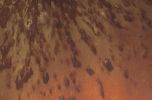
PSP_004313_1760_RED_abrowse-01.jpgWinslow Crater - extra-detail mgnf from frame n. 1: the "Herringbone Pattern" (MULTISPECTRUM; credits: Lunexit)60 visitenessun commentoMareKromium
|
|

PSP_006673_1600_RED_abrowse.jpgBright Material on the Floor of an Unnamed Crater (natural colors; credits: Lunexit)60 visiteThis image shows part of a crater wall and floor, where the floor is covered by dunes and distinct regions of bright material. The bright material stands higher than the rest of the floor suggesting that it is more resistant to erosion than surrounding materials.
It is possible that more and more bright material will be exposed over time; why the material is bright is unknown.
The material might be evaporites, that form when salt water dries up and leaves behind salt deposits (the evaporites).
Also in this scene is a crater with a ridge running up to its west (left) side. The ridge is lighter and might be evidence that water flowed through it, bleaching the rocks as it went. The water might have cemented the soil, causing it to be more resistant to erosion and high standing as seen today.MareKromium
|
|

PSP_007653_2010_RED_abrowse-00.jpgBright on Dark (MULTISPECTRUM; credits: Lunexit)60 visiteThis image reveals bright Slope Streaks in Bahram Vallis, a long sinuous valley that winds across North-Eastern Lunae Planum and Xanthe Terra to the circum-Chyrse basin.
Typically, dark and light-toned Slope Streaks appear together on light-toned slopes. This scene is a rare case in which only bright streaks are visible on a dark surface. Slope Streaks generally start at a point source and widen downslope as a single streak or branch into multiple streaks. Some of the Slope Streaks show evidence that downslope movement is being diverted around obstacles, such as large boulders, and a few appear to originate at boulders or clumps of rocky material.
Many hypotheses have been proposed for the formation of slope streaks including dry avalanching, geochemical weathering, liquid stains or flows, and moisture wickering. Recent observations from HiRISE images have revealed that the interior of Slope Streaks is lower in elevation than the surroundings indicating that material must have been removed and then deposited in the formation of the streak.
Slope Streak formation is among the few known processes currently active on Mars. Where they appear together, dark Slope Streaks cross cut and lie on top of the older and lighter-toned streaks leading to the belief that lighter-toned streaks are dark streaks that have lightened with time as new dust settled on their surface. Over the course of several years, MOC images from this Region did not reveal any new dark or light-toned Slope Streaks suggesting that streak formation is not currently active here.
HiRISE will continue to monitor this Region for new slope streaks and changes in tone of old streaks.MareKromium
|
|
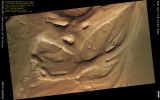
PSP_007738_2145_RED_abrowse.jpgStreamlined Islands in Hrad Vallis (possible natural colors; credits: Lunexit)60 visiteThis image shows a portion of Hrad Vallis, an approx. 400 mt (1300 feet) deep and about 800 Km (approx. 500 mile) long depression located in the Elysium Planitia.
Hrad Vallis is one of several channel systems that are found just West of the Elysium volcanoes. The scoured floor of Hrad Vallis shows the effects of erosion, presumably by water.
Flowing water in the past has carved and sculpted rocky masses into streamlined shapes or islands. The streamlined islands often have sharp edges and are narrower at the downstream end and wider at the upstream end. The streamlined islands visible here are located in an area where the flow condensed from the fractured terrain of the Hrad Valles headwaters (to the South-East) to a more regular channel (to the North-West).MareKromium
|
|
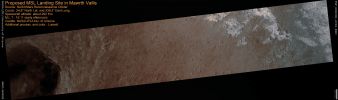
PSP_008390_2050_RED_abrowse.jpgProposed MSL Landing Site in Mawrth Vallis - ellipse 4 (MULTISPECTRUM; credits: Lunexit)60 visiteMawrth Vallis has a rich mineral diversity, including clay minerals that formed by the chemical alteration of rocks by water. The CRISM instrument detects a variety of clay minerals here, which could signify different processes of formation. The high resolution of the HiRISE camera helps us to see and trace out layers, polygonal fractures, and with CRISM, examine the distribution of various minerals across the surface.
This surface is scientifically compelling for the MSL Rover, although some of the terrain can be somewhat rough. Scientists use HiRISE images to find the safest possible Landing Site for the Rover.
MareKromium
|
|

PSP_005620_1210_RED_abrowse.jpgSouthern Alcoves (MULTISPECTRUM; credits: Lunexit)60 visiteThis image shows the West Wall of a Southern Hemisphere Crater. The scene is covered in Dust Devil Tracks which appear as dark wispy features.
Dust Devils are small-scale funnels that move across the surface kicking up dust as they go, thus leaving trails. The Crater is covered in small polygons in many locations. These polygons are probably related to periglacial processes; for example, temperature cycling of ice-rich material or sublimation, when gases trapped under the surface escape causing the remaining terrain to collapse to form pits.
Also in this Crater are several Gullies on the Southern Wall. These Gullies have very wide alcoves/source regions. It is unknown what is responsible for different Gully Alcove shapes and morphologies.MareKromium
|
|
| 2237 immagini su 187 pagina(e) |
 |
|
|
|
|
118 | |
|
|
|
|





