| Piú viste - Mars Reconnaissance Orbiter (MRO) |
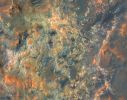
Mawrth_Vallis-PIA01924.jpgThe colors of Mawrth Vallis (False Colors; credits: NASA/JPL-Caltech/Univ. of Arizona)60 visiteCaption NASA originale:"This view shows diverse materials and morphologies in the region south of Mawrth Vallis on Mars. The color is composed of infrared, red, and blue-green color images, and has been enhanced to accentuate the color differences. The bright material may be rich in clays and date back to a time when Mars had a wetter environment. This is a sub-image of a larger view imaged by the High Resolution Imaging Science Experiment (HiRISE) on NASA's Mars Reconnaissance Orbiter on Oct. 1, 2006. The resolution is 25 centimeters (10 inches) per pixel, and the scene is 352 meters (385 yards) wide".
|
|

Deimos-PIA02699.jpgDeimos, from MRO60 visiteCaption NASA originale:"This image showing the position of the Martian moon Deimos against a background of stars is part of a successful technology demonstration completed by NASA's MRO before arrival at Mars. The spacecraft's Optical Navigation Camera (ONC) was used in February and March 2006 to demonstrate the use of pictures from a small camera for calculating precise location of a Mars-bound spacecraft by comparing the observed positions of Mars' two moons to their predicted positions relative to background stars. While this technique was not necessary for the Mars Reconnaissance Orbiter's own navigation, the demonstration prepares the way for relying on it for navigating precise arrivals for future missions that land on Mars.
This example image from the ONC was taken on March 6, 2006, at a distance of 1,08 MKM (about 671.000 miles) from Deimos. That moon, the smaller of Mars' two, has a diameter of about 15 Km (approx. 9 miles), and orbits 23.459 Km (approx. 14.577 miles) above Mars' surface".
|
|

Elysium_Planitia-Tra_000867_1875_red-01.jpgFresh Crater Cluster in Elysium Planitia (EDM - False Colors)60 visiteImage TRA_000867_1875 was taken by the High Resolution Imaging Science Experiment (HiRISE) camera onboard the Mars Reconnaissance Orbiter spacecraft on October 3, 2006. The complete image is centered at 7,4° North Latitude and 157,3 East longitude. The range to the target site was 274,6 Km (171,6 miles).
At this distance the image scale ranges from 54,9 cm/pixel (with 2 x 2 binning) to 109,9 cm/pixel (with 4 x 4 binning).
The image has been map-projected to 50 cm/pixel and north is to the right.
The image was taken at a Local Mars Time of 3:26 PM and the scene is illuminated from the West with a solar incidence angle of 52°, thus the Sun was about 38° above the horizon.
At a Solar Longitude of 115,1°, the season on Mars is Northern Summer.MareKromium
|
|

Northern_Plains-Psp_001380_2520_red-01.jpgAnother "Frozen Lake" in the Northern Plains? (2 - EDM - False Colors; credits for the additional process. and color.: Dr Paolo C. Fienga - Lunexit Team)60 visitenessun commentoMareKromium
|
|

Northern_Plains-Psp_001380_2520_red-00.jpgAnother "Frozen Lake" in the Northern Plains? (1 - CTX Frame - False Colors; credits for the additional process. and color.: Dr Paolo C. Fienga - Lunexit Team)60 visitenessun commentoMareKromium
|
|

Terra_Sirenum-PIA09101.jpgSeasonal frost in Terra Sirenum (according to NASA)60 visiteCaption NASA originale:"This image of the Terra Sirenum Region of Mars was taken by the Compact Reconnaissance Imaging Spectrometer for Mars (CRISM) at 09:18 UTC (4:18 a.m. EST) on Nov. 25, 2006, near 38,9° South Lat. and 195,9° East Long. CRISM's image was taken in 544 colors covering 0,36-3,92 micrometers and shows features as small as 18 mt (60 feet) across.
At this time, Mars' Southern Hemisphere was experiencing mid-Winter. During Martian Southern Winter, the Southern Polar Cap is covered and surrounded by CO2 frost and water frost. This is unlike Earth, whose frozen Winter precipitation is made up of only one volatile -- water. The CO2 frost evaporates, or sublimates, at a lower temperature than water frost. So, during Spring, the CO2 ice evaporates first and leaves a residue of water frost, which later sublimates as well.
The image shown here covers part of a crater rim, which is illuminated from the upper left. North is at the top.
The topography creates a cold microenvironment on the South side of the rim that is partially protected from solar illumination. That cold surface contains an outlier of the southern seasonal frost about 15° of Lat. closer to the Equator than the average edge of the frost at this season.
The top image was constructed from 3 infrared wavelengths that highlight the bluer color of frost than the background rock and soil. Note that the frost occurs both on sunlit and shaded surfaces on the south side of the rim. The shaded areas are still visible because they are illuminated indirectly by the Martian Sky.
The bottom image was constructed by measuring the depths of spectral absorption bands due to water frost and CO2 frost and displaying the results in image form. Blue shows strength of an absorption due to water frost near 1,50 mmts and green shows strength of an absorption due to CO2 frost near 1,45 mmts. Red shows brightness of the surface at 1,33 micrometers -- outside of the frost absorption bands -- in order to show the relationship of frost to the illuminated crater rim.
In comparing the top and bottom images, note that water frost occurs in many locations on the south-facing side of the crater rim, both in sunlit and shaded areas. Because it faces away from the Sun, this side of the crater rim is colder than the north, Sun-facing side.
This favors the formation of frost. In contrast, CO2 frost occurs only in the coldest, most shaded areas".MareKromium
|
|

Psp_001697_1390_red.jpgUnnamed (and yet beautiful) Crater with Gullies in Terra Sirenum60 visiteThis image shows part of an unnamed crater, itself located inside the much larger Newton Crater, in Terra Sirenum. This unnamed crater is approx. 7 Km in diameter (over 4 miles) and some 700 mt (about 760 yards) deep.
Numerous gully systems are visible on the East- and South-facing walls of the crater; their characteristics are astonishingly diverse, though.
These troughs are extremely rectilinear, lack tributaries and do not seem to have terminal fan deposits: they terminate rather abruptly, some of them in a spatula-like shape. Their characteristics contrast sharply with those of gully systems elsewhere in this same crater, which are sinuous, have numerous tributaries and show distinct fan deposits.
HiRISE is unveiling the large diversity exhibited by Martian Gully Systems, thanks to its HR, stereo and color capabilities. These diverse types of gullies observed may have been produced by different mechanisms. Current leading hypotheses explaining the origin of gullies include erosion from seepage or eruption of water from a subsurface aquifer, melting of ground ice, or surface snow; and dry landslides. MareKromium
|
|

Psp_001481_2410_red-00.jpgEolian and Periglacial Activities in Vastitas Borealis (DD Tracks and Polygons)60 visiteThis image shows a region of approximately 7 x 7 km (4.4-by-4.4 miles) located in Vastitas Borealis, part of the Northern Plains.
The surface imaged is relatively young, as indicated by the lack of recent impact craters.
Eolian and Periglacial activity seem to be the dominant geological processes at work, as shown by numerous crisscrossing DD Tracks and ubiquitous polygonal features, respectively.
Dust Devils form when the sun warms up the air near a flat, dry surface. Warm air then rises quickly through the cooler air above and starts spinning, causing a forward motion. The spinning, forward-moving cell may pick up dust and sand as it advances, thus leaving behind a "clean" track. We infer from this image that a thin veneer of light-colored particles of dust and/or fine-grained sand cover relatively darker materials, apparent in the dust devil tracks.
The tracks pictured in this image are in many cases more than 30 mt (27 yards) wide and over 4 Km (2,5 miles) long, surpassing the dimensions of average terrestrial DD tracks.MareKromium
|
|

TRA_000878_1410_RGB.jpgTerra Sirenum60 visiteThis region receives very little sunlight in Southern Winter, and the bluish areas consist of frost. At the latitude of this image, frost is most likely composed of water because the temperature is not low enough for CO2 condensation. The reddish regions are locations where frost has been removed, most likely by sublimation. The dark, unfrosted regions (for example, in the channel of the gully on the far right) represent the most recent activity in the gullies and are possibly a result of seasonal melting.
|
|

PSP_002244_1720_red.jpgWhite Rock (Enhanced Absolute Natural Colors; credits for the additional process. and color.: Dr Paolo C. Fienga - Lunexit Team)60 visiteThis image shows a portion of a relatively bright landform named "White Rock" on the floor of Pollack Crater in the Sinus Sabaeus Region of Mars.
Data from the Mars Global Surveyor Thermal Emission Spectrometer (TES) indicates that this landform is not anomalously bright, relative to other bright Martian Regions. Further, the apparent brightness seen here is due to contrast with other materials on the crater floor.
Dunes and ripples are visible in the dark material between the bright ridges. Their orientations appear to be influenced by wind directionally channeled by the ridges. Material appears to have been shed from the white landform and deposited on the darker bedforms indicating that the light-toned outcrops break down into fine materials.
Its high albedo and location in a topographic basin have led to suggestions that White Rock is an erosional remnant of an ancient lacustrine evaporate deposit.
Other interpretations include an eroded accumulation of compacted or weakly cemented aeolian sediment.
|
|

PSP_004000_1560_RED_browse.jpgLayers in Eberswalde Crater60 visiteThis image covers a portion of Eberswalde Crater, revealing a possible delta-lake transition. Water flowed into the crater through a series of tributary channels to the west of the crater and after the water entered, it formed a distributive network and partly filled the crater to form a lake (Eberswalde Crater is approx. 70 Km wide and 1,2 Km deep).
The bright layers are part of the terminal scarp at the eastern edge of the delta. Some of the steeper slopes visible at the edge of the fan may be coarser-grained resistant channel ridges. The CRISM instrument on board the Mars Reconnaissance Orbiter has detected phyllosilicates (clays) in the bright layers. One of the ways clays form on Earth is when water erodes rock and makes fine particles which settle out of water; this often occurs in river deltas and lake beds.
The delta in Eberswalde Crater and the detection of phyllosilicates provides evidence for possible persistent aqueous activity on Mars.MareKromium
|
|
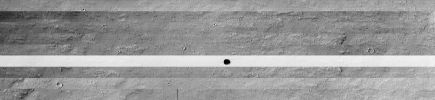
PSP_004847_1745-WFull.JPGThe "Martian Black Hole" (general context frame)60 visiteRingraziamo il Dr Gianluigi Barca per il lavoro svolto e per la pazienza avuta. Di che si tratta? Si tratta della ricostruzione, strip-by-strip, della Regione situata nei pressi del Grande Vulcano Arsia Mons laddove, come vedete bene, si trova il nostro "Martian Black Hole".
Come è facile notare, la striscia che comprende la voragine è stata processata (o ripresa?) in maniera tale da risultare, rispetto alle altre stripes che vanno a comporre l'interezza della Regione, completamente piallata e palesemente sovraesposta.
Il motivo (l'unico che ci viene in mente) potrebbe essere trovato nel tentativo di contrastare meglio quello che si vedeva "dentro" la voragine. Tuttavia, considerati i mezzi dei quali la NASA dispone, ci sentiamo pure di dire che quanto fatto NON è esattamente un "gran bel lavoro".
E allora?
E allora ribadiamo ed esplichiamo meglio quanto scritto in "Velvet Underground": o la NASA è in perfetta Buona Fede (però lavora - spesso - "in qualche modo"...), oppure la porzione di terreno che circonda la "voragine" è stata VOLUTAMENTE piallata, per motivi ignoti.
La Verità? Noi non la sappiamo, ma la nostra Coscienza e Professione ci spingono a proporre TUTTE le ipotesi che ci vengono in mente e che trovano una certa sostanza. Per il resto...dovete decidere Voi.MareKromium
|
|
| 2237 immagini su 187 pagina(e) |
 |
|
|
|
|
117 | |
|
|
|
|





