| Piú viste - Mars Reconnaissance Orbiter (MRO) |
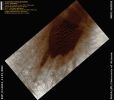
ESP_014041_1145_RED_abrowse.jpgUnusually-looking Dunefield (Natural Colors; credits: Lunexit)62 visitenessun commentoMareKromium
|
|

ESP_014114_0935_RED_abrowse.jpgSouth Polar Residual Cap Monitoring (Natural Colors; credits: Lunexit)62 visitenessun commentoMareKromium
|
|

ESP_014083_0945_RED_abrowse-00.jpgActive Geyser on Mars: the "Region" (Natural Colors; credits: Lunexit)62 visiteCoord.: 85,4° South Lat. and 104,0° East Long.
Spacecraft altitude: about 248 Km
M.L.T.: 16:08 (middle afternoon)
S.I.A.: 69° (with the Sun about 21° above the Local Horizon)
Credits: NASA/JPL/Univ. of Arizona
Additional process. and color.: Lunexit
Attività geotermica su Marte? La risposta, detta quasi sussurrando, ci arriva direttamente dalla NASA ed è "Si": su Marte si manifesta ancora CERTAMENTE un quantum (residuale?) di attività geotermica e la prova è nelle bocche ancora attive di una serie di geysers che vediamo nelle Regioni Sud-Polari (le Regioni che sembrano ospitarne di più, ma certo non le uniche Regioni ancora "vive" di Marte).
Dietro questa semplice (ed affascinante) ammissione, si apre un universo di possibilità, tutte quante accomunate da una circostanza: il sottosuolo di Marte è ancora "vivo" ed è ancora abbastanza "caldo e vivace" da sostenere la verificazione di eventi eruttivi (di modesta scala, ma non per questo di modesta importanza).
A quando la notizia che nel sottosuolo di Marte esistono ancora e, nelle ere, si sono sviluppate ed evolute delle Forme Vitali Indigene?...MareKromium
|
|

ESP_014426_1580_RED_abrowse.jpgTerra Sabaea and Terra Tyrrhena Boundary (Natural Colors; credits: Lunexit)62 visitenessun commentoMareKromium
|
|
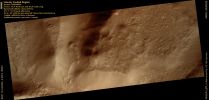
ESP_014306_1905_RED_abrowse.jpgHeavily Faulted Region (Natural Colors; credits: Lunexit)62 visitenessun commentoMareKromium
|
|
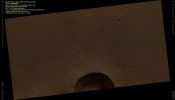
ESP_014262_1510_RED_abrowse.jpgEjecta Blanket - West Side of Zumba Crater (Natural Colors; credits: Lunexit)62 visitenessun commentoMareKromium
|
|
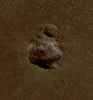
ESP_015962_1695_RED_abrowse-02.jpgRelatively fresh Impact Crater (EDM n.2 - Natural Colors; credits: Dr Paolo C. Fienga - Lunexit Team)62 visitenessun commentoMareKromium
|
|

Polar_Polygons-PIA07354.jpgPolar Polygons (Natural Colors; credits: Dr Paolo C. Fienga - Lunexit Team)62 visitenessun commentoMareKromium
|
|
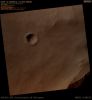
ESP_018094_1720_RED_abrowse.jpgRelatively recent Impact Crater in Meridiani Planum (Absolute Natural Colors; credits: Dr Paolo C. Fienga - Lunexit Team)62 visiteThe approximately 650-mt (2135 foot) diameter Crater in this image is relatively fresh, as evidenced by its sharp Rim and unmodified shape. Ejecta appears on top of pre-existing craters, and stands out against the background, again indicating relative youth.
However, there is something else interesting about the ejecta for this Crater: it is butterfly-shaped, with much more expansive ejecta along one axis, and much less along the other one.
Butterfly-shaped ejecta indicate that the body that caused the crater struck Mars at an oblique (or very shallow) angle. When this happens, the crater shape may be elliptical, although round craters can result from oblique impacts, too. During an oblique impact, much more ejecta is thrown out perpendicular to the direction of impact, and relatively little material is ejected along the impactor's trajectory.
Oblique impacts are relatively rare, and so a fresh, oblique impact like this one is an attractive target.MareKromium
|
|
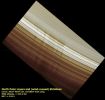
Psp_001488_2665_red.jpgNorth Polar Layers and WInd-caused Striations (Natural Colors; credits for the additional process. and color.: Dr Paolo C. Fienga - Lunexit Team)62 visitenessun commentoMareKromium
|
|
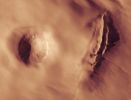
PSP_002922_1725_RED_abrowse-02.jpgPossible Volcanic "Mouth", on Arsia Mons' Flank (EDM - RAW Natural Colors - credits for the additional process.: Dr Marco Faccin)62 visitenessun commentoMareKromium
|
|

ESP_018522_2270-7-MF-PCF-LXTT~0.jpgBull's Eye Impact Crater (Absolute Natural Colors; credits for the additional process. and color.: Dr Paolo C. Fienga - Lunexit Team)62 visiteWhat caused the Central Pit within this Impact Crater: unusual Subsurface Layering or a lucky second impact? Impacts into layers of alternately strong and weak material – for example, ice rich versus non-ice-rich – produce terracing such as that seen between the Inner Pit and the Outer Rim. Scientists have used Terraced Craters to estimate the thickness of Lava Flows on the Moon and elsewhere. Uneven Sublimation and Periglacial Erosion of exposed ice-rich material in the interior of the Crater may explain why the small Central Pit is slightly offset from center relative to the Terrace and Rim of the larger Crater.
The Pit in the center of the main feature could also be from a later Impact Crater striking inside and slightly off-center from the original. It has a Raised Rim, which is characteristic of impact craters and is difficult to explain with a layered target. While no ejecta from this later impact can be seen, the ejecta could have been removed by extensive periglacial modification.
Additionally the Floor Fill around the Inner Crater resembles impact ejects elsewhere at this latitude, and some of the "Landslides" to the East could be flow-back of ejecta off the Walls of the larger crater.MareKromium
|
|
| 2237 immagini su 187 pagina(e) |
 |
|
|
|
|
113 | |
|
|
|
|





