| Piú viste - Mars Reconnaissance Orbiter (MRO) |
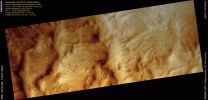
Psp_009548_1420_red.jpgEnigmatic Terrain in Hellas Planitia (Saturated Natural Colors; credits for the additional process. and color.: Dr Paolo C. Fienga - Lunexit Team)62 visiteHellas Planitia is the low-lying plain on the floor of the Hellas Basin, an ancient impact crater over 2000 Km wide. This Basin includes the lowest point on the surface of Mars.
A variety of unusual landforms occur on the floor of the basin due to the low elevation. One hypothesis is that Hellas may once have held lakes or seas, possibly with thick ice that might account for some of these features.
This image shows a small portion of Western Hellas, in a Region of "Enigmatic Ridges".
These ridges form an intricate pattern, enclosing kilometer-wide depressions. These strange features are still not well-understood; one possibility is that they formed in lake-bottom sediments when ice covering the lake touched bottom and shoved wet, loose material to the side.
This HiRISE image reveals that the ridges contain many boulders; sediments deposited on the bottom of a lake might be fine-grained, although they may have hardened to rock later. The image also shows lineations, probably outcropping layers, running between the large ridges.
Because the resolution of HiRISE images is sufficient to see details such as the abundance of boulders and the presence of thin sedimentary layers, images of this and other poorly-understood terrains will be important in interpreting the geological and climatological history of Mars.
This observation is part of a stereo pair along with PSP_007834_1420.MareKromium
|
|
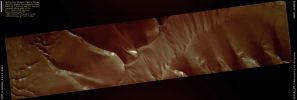
PSP_010090_1255_RED.jpgSpring over Russel Crater (natural colors; credits: Lunexit)62 visiteSpring is already starting to show its influence at the Russell Crater field of sand dunes. Channels down the face of the largest dune show dark spots where the sublimation of the seasonal carbon CO2 Ice Cap has begun.
This active process (where ice evaporates directly to gas) dislodges loose material, leaving dark streaks down steep slopes. The process starts when the Sun peeks above the horizon at the end of Antarctic Night.
Bright streaks may be loose frost cascading down steep slopes.MareKromium
|
|

PSP_009320_1805_RED.jpgLayering in Crater Wall (natural colors; credits: Lunar Explorer Italia)62 visiteMars Local Time: 15:26 (early afternoon)
Coord. (centered): 0,3° North Lat. and 147,2° East Long.
Spacecraft altitude: 273,0 Km (such as about 170,6 miles)
Original image scale range: 27,3 cm/pixel (with 1 x 1 binning) so objects ~54,6 cm across are resolved
Map projected scale: 25 cm/pixel
Map projection: EQUIRECTANGULAR
Emission Angle: 1,9°
Phase Angle: 53,9°
Solar Incidence Angle: 55° (meaning that the Sun is about 35° above the Local Horizon)
Solar Longitude: 102,2° (Northern Summer)
Credits: NASA/JPL/University of Arizona
Additional process. and coloring: Lunar Explorer ItaliaMareKromium
|
|

Psp_009461_2470_red.jpgMonitoring the Northern Plains (possible True Colors; credits: Lunar Explorer Italia)62 visiteMars Local Time: 15:01 (early afternoon)
Coord. (centered): 66,9° North Lat. and 246,0° East Long.
Spacecraft altitude: 312,6 Km (such as about 195,4 miles)
Original image scale range: 31,3 cm/pixel (with 1 x 1 binning) so objects ~62,6 cm across are resolved
Map projected scale: 25 cm/pixel
Map projection: EQUIRECTANGULAR
Emission Angle: 0,3°
Phase Angle: 51,4°
Solar Incidence Angle: 51° (meaning that the Sun is about 39° above the Local Horizon)
Solar Longitude: 107,2° (Northern Summer)
Credits: NASA/JPL/University of Arizona
Additional process. and coloring: Lunar Explorer ItaliaMareKromium
|
|

Psp_010369_2065_red.jpgScoured Crater Rim (possible True Colors; credits: Lunar Explorer Italia)62 visiteMars Local Time: 15:30 (middle afternoon)
Coord. (centered): 26,3° North Lat. and 304,3° East Long.
Spacecraft altitude: 290,2 Km (such as about 181,4 miles)
Original image scale range: 29 cm/pixel (with 1 x 1 binning) so objects ~87 cm across are resolved
Map projected scale: 25 cm/pixel
Map projection: EQUIRECTANGULAR
Emission Angle: 8,1°
Phase Angle: 57,9°
Solar Incidence Angle: 50° (meaning that the Sun is about 40° above the Local Horizon)
Solar Longitude: 140,7° (Northern Summer)
Credits: NASA/JPL/University of Arizona
Additional process. and coloring: Lunar Explorer ItaliaMareKromium
|
|

Psp_010624_2045_red.jpgFresh Impact Crater (Natural Colors; credits: Lunar Explorer Italia)62 visiteMars Local Time: 15:34 (middle afternoon)
Coord. (centered): 24,1° North Lat. and 182,5° East Long.
Spacecraft altitude: 291,6 Km (such as about 182,3 miles)
Original image scale range: 29,2 cm/pixel (with 1 x 1 binning) so objects ~88 cm across are resolved
Map projected scale: 25 cm/pixel
Map projection: EQUIRECTANGULAR
Emission Angle: 7,9°
Phase Angle: 59,9°
Solar Incidence Angle: 52° (meaning that the Sun is about 38° above the Local Horizon)
Solar Longitude: 150,7° (Northern Summer)
Credits: NASA/JPL/University of Arizona
Additional process. and coloring: Lunar Explorer ItaliaMareKromium
|
|

ESP_011345_0950_RED_abrowse.jpgSmall Fan-like Surface Features on the South Polar Perennial Cap (Natural Colors; credits: Lunar Explorer Italia)62 visiteMars Local Time: 17:54 (late afternoon)
Coord. (centered): 84,8° South Lat. and 339,3° East Long.
Spacecraft altitude: 247,7 Km (such as about 154,8 miles)
Original image scale range: 99,1 cm/pixel (with 1 x 1 binning) so objects ~ 2,97 mt across are resolved
Map projected scale: 1 mt/pixel
Map projection: EQUIRECTANGULAR
Emission Angle: 0,9°
Phase Angle: 88,7°
Solar Incidence Angle: 89° (meaning that the Sun is about 1° above the Local Horizon)
Solar Longitude: 181,0° (Northern Autumn)
Credits: NASA/JPL/University of Arizona
Additional process. and coloring: Lunar Explorer ItaliaMareKromium
|
|

ESP_012016_1800_RED_abrowse.jpgIani Chaos (Natural Colors; credits: Lunar Explorer Italia)62 visitenessun commentoMareKromium
|
|
ESP_013066_1070_RED_abrowse.jpgFault in the South Polar Layered Deposits (Natural Colors; credits: Lunar Explorer Italia)62 visitenessun commentoMareKromium
|
|
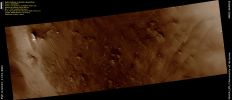
PSP_010397_1725_RED_abrowse-00.jpgLight-Toned Rock Exposures in Noctis Labyrinthus OR Salty "Outlines"? (ctx frame - Natural Colors; credits: Lunar Explorer Italia)62 visitenessun commentoMareKromium
|
|

ESP_013958_1170_RED_abrowse.jpgDD Tracks in Aonia Terra (Natural Colors; credits: Lunexit)62 visiteThroughout this entire image in Aonia Terra, it is possible to make out regular polygonally shaped patterns. Here on Earth, wherever ice-rich permafrost occurs (soil which stays frozen throughout the year), the ground may crack and form similar patterns to those we see on Mars.
Despite remaining below freezing, changes in seasons and ground temperature cause significant thermal-contraction stress, enough so that the terrain fractures into a honeycomb network of subsurface cracks.
Criss-crossed dark paths wind throughout this Region. Dust Devils, turbulent whirlwinds fueled by rising ground-warmed Atmosphere, track across the Surface, stripping the ground of bright surface dust as they go. Comparable to miniature tornadoes, they efficiently transport Surface Materials on Mars. Left in their passing is the darker coarse-grained soil underneath.
In this image, the Sun is low on the horizon; the shadows make it easier to see the scattered rocks and boulders.
Sometimes, these boulders occur in rings, the remnants of an ancient impact whose crater has since eroded to a flat surface. The boulders are left behind, illustrating where the form of the crater once stood.MareKromium
|
|

ESP_014126_2120_RED_abrowse.jpgNorthern Crater with Windstreak (Natural Colors; credits: Lunexit)62 visitenessun commentoMareKromium
|
|
| 2237 immagini su 187 pagina(e) |
 |
|
|
|
|
112 | |
|
|
|
|





