| Piú viste - Mars Reconnaissance Orbiter (MRO) |

ESP_013958_1170_RED_abrowse.jpgDD Tracks in Aonia Terra (Natural Colors; credits: Lunexit)62 visiteThroughout this entire image in Aonia Terra, it is possible to make out regular polygonally shaped patterns. Here on Earth, wherever ice-rich permafrost occurs (soil which stays frozen throughout the year), the ground may crack and form similar patterns to those we see on Mars.
Despite remaining below freezing, changes in seasons and ground temperature cause significant thermal-contraction stress, enough so that the terrain fractures into a honeycomb network of subsurface cracks.
Criss-crossed dark paths wind throughout this Region. Dust Devils, turbulent whirlwinds fueled by rising ground-warmed Atmosphere, track across the Surface, stripping the ground of bright surface dust as they go. Comparable to miniature tornadoes, they efficiently transport Surface Materials on Mars. Left in their passing is the darker coarse-grained soil underneath.
In this image, the Sun is low on the horizon; the shadows make it easier to see the scattered rocks and boulders.
Sometimes, these boulders occur in rings, the remnants of an ancient impact whose crater has since eroded to a flat surface. The boulders are left behind, illustrating where the form of the crater once stood.MareKromium
|
|

ESP_014114_0935_RED_abrowse.jpgSouth Polar Residual Cap Monitoring (Natural Colors; credits: Lunexit)62 visitenessun commentoMareKromium
|
|

ESP_014418_0930_RED_abrowse.jpgSouth Polar Residual Cap Monitoring (Natural Colors; credits: Lunexit)62 visitenessun commentoMareKromium
|
|

ESP_014284_2045_RED_abrowse.jpgUnnamed Crater in Mawrth Vallis Region (Natural Colors; credits: Lunexit)62 visitenessun commentoMareKromium
|
|

ESP_014261_0930_RED_abrowse.jpgSouth Polar Residual Cap Monitoring (Natural Colors; credits: Lunexit)62 visiteThis HiRISE image is of a portion of Mars' South Polar Residual Ice Cap. Like Earth, Mars has concentrations of water ice at both Poles.
Because Mars is so much colder, however, the seasonal ice that gets deposited at high latitudes in the Winter and is removed in the Spring (generally analogous to winter-time snow on Earth) is actually Carbon Dioxide Ice. Around the South Pole there are areas of this CO2 ice that do not disappear every Spring, but rather survive Winter after Winter. This persistent Carbon Dioxide Ice is called "South Polar Residual Cap", and is what we are looking at in this HiRISE image.
Relatively high-standing smooth material is broken up by semi-circular depressions and linear, branching troughs that make a pattern resembling those of your fingerprints. The high-standing areas are thicknesses of several meters of CO2 Ice.
The depressions and troughs are thought to be caused by the removal of Carbon Dioxide Ice by Sublimation (the change of a material from solid directly to gas). HiRISE is observing this CO2 Terrain to try to determine how these patterns develop and how fast the depressions and troughs grow.
While the South Polar Residual Cap as a whole is present every year, there are certainly changes taking place within it. With the high resolution of HiRISE, we intend to measure the amount of expansion of the depressions over multiple Mars years.
Knowing the amount of Carbon Dioxide removed can give us an idea of the atmospheric, weather, and climate conditions over the course of a year.
In addition, looking for where CO2 Ice might be being deposited on top of this terrain may help us understand if there is any net loss or accumulation of the CO2 Ice over time, which would be a good indicator of whether Mars' climate is in the process of changing, or not. (Written by: Patrick Russell)MareKromium
|
|
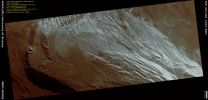
PSP_001456_1695_RED_abrowse-00.jpgLight Layered Deposits in Valles Marineris Region (CTX Frame - Natural Colors; credits: Lunexit)62 visiteThis image shows bright Layered Deposits near the junction of Coprates Chasma and Melas Chasma, both part of the Valles Marineris Canyon System.
The Outcrop visible in this frame is found in a wide Alcove located in the Northern Wall and it forms a broad mound which is several kilometers wide; dark, wind-blown materials cover it in places.
Similar light-toned rock occurs in many places of the Valles Marineris.
An important question is when these materials formed: were they deposited within the Troughs after they opened and then eroded, or are they remnants of the Wall Rock?
Analysis of the orientation of the layers using HiRISE images may help scientists answer this question.
There are no fresh Impact Craters preserved on the Outcrop Surface, suggesting that the Layered Deposits are being eroded rapidly enough to erase the Craters.
In many places, the light rocks have regular fractures called "Joints". Joints are common in Earthly rocks and HiRISE images show them in many places on Mars as well.
These Joints can provide information about the forces that affected - in time - the rocks of this area, and therefore they could also help us to (at least partially) unravel the Geologic History of Mars in general and this Outcrop in particular.MareKromium
|
|

ESP_011386_2065_and_ESP_011531_2065.jpgCollapse Features in Tractus Fossae (High-Def-3D; credits: Dr M. Faccin)62 visiteAcquisition date: 30 December 2008
Mars Local Time: 15:46 (middle afternoon)
Latitude (centered): 26,1° North
Longitude: 259,4° East
Range to target site: 281,9 Km (approx 176,2 miles)
Original image scale range: 28,2 cm/pixel (with 1 x 1 binning) so objects ~85 cm across are resolved
Map projected scale: 25 cm/pixel and North is up
Map projection: EQUIRECTANGULAR
Emission angle: 6,7°
Phase angle: 54,5°
Solar Incidence Angle: 61° (with the Sun about 29° above the Local Horizon)
Solar Longitude: 182,8° (Northern Autumn)MareKromium
|
|
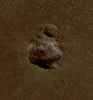
ESP_015962_1695_RED_abrowse-02.jpgRelatively fresh Impact Crater (EDM n.2 - Natural Colors; credits: Dr Paolo C. Fienga - Lunexit Team)62 visitenessun commentoMareKromium
|
|
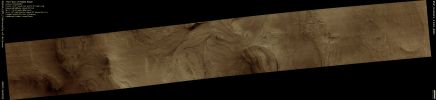
ESP_016022_1420_RED_abrowse-00.jpgThe Floor of Hellas Basin (CTX Frame - Natural Colors; credits: Dr Paolo C. Fienga - Lunexit Team)62 visiteHiRISE images are revealing some very strange landforms on the Floor of Hellas. Materials appear to have flowed in a viscous manner, like ice.
Viscous flow features are common over the Middle Latitudes of Mars, but those in Hellas are often distinctive for unknown reasons.
MareKromium
|
|

PSP_001700_2505_RED_abrowse-01.jpgThe "Frozen pseudo-Lake" of Vastitas Borealis (EDM - Natural Colors; credits: Dr Paolo C. Fienga - Lunexit Team)62 visiteLa parte realmente "interessante" del frame è proprio nella texture della porzione più chiara e profonda del "Frost Patch", perchè è in quel punto della Surface Feature che, volendo, si riesce a vedere qualcosa di significativo e quindi si può anche provare a ragionare e ad osservare con estrema attenzione eppure...eppure la NASA ci mostra le dunette (fangose?) che lo delimitano ed ignora il resto.
Beh, vorrà dire che l'Analisi sulla porzione più "bianca e profonda" del Frost Patch la faremo noi, con calma.
E che i Signori di Pasadena ci scusino tanto per aver osato dubitare della correttezza del loro (pseudo) "Metodo Scientifico"!MareKromium
|
|
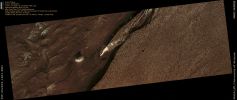
PSP_002839_1825_RED_abrowse-1.jpgAram Chaos (Absolute Natural Colors; credits for the additional process. and color.: Dr Paolo C. Fienga - Lunexit Team)62 visiteAram Chaos appears to be a former impact crater. The terrain is disrupted, giving it a chaotic appearance (hence the name "chaos"). Scientists have postulated that a lake may have once existed inside the crater and sediments were laid down within the lake. The mineral Hematite (rich in Iron) has been detected by orbiting spacecraft within Aram Chaos. Hematite has been identified in several other locations on Mars, including at the Mars Exploration Rover Landing Site in Meridiani Planum. The Hematite at both Meridiani and Aram Chaos most likely formed by precipitation in water.
This HiRISE image shows the light-toned sediments inside Aram Chaos that could have formed in a former lake. Unfortunately, dark debris now obscures much of this sediment, making it difficult to view and interpret the rocks. The light-toned Layered Deposit in the South (left) of the image is higher standing and has a peculiarly-looking pitted surface.
Circular structures with dark centers are likely to be impact craters that have been partly filled with dark debris, including sand. More irregular depressions appear to result from erosion of layered beds within the sediments. Wind could erode materials that are slightly weaker more quickly and produce the irregular topography seen along the surface of the deposit.MareKromium
|
|

ESP_018485_1765_RED_abrowse.jpgPeri-Equatorial Scarp and Fans (Natural Colors; credits for the additional process. and color.: Dr Paolo C. Fienga - Lunexit Team)62 visitenessun commentoMareKromium
|
|
| 2237 immagini su 187 pagina(e) |
 |
|
|
|
|
111 | |
|
|
|
|





