| Piú viste - Mars Reconnaissance Orbiter (MRO) |
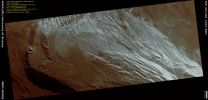
PSP_001456_1695_RED_abrowse-00.jpgLight Layered Deposits in Valles Marineris Region (CTX Frame - Natural Colors; credits: Lunexit)63 visiteThis image shows bright Layered Deposits near the junction of Coprates Chasma and Melas Chasma, both part of the Valles Marineris Canyon System.
The Outcrop visible in this frame is found in a wide Alcove located in the Northern Wall and it forms a broad mound which is several kilometers wide; dark, wind-blown materials cover it in places.
Similar light-toned rock occurs in many places of the Valles Marineris.
An important question is when these materials formed: were they deposited within the Troughs after they opened and then eroded, or are they remnants of the Wall Rock?
Analysis of the orientation of the layers using HiRISE images may help scientists answer this question.
There are no fresh Impact Craters preserved on the Outcrop Surface, suggesting that the Layered Deposits are being eroded rapidly enough to erase the Craters.
In many places, the light rocks have regular fractures called "Joints". Joints are common in Earthly rocks and HiRISE images show them in many places on Mars as well.
These Joints can provide information about the forces that affected - in time - the rocks of this area, and therefore they could also help us to (at least partially) unravel the Geologic History of Mars in general and this Outcrop in particular.MareKromium
|
|

ESP_011386_2065_and_ESP_011531_2065.jpgCollapse Features in Tractus Fossae (High-Def-3D; credits: Dr M. Faccin)63 visiteAcquisition date: 30 December 2008
Mars Local Time: 15:46 (middle afternoon)
Latitude (centered): 26,1° North
Longitude: 259,4° East
Range to target site: 281,9 Km (approx 176,2 miles)
Original image scale range: 28,2 cm/pixel (with 1 x 1 binning) so objects ~85 cm across are resolved
Map projected scale: 25 cm/pixel and North is up
Map projection: EQUIRECTANGULAR
Emission angle: 6,7°
Phase angle: 54,5°
Solar Incidence Angle: 61° (with the Sun about 29° above the Local Horizon)
Solar Longitude: 182,8° (Northern Autumn)MareKromium
|
|

PSP_001700_2505_RED_abrowse-01.jpgThe "Frozen pseudo-Lake" of Vastitas Borealis (EDM - Natural Colors; credits: Dr Paolo C. Fienga - Lunexit Team)63 visiteLa parte realmente "interessante" del frame è proprio nella texture della porzione più chiara e profonda del "Frost Patch", perchè è in quel punto della Surface Feature che, volendo, si riesce a vedere qualcosa di significativo e quindi si può anche provare a ragionare e ad osservare con estrema attenzione eppure...eppure la NASA ci mostra le dunette (fangose?) che lo delimitano ed ignora il resto.
Beh, vorrà dire che l'Analisi sulla porzione più "bianca e profonda" del Frost Patch la faremo noi, con calma.
E che i Signori di Pasadena ci scusino tanto per aver osato dubitare della correttezza del loro (pseudo) "Metodo Scientifico"!MareKromium
|
|

ESP_018485_1765_RED_abrowse.jpgPeri-Equatorial Scarp and Fans (Natural Colors; credits for the additional process. and color.: Dr Paolo C. Fienga - Lunexit Team)63 visitenessun commentoMareKromium
|
|

ESP_019193_2665_RED_abrowse.jpgExposed NPLD (Absolute Natural Colors; credits for the additional process. and color.: Dr Paolo C. Fienga - Lunexit Team)63 visitenessun commentoMareKromium
|
|

Chasma-Ophir_Chasma-PSP_007535_1755-PCF-LXTT-IPF.jpgFeatures of Ophir Chasma (CTX Frame - Absolute Natural Colors; credits for the additional process. and color.: Dr Paolo C. Fienga/Lunar Explorer Italia/Italian Planetary Foundation)63 visiteThe really huge Landslides existing along the Walls of Ophir Chasma (which is nothing else but a deep Canyon located in the Coprates Quadrangle of Mars, at about 4° South Latitude and 72,5° West Longitude. It is approx. 317 km long and it was so named after a "Classical Albedo Feature") host a variety of Geologic Surfaces and Mineralogies.
Some of them possess a variety of Hydrated Sulfate Minerals that formed, eons ago, in the presence of Partially Acidic Liquid Water. This NASA - Mars Reconnaissance Orbiter's Contextual (or "CTX", for short) Image, which is representing an ancient (possibly and approximately 3 Billion Years-old) Landslide, shows us the presence, within it, of 2 (two) very distinct Surface Albedoes, which, in fact, mark a Transition Zone from one Sulfate Mineralogy to another (a circumstance that proves beyod doubts the occurrence, in a far and distant past, of some remarkable variations in the evolution of the visible Surface).
The Upper Slopes (such as the ones located towards the North) are light-toned, and this fact is due to the concurrent abundance of Hydrated Sulfate Minerals and Bright Surface Dust. On the other hand, the Surfaces that make up the Southern Portion of the Landslide, are darker in tone, and this is due to the greater abundance of Dark Sediment that, in time, formed "Strings of Sand Drifts". In addition to the above, the underlying Units of Bedrock consist of Darker Minerals that received a lesser hydration then the Northern ones, and this further circumstance implies the occurrence of a strong (and, perhaps, sudden) change in the Ancient Aqueous Environments that formed them.
Mars Local Time: 14:52 (Early Afternoon)
Coord. (centered): 4,328° South Lat. and 288,657° East Long.
Spacecraft altitude: 271,0 Km (such as about 168,291 miles)
Original image scale range: 27,1 cm/pixel (with 1 x 1 binning) so objects ~ 81 cm across are resolved
Map projected scale: 25 cm/pixel
Map projection: EQUIRECTANGULAR
Emission Angle: 6,3°
Phase Angle: 52,7°
Solar Incidence Angle: 47° (meaning that the Sun was about 43° above the Local Horizon at the time the picture was taken)
Solar Longitude: 27,0° (Northern Spring - Southern Fall)
Credits: NASA/JPL/University of Arizona
Additional process. and coloring: Lunar Explorer Italia
This picture (which is a NASA - Original Mars Reconnaissance Orbiter b/w and NON-Map Projected frame identified by the serial n. PSP_007535_1755) has been additionally processed, magnified, contrast enhanced, Gamma corrected, and then colorized in Absolute Natural Colors (such as the colors that a human eye would actually perceive if someone were onboard the NASA - Mars Reconnaissance Orbiter and then looked down, towards the Surface of Mars), by using an original technique created - and, in time, dramatically improved - by the Lunar Explorer Italia Team.MareKromium
|
|
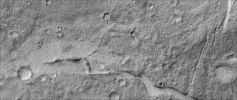
T-TRA_000834_1835_RED.jpgAram Chaos62 visiteAram Chaos is thought to be a degraded impact crater that was once filled with water and sedimentary units. The term "chaos" refers to the cracks and angled blocks formed perhaps by withdrawl of subsurface material. This sub-image covers only a small portion of Aram Chaos and illustrates the modification of the crater by fracturing, younger impact craters, and wind. A linear fracture cuts through the center of the image while a more sinuous depression filled with bright ripples or dunes is located towards the bottom of the image. Both depressions could have resulted from collapse associated with modification of the impact crater that created Aram Chaos or later disruption when water and sediment covered some of the crater floor. Impact craters of many shapes and sizes can be seen across the image, indicating a relatively older surface that has seen little modification since its formation. The bright ripples or dunes appear to cluster in low-lying topography, such as the sinuous depression and a larger impact crater in the lower right of the image, suggesting that wind has moved fine material along the surface until it becomes trapped in low spots where it collects to form ripples or dunes.
|
|
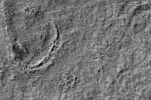
T-TRA_000830_1440_RED_NigerVallis_01.jpgNiger Vallis62 visiteThis image shows a portion of the floor of Niger Vallis, an ancient Martian outflow channel. Niger Vallis originates on the flanks of the volcano Hadriaca Patera, and empties into the Hellas impact basin. Outflow channels are observed in many regions of the planet, and may have been carved by brief eruptions of liquid water from beneath the surface. Since Niger Vallis formed, impacts have cratered the channel floor, and fine-grained wind-blown debris has been transported across the surface, eroding and burying all but the freshest craters. The curved ridge in the scene may be the remnant of a large crater rim. At the high resolution of this image, a pattern of parallel dunes and ripples can be seen, as well as individual boulders as large as two meters across.
|
|

Northern_Plains-Psp_001380_2520_red-00.jpgAnother "Frozen Lake" in the Northern Plains? (1 - CTX Frame - False Colors; credits for the additional process. and color.: Dr Paolo C. Fienga - Lunexit Team)62 visitenessun commentoMareKromium
|
|

North_Polar_Layers-PSP_001334_2645_RED.jpgIcy North Polar Layers (natural colors)62 visitenessun commentoMareKromium
|
|

PSP_003193_0850_RED_browse_00.jpgMartian Spring: the "V" Fans (context image)62 visiteSouthern Spring sunshine is causing the seasonal Carbon Dioxide (CO2) Cap at the South Pole to evaporate.
This process happens fitfully, as small and large spots expose bare ground, which warms up, causing small spots to grow.
The defrosting areas are controlled by small scale differences in topography, which cause some areas of frost to be sheltered longer than others.
Once dust has accessed the surface it is blown in directions controlled by the local winds, making a distinctive fan. When the wind changes direction the fans broaden or may show multiple orientations.
It has also been proposed that dust is carried to the top of translucent seasonal carbon dioxide ice by release of gas held under pressure by the ice cap. When the pressure is released, like pulling the cork out of a champagne bottle, the gas escapes, carrying dust with it.MareKromium
|
|

PSP_003222_1565_RED_browse.jpgProposed MSL Site in Eberswalde Crater62 visitenessun commentoMareKromium
|
|
| 2237 immagini su 187 pagina(e) |
 |
|
|
|
|
110 | |
|
|
|
|





