| Piú viste - Mars Reconnaissance Orbiter (MRO) |

PSP_003695_1250_RED_abrowse-00.jpgUnnamed Southern Crater with Large Dunefield and DD Streaks (CTX Frame - Natural Colors; credits for the additional process. and color.: Dr Paolo C. Fienga - Lunexit Team)64 visitePSP_003695_1250 shows a Southern Hemisphere crater with gullies, dunes, periglacial modification, bright rock deposits and Dust Devil Tracks.
Although these features are all common on Mars, there are not many places that have all of them together as viewed here.
The gullies seen at the top of the image are likely caused by wet debris flows. They have deposits of multiple ages. The gully on the left has bright deposits that have been modified by periglacial processes overlain by slightly darker deposits that have not been modified. Periglacial processes, such as seasonal freezing and thawing, are responsible for the polygonal fractures seen near the gullies and around the image.
The dark material in the center of the image is a dune field.
There are several different sizes and orientations of dunes — these different orientations indicate that the dominant winds in the area have changed throughout time.
The dark streaks that criss-cross on the outskirts of the dune field are DDT.
DDs are spinning cells of dust that travel across the Martian Surface. As they move, they pick up and redeposit particles, as well as disturbing dust on the surface.
They are responsible elsewhere on Mars for removing dust from the solar panels of the Mars Exploration Rovers Spirit and Opportunity, which has helped to extend their missions way beyond the 90-day primary mission.
Note that the black rectangular feature near the top right of the image is a data gap resulting from data transmission problems; it is not a real feature. MareKromium
|
|
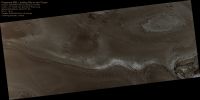
PSP_003907_1780_RED_browse-1.jpgProposed MSL Site in Iani Chaos (Natural Colors; credits for the additional process. and color.: Dr Paolo C. Fienga - Lunexit Team)64 visitenessun commentoMareKromium
|
|
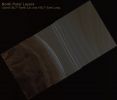
NorthernLayers-TRA_000878_2660_RED.jpgNorth Polar Layered Deposits (Absolute Natural Colors; credits for the additional process. and color.: Dr Paolo C. Fienga - Lunexit Team:)64 visitenessun commentoMareKromium
|
|

PSP_006972_1710_RED_abrowse.jpgRecent Impact (Absolute Natural Colors; credits for the additional process. and color.: Dr Paolo C. Fienga - Lunexit Team)64 visitenessun commentoMareKromium
|
|

ESP_031268_2115-PCF-LXTT-IPF-0.jpgUnusually-looking Surface Feature (CTX Frame - Absolute Natural Colors; credits for the additional process. and color.: Dr Paolo C. Fienga/Lunar Explorer Italia/Italian Planetary Foundation)64 visiteThis image, taken by the NASA - Mars Reconnaissance Orbiter on March 28, 2013, shows us a number of shallow and Irregular Pit-like Features with Raised Rims, all concentrated along Ridges and other Topographic Features (---> Surface Reliefs). How did these unusually-looking Surface Features form? One idea is that they could be the final and visible result of the Sublimation of shallow lenses of nearly pure Ice but, even assuming that this theory is correct, why do the Pits have Raised Rims? So far, nobody was good enough to answer to that question.
If we keep reasoning about the possible nature of these Surface Features, we also have to say that they cannot - reasonably - be just shallow Impact Craters, because such an alignment seems extremely unlikely (and the irregular margins of the alleged "Impact Craters" would be even harder to explain); furthermore, these Landforms cannot even be Wind-blown Deposits of Material because, all the way next to them, can be seen very many Boulders which are way too big (and therefore too heavy!) to be moved simply by the Wind.
As you can see, there are younger Wind-blown Drifts on top of the Pits and, for the time being, we have not found a clear (---> substantiated) connection between these Landforms and some possible Volcanic Phenomenon. However, a few Planetary Scientists speculated that there might have been ancient Oceans over this Region, but could this possibility, even if it is correct, somehow be good to satisfactorily explain these Features? The answer is no. Last, but not least, what we see in this frame could also be the result of an ancient Glaciation where, perhaps, powerful Winds deposited Ice-rich Debris next to Topographic Obstacles.
Future (and closer) images of this Region may provide us with more clues but, for now, this Landforms are still a mystery. Just one of the many, of course...
Mars Local Time: 14:20 (Early Afternoon)
Coord. (centered): 30,959° North Lat. and 339,402° East Long.
Spacecraft altitude: 293,8 Km (such as about 182,449 miles)
Original image scale range: 58,8 cm/pixel (with 2 x 2 binning) so objects ~ 1 mt and 76 cm across are resolved
Map projected scale: 50 cm/pixel
Map projection: EQUIRECTANGULAR
Emission Angle: 2,6°
Phase Angle: 62,5°
Solar Incidence Angle: 64° (meaning that the Sun was about 26° above the Local Horizon at the time the picture was taken)
Solar Longitude: 290,8° (Northern Winter - Southern Summer)
Credits: NASA/JPL/University of Arizona
Additional process. and coloring: Lunar Explorer Italia
This picture (which is a NASA - Original Mars Reconnaissance Orbiter NON-Map Projected EDM b/w frame identified by the serial n. ESP_031268_2115-1) has been additionally processed and then colorized in Absolute Natural Colors (such as the colors that a human eye would actually perceive if someone were onboard the NASA - Mars Reconnaissance Orbiter and then looked down, towards the Surface of Mars), by using an original technique created - and, in time, dramatically improved - by the Lunar Explorer Italia Team.MareKromium
|
|

Q-pia08014-05-AEB1-full-reduced1.jpgMartian Southern Highlands (5) - HR63 visitenessun commento
|
|

TRA_000827_1875_RED_browse-2.jpgCerberus' River (Extremely Saturated Natural Colors; credits for the additional process. and color.: Dr Gianluigi Barca - Lunexit Team)63 visitenessun commentoMareKromium
|
|

PSP_006991_1905.jpgSeeps (MULTISPECTRUM; credits: Lunexit)63 visitenessun commentoMareKromium
|
|
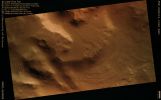
PSP_008233_1920_RED_abrowse.jpgCrater Floor Fan (MULTISPECTRUM; credits: Lunexit)63 visiteThis image shows a Fan of material deposited on the floor of a large Impact Crater.
The material was transported into the Crater through a valley, likely by running water. The end of the valley is visible in the West (lower) part of the image. Arcuate steps visible in the East are probably due to layers of different strength or cohesion; these suggest variations in the flow conditions.
A faint Trough is carved into the upper surface of the Fan. This could have been cut by the last water to flow across the surface. If the channel was flowing into a lake, this might indicate a drop in lake level, leading to erosion.
The surface of the Fan has many small dark spots, particularly on the upper tier.
The largest spots, most commonly around impact craters, are big enough to show that these are boulders.
If these boulders are original and not due to the hardening of fan sediments into rock, it suggests that the flows which deposited the Fan were relatively energetic events able to carry rocks across several feet.MareKromium
|
|

Mawrth_Vallis-The_Pyramid-GIF.gifZooming on a "Pseudo-Pyramid" - Mawrth Vallis (GIF-Movie, by Carlo Contu)63 visiteAcquisition date: January, 05, 2007
Local Mars Time: 15:32
Latitude: 22,5° North
Longitude: 341,8° East
Range to target site: 286,8 Km
Original image scale range: 28,7 cm/pixel (with 1 x 1 binning) so objects ~86 cm across are resolved
Emission angle: 6,3 °
Phase angle: 59,4 °
Solar incidence angle: 53°, with the Sun about 37° above the horizon MareKromium
|
|

Psp_009011_1705_red.jpg"Apparent Valley", West of Ganges Chasma (natural colors; credits: Lunexit)63 visiteThis image shows an "Apparent Valley" North of a 37-Km long pit called Ophir Cavus. This valley is just West of another 155-Km long valley system called Allegheny Vallis, that also emanates from the pit.
The association of valleys with the pit suggests that water was released when the pit formed, perhaps when volcanic eruptions melted ice in the surface or subsurface.
The HiRISE image reveals light-toned units along portions of the plains and these could be minerals deposited by the flowing water or alteration of the plains by the water that once flowed here.MareKromium
|
|
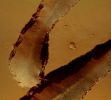
PSP_009913_1910_RED_abrowse-01.jpgFissures in Cerberus Fossae (Enhanced and Saturated Natural Colors; credits: Lunexit)63 visiteThe colors in this frame result from differences in composition of the materials and ALSO represent how the landscape would appear to the human eye. Note that one can make out boulders and small dunes at the bottom of these fractures and layering within the walls. Just visible at the top of the image is some well-preserved impact crater ejecta.
The image is 1,2 Km across.MareKromium
|
|
| 2237 immagini su 187 pagina(e) |
 |
|
|
|
|
108 | |
|
|
|
|





