| Piú viste - Mars Reconnaissance Orbiter (MRO) |
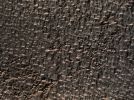
PSP_008427_1380_RED_abrowse-02.jpgAutumn in Hellas Basin (edm n. 2 - MULTISPECTRUM-2; credits: Lunexit)64 visitenessun commentoMareKromium
|
|
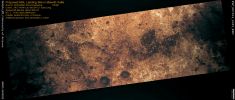
PSP_007612_2045_RED_abrowse~0.jpgProposed MSL Landing Site in Mawrth Vallis (MULTISPECTRUM; credits: Lunexit)64 visitenessun commentoMareKromium
|
|

PIA10142-SeasonalDryIce~0.jpgTranslucent Seasonal Ice (MULTISPECTRUM; credits: Lunexit)64 visiteIn a Region near the South Pole of Mars, translucent Carbon Dioxide ice covers the ground seasonally. For the first time we can "see" the translucent ice by the affect it has on the appearance of the surface below.
Dark fans of dust from the surface drape over the top of the seasonal ice.
The surface would be the same color as the dust except that the seasonal ice affecting its appearance. Bright bluish streaks are frost that has re-crystallized from the atmosphere.
Sunlight can penetrate through the seasonal layer of translucent ice to warm the ground below. That causes the seasonal ice layer to sublime (evaporate) from the bottom rather than the top. MareKromium
|
|

PSP_006278_2225_RED_abrowse.jpgUnusual Surface Patterns inside Moreux Crater (MULTISPECTRUM; credits: Lunexit)64 visiteUnusual surface patterns near the center of Moreux Crater suggest a complicated history of glacial flow. A series of ridges and troughs originating from the crater’s central peak to the west of this image terminate in this area in a jumble of twisted patterns and circular depressions.
The superposition of impact craters and sand dunes on top of these ridges and troughs suggests that the flow patterns are old and that any ice may be largely gone. The round depressions may have formed when large sections of relatively clean ice were left in place to melt or sublimate. The ridges would be analogous to moraines in Earth glaciers, formed from rock and debris mixed with the ice that flow with the glacier.
The complicated and twisting patterns indicate that the ice flowed into this area, which is at a lower elevation on the crater floor, and piled up behind itself as the flow stalled. Numerous boulders are also scattered over the surface of ridges and troughs.
Boulders may have been carried into place with the ice and as the ice was removed, the boulders were left in place.
MareKromium
|
|
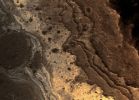
PIA11377.jpgMartian "Opal" (natural colors; credits: Lunexit)64 visiteNASA's Mars Reconnaissance Orbiter has revealed Martian rocks containing a hydrated mineral similar to Opal.
The rocks are light-toned and appear cream-colored in this natural-color image taken by the High Resolution Imaging Science Experiment (HiRISE) camera. Images acquired by the orbiter reveal that different layers of rock have different properties and chemistry.
The Opal minerals are located in distinct beds of rock outside of the large Valles Marineris Canyon System and are also found in rocks within the canyon. The presence of opal in these relatively young rocks tells scientists that water, possibly as rivers and small ponds, interacted with the surface as recently as two billion years ago, one billion years later than scientists had expected.
The discovery of this new category of minerals spread across large regions of Mars suggests that liquid water played an important role in shaping the Planet's Surface and possibly hosting life. MareKromium
|
|
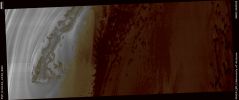
PSP_010169_2650_RED_abrowse-00.jpgDunes and other Surface Features in Chasma Boreale (ctx frame - possible True Colors; credits: Lunexit)64 visiteThis image shows dark sand dunes in Chasma Boreale. Chasma Boreale is a giant trough that cuts into the North Polar Ice Cap for about 570 Km (approx. 350 miles) forming a broad valley bordered by stacked layers of ice.
A portion of the North Polar Ice Cap is visible at the northern edge of the trough in the left portion of the image.
Many dark toned sand dunes march down the trough under the winds’ direction.
Coord.: 84,9° North Lat. and 331,8° East Long.
Spacecraft altitude: about 319 Km
M.L.T.: 13:35 (early afternoon)
Solar Incidence Angle: 67°MareKromium
|
|

Psp_009468_2385_red.jpgCentral Peak of an Unnamed Crater in the Northern Plains (possible True Colors; credits: Lunar Explorer Italia)64 visiteMars Local Time: 15:13 (early afternoon)
Coord. (centered): 57,9° North Lat. and 58,7° East Long.
Spacecraft altitude: 310,8 Km (such as about 194,2 miles)
Original image scale range: 31,1 cm/pixel (with 1 x 1 binning) so objects ~93 cm across are resolved
Map projected scale: 25 cm/pixel
Map projection: EQUIRECTANGULAR
Emission Angle: 6,1°
Phase Angle: 42,5°
Solar Incidence Angle: 48° (meaning that the Sun is about 42° above the Local Horizon)
Solar Longitude: 107,4° (Northern Summer)
Credits: NASA/JPL/University of Arizona
Additional process. and coloring: Lunar Explorer ItaliaMareKromium
|
|
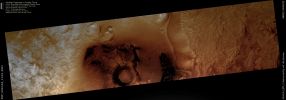
PSP_006504_1910_RED_abrowse-00~0.jpgAeolian Features in Arabia Terra (MULTISPECTRUM; credits: Lunexit)64 visiteThis observation shows part of the floor of a large impact crater in Arabia Terra. This crater formed in the distant past when a large asteroid or comet struck Mars, and it has been heavily modified since formation.
The crater was partially filled by sediments, forming the rock outcrops and layers visible in this image.
After this material was laid down, part of the deposits were eroded away. The central part of the image has been carved especially deeply, forming a distinct depression.
This depression has been a site of aeolian transport of sand in more recent times. A particularly interesting aspect of this site is that there appears to have been multiple styles of aeolian activity. Both large sand dunes (the dark hills) and smaller ripples (sharp, light-toned narrow ridges) are visible.
While ripples are often found in association with dunes, the different colors suggest that the material is not the same.
(At full resolution, the surfaces of both the dunes and the large ripples are covered with much smaller ripples)
Even where the ripples and dunes are in contact, there is a distinct contrast between the materials: dark sand appears to fill a trough between two large light ripples, suggesting that the dark sand has moved more recently. This could be due to different grain sizes, since certain sizes are most easily lifted by the wind.MareKromium
|
|
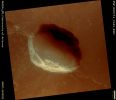
PSP_009751_1645_RED.jpgPit in Southeastern Syria Planum (possible True Colors; credits: Lunar Explorer Italia)64 visiteMars Local Time: 15:32 (middle afternoon)
Coord. (centered): 15,4° North Lat. and 261,7° East Long.
Spacecraft altitude: 251 Km (such as about 156,9 miles)
Original image scale range: 25,1 cm/pixel (with 1 x 1 binning) so objects ~75 cm across are resolved
Map projected scale: 25 cm/pixel
Map projection: EQUIRECTANGULAR
Emission Angle: 5°
Phase Angle: 68°
Solar Incidence Angle: 64° (meaning that the Sun is about 26° above the Local Horizon)
Solar Longitude: 117,6° (Northern Summer)
Credits: NASA/JPL/University of Arizona
Additional process. and coloring: Lunar Explorer ItaliaMareKromium
|
|
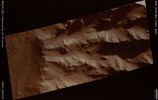
PSP_009789_1660_RED.jpgCoprates' Wall (possible True Colors; credits: Lunar Explorer Italia)64 visiteMars Local Time: 15:42 (middle afternoon)
Coord. (centered): 14,1° South Lat. and 306,6° East Long.
Spacecraft altitude: 289,5 Km (such as about 180,9 miles)
Original image scale range: 29 cm/pixel (with 1 x 1 binning) so objects ~87 cm across are resolved
Map projected scale: 25 cm/pixel
Map projection: EQUIRECTANGULAR
Emission Angle: 26,4°
Phase Angle: 46,9°
Solar Incidence Angle: 65° (meaning that the Sun is about 25° above the Local Horizon)
Solar Longitude: 118,9° (Northern Summer)
Credits: NASA/JPL/University of Arizona
Additional process. and coloring: Lunar Explorer ItaliaMareKromium
|
|

PSP_003249_1510_RED_browse_00~0.jpgLayered Deposits in Ritchey Crater (Enhanced Natural Colors; credits for the additional process. and color.: Dr Paolo C. Fienga - Lunexit Team)64 visiteThis HiRISE image shows eroding layered deposits in Ritchey Crater, a large impact crater in the Southern Highlands.
Three general units can be seen: a relatively dark upper layer, a light middle unit, and the floor material, which may be mostly obscured by dust.
The dark cap layer appears to be relatively hard and resistant, while the light material is weak.
Once the upper layer is removed, the light layer does not last long.
It is unclear how each of these layers formed.
Volcanic ash layers, lake or stream deposits, or sandstone deposited by dunes can all produce horizontal layers. Unraveling the origin would provide important clues to Mars' past.MareKromium
|
|

ESP_011618_1885_RED_abrowse-00.jpgRecent Double-Impact (ctx frame - possible Natural Colors; credits: Lunar Explorer Italia)64 visiteMars Local Time: 15:46 (middle afternoon)
Coord. (centered): 8,6° North Lat. and 46,8° East Long.
Spacecraft altitude: 273,6 Km (such as about 171,0 miles)
Original image scale range: 27,4 cm/pixel (with 1 x 1 binning) so objects ~82 cm across are resolved
Map projected scale: 25 cm/pixel
Map projection: EQUIRECTANGULAR
Emission Angle: 5,9°
Phase Angle: 64,1°
Solar Incidence Angle: 58° (meaning that the Sun is about 32° above the Local Horizon)
Solar Longitude: 193,2° (Northern Autumn)
Credits: NASA/JPL/University of Arizona
Additional process. and coloring: Lunar Explorer ItaliaMareKromium
|
|
| 2237 immagini su 187 pagina(e) |
 |
|
|
|
|
106 | |
|
|
|
|





