| Piú viste - Mars Reconnaissance Orbiter (MRO) |

ESP_011618_1885_RED_abrowse-00.jpgRecent Double-Impact (ctx frame - possible Natural Colors; credits: Lunar Explorer Italia)66 visiteMars Local Time: 15:46 (middle afternoon)
Coord. (centered): 8,6° North Lat. and 46,8° East Long.
Spacecraft altitude: 273,6 Km (such as about 171,0 miles)
Original image scale range: 27,4 cm/pixel (with 1 x 1 binning) so objects ~82 cm across are resolved
Map projected scale: 25 cm/pixel
Map projection: EQUIRECTANGULAR
Emission Angle: 5,9°
Phase Angle: 64,1°
Solar Incidence Angle: 58° (meaning that the Sun is about 32° above the Local Horizon)
Solar Longitude: 193,2° (Northern Autumn)
Credits: NASA/JPL/University of Arizona
Additional process. and coloring: Lunar Explorer ItaliaMareKromium
|
|
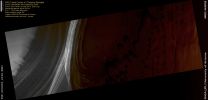
PSP_009905_2650_RED.jpgNorth Polar Layered Deposits (NPLD) and Dunes in Chasma Boreale (natural colors; credits: Lunexit)66 visiteThis image shows a steep, layered slope and flatter, dune-covered plains in Mars’ North Polar Region. The layers are composed of varying contents of water ice and dust.
On Earth, icy layers like these in Greenland and Antarctica are important because they contain a record of past climate conditions. By looking at the detailed sequence of Polar Layers on Mars, scientists hope to be able to discover the types of variations that Mars’ climate may have experienced.
The lowest section in the stack of light layers is noticeably darker because of the presence of dark, sandy material. Erosion of this dark material is thought to provide the sand making up the large dunes on the plains.
Several exceptionally well-developed barchan (crescent-shaped) dune forms up to approximately 50 meters (160 feet) across are present in the center of the image.MareKromium
|
|
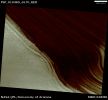
PSP_010489_2670_RED_abrowse.jpgTrough on the North Polar Layered Deposits (Natural Colors; credits: Lunar Explorer Italia)66 visiteMars Local Time: 11:00 (late morning)
Coord. (centered): 87,0° North Lat. and 195,5° East Long.
Spacecraft altitude: 316,1 Km (such as about 197,6 miles)
Original image scale range: 31,6 cm/pixel (with 1 x 1 binning) so objects ~ 95 cm across are resolved
Map projected scale: 25 cm/pixel
Map projection: EQUIRECTANGULAR
Emission Angle: 0,7°
Phase Angle: 73,7°
Solar Incidence Angle: 73° (meaning that the Sun is about 17° above the Local Horizon)
Solar Longitude: 145,4° (Northern Summer)
Credits: NASA/JPL/University of Arizona
Additional process. and coloring: Lunar Explorer ItaliaMareKromium
|
|

ESP_012997_1445_RED_abrowse.jpg"8"! (Natural Colors; credits: Lunar Explorer Italia)66 visiteThis image shows two craters in the Southern Hemisphere just South of Sirenum Fossae.
The Northern Crater (the one that is an upper position) is smaller, appears more degraded, and is partially filled with sediments that form a hummocky surface. Dunes have formed subsequently on this Surface. Some incipient gully-like features have formed midway along the Southern Crater Wall and expose Layers that are more resistant to erosion.
The larger crater to the South is eroded by Gullies on its Northern Slope while the Southern Slope Region lacks them. Most Gullies in this scene appear to emanate from more resistant Layers, although the larger Gullies have eroded back almost to the Crater Rim.
The nature of the Layers and their connection to the water that formed the Gullies is unknown.
Gullies typically form when flowing water erodes sediments and soft rocks in a channelized flow. Because Mars is very cold and dry, it is unknown where the water came from to form the Gullies.MareKromium
|
|
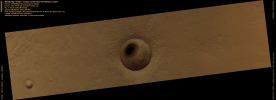
PSP_007004_2000_RED_abrowse.jpgRelatively "Fresh" Crater on the Floor of Pasteur Crater (Natural Colors; credits: Lunar Explorer Italia)66 visitenessun commentoMareKromium
|
|

ESP_014159_1670_RED_abrowse-01.jpg"Worm-like" Surface Feature in the Southern Highlands (EDM - Natural Colors; credits: Lunexit)66 visitenessun commentoMareKromium
|
|
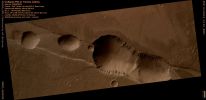
ESP_014432_2110_RED_abrowse.jpgCollapse Pits in Tractus Catena (Natural Colors; credits: Lunexit)66 visitenessun commentoMareKromium
|
|

ESP_019060_1330-LXTT2.jpgSouthern Gullies (EDM n.2 - Enhanced True Colors; credits for the additional process. and color.: Elisabetta Bonora - Lunexit Team)66 visitenessun commentoMareKromium
|
|

PSP_003695_1250_RED_abrowse-01.jpgUnnamed Southern Crater with Large Dunefield and DD Streaks (EDM - Natural Colors; credits for the additional process. and color.: Dr Paolo C. Fienga - Lunexit Team)66 visiteThis EDM, approx. 750 mt across, shows Dust Devil Tracks near the South-West edge of the Dunefield. The bright protruding rocks on the lower side of the image are either being exposed or being buried, as the Dunes migrate. MareKromium
|
|

ESP_019256_1530_RED_abrowse-00.jpgThe "White Cliffs" of Holden Crater (CTX Frame - Natural Colors; credits for the additional process. and color.: Dr Paolo C. Fienga - Lunexit Team)66 visitenessun commentoMareKromium
|
|
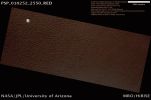
PSP_010252_2550_RED-PCF-LXTT.jpgSmall Snow-filled Depression in Vastitas Borealis (Absolute Natural Colors; credits for the additional process. and color.: Dr Paolo C. Fienga - Lunexit Team)66 visitenessun commentoMareKromium
|
|
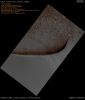
ESP_016190_2635_RED_abrowse.jpgFrost-covered Northern Dunefield (Absolute Natural Colors; credits for the additional process. and color.: Dr Paolo C. Fienga - Lunexit Team:)66 visitenessun commentoMareKromium
|
|
| 2237 immagini su 187 pagina(e) |
 |
|
|
|
|
104 | |
|
|
|
|





