| Piú viste - Mars Reconnaissance Orbiter (MRO) |

Psp_001385_1985_red.jpgUnnamed Crater, Boulders and Pseudo-Pyramids66 visiteMost debris on crater walls slides straight downhill. In this HiRISE image we see examples of boulders that have bounced downhill, not necessarily vertically.
A prominent example looks like a dotted line from the top of the crater wall where the boulder took off to the crater floor where it finally came to rest.
Numerous boulders have slid partway down toward the crater floor, which is covered by sand dunes. This is actually a small crater (~1 Km wide) within an unnamed but much larger ~30 Km crater.
|
|
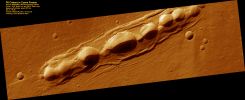
PSP_003370_2140_RED_browse.jpgPit Craters (or Collapse Pits) in Cyane Fossae66 visiteThis image shows several pits along the floor of Cyane Fossae, a set of fissures between the giant volcanoes of Olympus Mons and Alba Patera (North-East of Olympus Mons).
The fissures probably formed when the surface of the Planet was actively being stretched from the stresses of volcanic activity, causing the surface to split open along faults. There is no material piled up around the edges of the pits, as would be expected if these were impact craters or volcanic vents. Instead, parts of the Fossae floor likely collapsed into the void underlying Cyane Fossae, forming the pits.
This type of process, in which the crust is split open, has occurred here on Earth, and it created the geologic "basin and range" province of the western United States.
The walls of the pits are likely covered in dust and the few dark streaks along the walls are likely formed by avalanches of dust. Striations along the slope may be produced by the passage of DDs.
Dust also appears on the floors of the collapse pits and covered most of the plains nearby. Despite the presence of this layer of dust, bouldery outcrops occur in places along the wall, suggesting that the underlying material is hard and rocky.
MareKromium
|
|

PSP_006528_1120_RED_abrowse-01.jpgSources of Basaltic Sand (extra-detail mgnf n. 1; MULTISPECTRUM - credits: Lunexit)66 visiteThis image was targeted at a point in Mitchell Crater in the Southern Highlands of Mars where sands abruptly appear and spread North.
The sands seem to derive from the edge of an eroding mesa (shown here with an arrow; 8,66 Km, or about 5,4 miles across).
A close-up view of the terrain nearby (see the extra-detail mgnf n. 2) suggests that boulders and sand have been excavated by erosion from beneath brighter, polygonally fractured ground (1,45 Km, or about 0,9 mi across). MareKromium
|
|
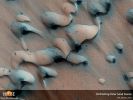
PSP_007043_2650-BLUE-MarsPolarDunes2_hirise_big-00.jpgSand Dunes Thawing on Mars (False Colors; credits: NASA)66 visiteCaption NASA:"What are these strange shapes on Mars? Defrosting sand dunes.
As spring now dawns on the Northern Hemisphere of Mars, dunes of sand near the pole, as pictured above, are beginning to thaw.
The Carbon Dioxide and water ice actually sublime in the thin atmosphere directly to gas. Thinner regions of ice typically defrost first revealing sand whose darkness soaks in sunlight and accelerates the thaw. The process might even involve sandy jets exploding through the thinning ice. By Summer, spots will expand to encompass the entire dunes. The Martian North Pole is ringed by many similar fields of barchan sand dunes, whose strange, smooth arcs are shaped by persistent Martian Winds".MareKromium
|
|

PSP_006284_1145_RED_abrowse-02.jpgOn the edge of the Dunefield... (MULTISPECTRUM; credits: Lunexit)66 visitenessun commentoMareKromium
|
|

PSP_007801_2610_RED_abrowse.jpgDefrosting Dunes in the North Polar Sand Sea (MULTISPECTRUM; credits: Lunexit)66 visiteThis image shows defrosting sand dunes near the North Polar Region of Mars.
Around Mars’ North Pole is a vast Region or “sea” of sand dunes that become covered with CO2 frost or ice in the Northern Hemisphere’s Winter. The light areas indicate that parts of the dunes are still covered in frost or ice.
As Mars’ Northern Hemisphere enters into Spring and begins to warm, the CO2 sublimates. The CO2 sublimates in surprising ways, with trapped gas bursting through the ice in jets that leave dark streaks when the wind is blowing
During the Summer, all the frost will have sublimed leaving dark sand dunes. The unfrosted dunes are dark because the sand is derived from dark volcanic rocks.MareKromium
|
|
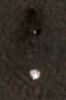
PSP_008591_2485_cut_c.jpgBack-Shell and Parachute (MULTISPECTRUM; credits: Lunexit)66 visitenessun commentoMareKromium
|
|
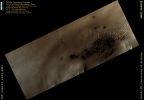
PSP_008197_2655_RED_abrowse.jpgCircular Defrosting Feature (MULTISPECTRUM-2; credits: Lunexit)66 visitenessun commentoMareKromium
|
|
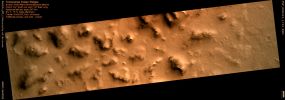
PSP_008323_1735_RED_abrowse-00.jpgTARs and Unusual "Star Ripples" (MULTISPECTRUM; credits: Lunexit)66 visiteThis blocky terrain is southwest of Schiaparelli Crater and is surrounded by a field of Transverse Aeolian Ridges (TARs) and unusual "Star Ripples" (dunes).
TARs are linear ripples with crest-ridge morphologies that can vary in shape; these morphologies include forked, sinuous, barchanoid, networked or feathered characteristics. The ridges also appear to transition into star dunes.
Star Dunes are complex features and are not yet fully understood on Earth. They form by multidirectional wind regimes with a dominant Primary Wind. Chains of Star Dunes often appear to have a massive linear appearance, or can be modified linear or Barchan Dunes with the formation of secondary slipfaces (on the steeper slope). On Earth, there are incipient Star Dunes, such as in the Dumont Dune field in the Mojave Desert, that display similar characteristics. The Dumont embryonic Star Dunes may result from dunes merging as they overrun one another, or are modified preexisting dunes, which could also be the case in this image.
Martian weather models predict that the dominate wind comes from a South-Westerly direction. This direction aligns nicely with the Transverse Ripples and the main arms of the Star Ripples.
This suggests that the Star Ripples were also affected by a different wind pattern or "Secondary Winds" or "Secondary Airflow". (Secondary Airflow is the airflow and sediment transport around the slopes of the dune).
Formation of incipient Star Dunes depends on the nature (strength, direction, and duration) of the Primary Wind and the volume of the sand to create the dune. Secondary airflow maintains the dune arms. The last factor is the deposition or removal of the sand by grainfall or grainflow avalanching. Grainfall and grainflow transports material from the main crestline slipface and along-slope or down-slope which maintains the secondary arm crest.MareKromium
|
|
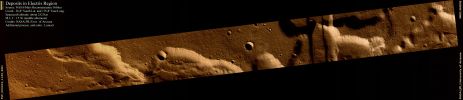
Psp_009029_1430_red.jpgDeposits in Electris Region (natural colors; credits: Lunexit)66 visiteThis observation reveals a portion of a long outcrop of a deposit in the Electris Region of Mars.
The Electris' Deposits occur over a range of landforms and relief and the process(es) responsible for their emplacement remain speculative.
Close examination of the outcrops reveal layering that in some places appear to include meter-scale blocks. Comparison with other HiRISE images of the deposit will enable more detailed mapping of its extent and nature and should provide new insight into the origin of these enigmatic materials.MareKromium
|
|
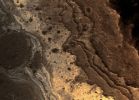
PIA11377.jpgMartian "Opal" (natural colors; credits: Lunexit)66 visiteNASA's Mars Reconnaissance Orbiter has revealed Martian rocks containing a hydrated mineral similar to Opal.
The rocks are light-toned and appear cream-colored in this natural-color image taken by the High Resolution Imaging Science Experiment (HiRISE) camera. Images acquired by the orbiter reveal that different layers of rock have different properties and chemistry.
The Opal minerals are located in distinct beds of rock outside of the large Valles Marineris Canyon System and are also found in rocks within the canyon. The presence of opal in these relatively young rocks tells scientists that water, possibly as rivers and small ponds, interacted with the surface as recently as two billion years ago, one billion years later than scientists had expected.
The discovery of this new category of minerals spread across large regions of Mars suggests that liquid water played an important role in shaping the Planet's Surface and possibly hosting life. MareKromium
|
|

Psp_009797_1525_red.jpgThe Central Peak of Isil Crater (possible True Colors; credits: Lunar Explorer Italia)66 visiteMars Local Time: 15:37 (middle afternoon)
Coord. (centered): 27,0° South Lat. and 87,9° East Long.
Spacecraft altitude: 254,5 Km (such as about 159,1 miles)
Original image scale range: 50,9 cm/pixel (with 1 x 1 binning) so objects ~1,53 mt across are resolved
Map projected scale: 50 cm/pixel
Map projection: EQUIRECTANGULAR
Emission Angle: 1,6°
Phase Angle: 70,8°
Solar Incidence Angle: 72° (meaning that the Sun is about 18° above the Local Horizon)
Solar Longitude: 119,2° (Northern Summer)
Credits: NASA/JPL/University of Arizona
Additional process. and coloring: Lunar Explorer ItaliaMareKromium
|
|
| 2237 immagini su 187 pagina(e) |
 |
|
|
|
|
103 | |
|
|
|
|





