| Piú viste - Mars Reconnaissance Orbiter (MRO) |
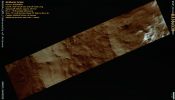
ESP_014324_0955_RED_abrowse.jpgSnow-Streaks on McMurdo Crater (Natural Colors; credits: Lunexit)67 visiteThe SPLD are a stack of ice and dust about 3 Km (a little less than 2 miles) thick. The many layers that make up this feature are of great interest to planetary scientists because, just as with ice sheets on Earth, they are thought to contain a record of the Planet’s climate in previous times.
As with the rest of Mars, impact craters form continuously on these Polar Deposits.
Rarely, a very large impact will occur and the crater will excavate all the way through this ice-sheet to the rocky terrain underneath. This is what happened in the case of McMurdo, a crater roughly 20 Km (about 12,5 miles) across which punched through the ice-sheet in the past.
This HiRISE image shows the wall of this Crater, only half of which has been preserved until current times.
You can see the many layers that comprise the SPLD exposed here.
Scientists study exposures like this to try to understand the length of the climatic record that is recorded in the icy material at the Poles of Mars.MareKromium
|
|

ESP_014432_1685_RED_abrowse.jpgTerraced Unnamed Crater (Natural Colors; credits: Lunexit)67 visitenessun commentoMareKromium
|
|
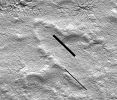
ESP_014282_0930_RED_abrowse-03.jpgSpiders (EDM n.2 - credits: Dr G. Barca)67 visite...Si, a questo punto è certo: si trattava di un image-artifact. Senza dubbi. Grandi complimenti al nostro sempre puntualissimo Dr Barca per la pazienza avuta!MareKromium
|
|
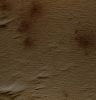
PSP_010200_1805_RED_abrowse-01.jpgFresh Crater Cluster (EDM - Natural Colors; credits: Dr Paolo C. Fienga - Lunexit Team)67 visiteMany of the newest craters are part of a crater cluster, like this one. This cluster is about 350 meters (almost a quarter mile) across at its longest, and the largest crater in the image is 5 meters (16 feet) in diameter.
These clusters likely result from breaking up of the impactor before it strikes the surface. How widely dispersed the craters are depends on the strength and density of the impactor. Scientists can study these clusters to learn more about the object that created them.MareKromium
|
|
ESP_016280_2655_RED_abrowse.jpgMartian Tears... (possible Natural Colors; credits: Dr Paolo C. Fienga - Lunexit Team)67 visitenessun commentoMareKromium
|
|
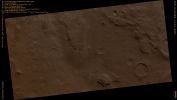
ESP_018488_2120_RED_abrowse.jpgErosional Surface Features in Arabia Terra (Natural Colors; credits for the additional process. and color.: Dr Paolo C. Fienga - Lunexit Team)67 visitenessun commentoMareKromium
|
|
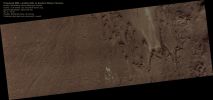
PSP_003843_1680_RED_abrowse.jpgPossible MSL Landing Side in Eastern Melas Chasma (Natural Colors; credits for the additional process. and color.: Dr Paolo C. Fienga - Lunexit Team)67 visitenessun commentoMareKromium
|
|
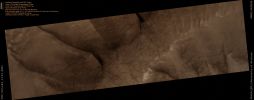
PSP_005383_1255_RED_abrowse-00.jpgDunefield with DD Tracks inside Russel Crater (Absolute Natural Colors; credits for the additional process. and color.: Dr Paolo C. Fienga - Lunexit Team)67 visiteDust Devils make dark, diffuse scribble markings on the Surface by kicking up Dust and are especially active in the Summertime over Dark Surfaces, such as those with many deposits of sand-sized material.
The Surface warms up in the Sunlight, creating the right conditions to form Dust Devils. Mars also has larger dust storms that can deposit a thin layer of Dust and eliminate the Dust Devil Tracks. MareKromium
|
|
North_Polar_Layers-Tra_000825_2665_red.jpgNorth Polar Layered Deposits (Absolute Natural Colors; credits for the additional process. and color.: Dr Paolo C. Fienga - Lunexit Team:)67 visitenessun commentoMareKromium
|
|
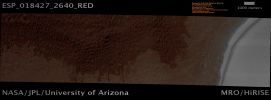
ESP_018427_2640_RED_abrowse-PCF-LXTT-1.jpgWhere the Erg meets the Polar Cap (Absolute Natural Colors; credits for the additional process. and color.: Dr Paolo C. Fienga - Lunexit Team)67 visitenessun commentoMareKromium
|
|
PSP_004277_1530_RED-PCF-LXTT-00.jpgFeatures of Holden Crater's Rim (CTX Frame "A" - Absolute Natural Colors; credits for the additional process. and color.: Dr Paolo C. Fienga - Lunexit Team)67 visiteHiRISE image PSP_004277_1530 covers a portion of the rim of Holden Crater, revealing breaches created when water over-topped the Rim and incised a series of Channels as it flowed down the Crater Wall.
The water responsible for the Channels was impounded outside of the rim of Holden in Uzboi Vallis (Holden Crater itself is approx. 150 Km in diameter).
Uzboi Vallis was interrupted when Holden Crater formed and the Rim formed an effective, temporary damn to flow farther to the North. Once the Uzboi Basin filled, water began flowing into Holden again, creating a series of low fan-shaped Deltas, alluvial deposits and a shallow, but relatively short-lived lake.
The Channels in this image were only active for a short time, as a Channel just to the East cut quickly into the Rim and became responsible for most of the drainage into the Crater.
The fact that most of the fan-shaped Deltas radiate from the Dominant Channel to the East rather than those in this image supports this scenario. MareKromium
|
|

North_Polar_Regions-Olympia_Undae-PIA18243-PCF-LXTT-IPF.jpgOlympia Undae (Absolute Natural Colors; credits for the additional process. and color. Dr Paolo C. Fienga/Lunar Explorer Italia/Italian Planetary Foundation)67 visiteOlympia Undae is a large Field of Sand Dunes surrounding the North Polar Ice Cap of Mars. Because of the High Latitude of the Dunes, they are covered with Water and Carbon Dioxide (CO2) Frost for the whole Winter, Springtime and part of Summer as well (remember that during the Wintertime the Dunes are also poorly illuminated). Said that, it comes natural to understand that these Dunes are are best viewed during Summertime (from mid, to late Summer, to be more precise), when some of their most obvious Features - such as the Ripples that form on the Dunes' Surface - can be seen in detail.
In this sub-image, taken by the NASA - Mars Reconnaissance Orbiter on April, 9, 2014, we can see the Dunes in the Early Martian Summer. The Dark (Gray, with Reddish nuances here) Material visible here is the Sand that makes up the Dunes. Between them, Bright Bedrock as well as some lingering Patches of Frost (White-colored) that has not yet sublimated, are also well visible. If you look carefully, you will be able to see small Ripples that formed on the Dunes' Flat Surfaces, as well as Bright so-called "Inter-Dune Areas".
This specific area has been viewed several times by HiRISE, so NASA was able to compare this image to other past ones (from about 2 years ago); the most obvious difference between these images was simply found in the Illumination, which was much better in the AD 2012 (it is possible to say so once it has been noticed that the 2012 images showed much finer details). However, and despite that beforementioned difference, several changes in the Boundaries of the Sand and Ripple positions were also found, and this last circumstance showed - and proved - that (the Dominant and very strong North Polar) Winds, perhaps assisted by the Sublimation of the Frost that covers most of the Dunes (an event, the latter, that actually contributes in loosening Sand), are continuously modifying the Landforms of Olympia Undae, from one year to another.
Mars Local Time: 13:52 (Early Afternoon)
Coord. (centered): 81,633° North Lat. and 178,830° East Long.
Spacecraft altitude: 321,8 Km (such as about 199,837 miles)
Original image scale range: 32,2 cm/pixel (with 1 x 1 binning) so objects ~ 97 cm across are resolved
Map projected scale: 25 cm/pixel
Map projection: POLAR STEREOGRAPHIC
Emission Angle: 17,9°
Phase Angle: 8,0°
Solar Incidence Angle: 60° (meaning that the Sun was about 30° above the Local Horizon at the time the picture was taken)
Solar Longitude: 113,9° (Northern Summer - Southern Winter)
Credits: NASA/JPL/University of Arizona
Additional process. and coloring: Lunar Explorer Italia
This picture (which is a NASA - Original Mars Reconnaissance Orbiter False Colors and NON Map-Projected sub-frame identified by the serial n. ESP_036099_2615-1) has been additionally processed, magnified to aid the visibility of the details, contrast enhanced, Gamma corrected, and then re-colorized in Absolute Natural Colors (such as the colors that a human eye would actually perceive if someone were onboard the NASA - Mars Reconnaissance Orbiter and then looked down, towards the Surface of Mars), by using an original technique created - and, in time, dramatically improved - by the Lunar Explorer Italia Team.MareKromium
|
|
| 2237 immagini su 187 pagina(e) |
 |
|
|
|
|
102 | |
|
|
|
|





