| Piú viste - The Soviet "Mars Programme" |
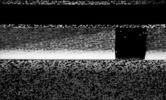
05-C_Mars03_lander.jpgMars' surface? No! Just "bad signal"...103 visiteA descent vehicle released by Mars-3 became the first probe to land on Mars, but it only operated for about 20 seconds, returning some data and 79 scan lines of video. The image below right is reported to be a view of that signal. It should probably be rotated 90° since the Mars-3 cameras were of the same cycloramic design as Luna-9, scanning vertically.
After extensive analysis, Soviet Scientists reported that it contains no information and it is not likely a view of the Martian horizon as some people have suggested.
|
|

Phobos2-C_Fobos_03.jpgPhobos, from Phobos-2 (3)101 visitenessun commento
|
|

03-C_Mars03_Atmosphere2.jpgThe "foggy" limb of Mars100 visiteThe first Soviet Orbiters, Mars-2 and Mars-3, arrived on November 27 and December 2, 1971. They carried the 52mm "Vega" and 350mm "Zulfar" phototelevision cameras (later used on Mars-4 and 5), carrying enough film for 480 photos per camera. These cameras were designed by A.S. Selivanov and his team at the Institute of Space Device Engineering.
The original plan was to spend the first 40 days performing photographic surveys; however, Mars was experiencing a severe planet-wide dust storm when the Soviet probes (and the American Mariner-9) arrived.
This photo left shows the atmospheric limb during the dust storm, from a distance of about 150.000 Km (the orbit of Mars-3 was highly elongated). Mars-2 did not return much data because of problems with its telemetry systems.
|
|

Mars5-C_Mars05_3_Color1.jpgColor shots from Mars-5 (1)99 visiteMars-5 entered an elliptic Martian orbit on February 12, 1974. Nearly synchronized with the rotation of the Planet, its two phototelevision cameras could be commanded to take 12 pictures during each close approach. The "Vega" camera used a wide area 52mm lens with color filters, the "Zulfar" camera used a telescopic 350mm lens and long-pass orange filter.
Images were transmitted in a rapid 220-line mode, and then selected pictures were retransmitted at 880 or 1760 line resolution.
|
|

Phobos2-C_Fobos_08.jpgPhobos, from Phobos-2 (8)98 visitenessun commento
|
|

Phobos2-C_Fobos_11.jpgPhobos, from Phobos-2 (11)95 visitenessun commento
|
|
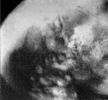
Mars5-C_Mars05_Panorama4.jpgMars from Mars-5: Mars' limb and (maybe) clouds (2)92 visitenessun commento
|
|

Phobos2-C_Fobos_10.jpgPhobos, from Phobos-2 (10)92 visitenessun commento
|
|
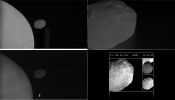
Phobos2-C_Fobos_07.jpgPhobos, from Phobos-2 (7)89 visitenessun commento
|
|

01-Mars.jpgMars, from "Mars 3": the Red Planet! (2)83 visiteQuesta Galleria costituisce un tributo a tutti quei Pionieri (Ingegneri, Astronomi, Astronauti, Tecnici e Collaboratori vari) che lavorarono nel silenzio oltre la "Cortina di Ferro". Costoro, diciamo "per mera sfortuna", mancarono l'obbiettivo di far scendere due Astronauti sulla Luna, ma furono tuttavia capaci, a costo di sacrifici immensi (e, a quanto si dice, di innumerevoli vite), di portare alcune Sonde (e svariati Landers) sulla Luna, nello Spazio di Marte, sul Pianeta Rosso e su Venere, raccogliendo sia preziose informazioni scientifiche, sia immagini di grandissimo valore storico e di enorme impatto visivo.
|
|
|
|
| 34 immagini su 3 pagina(e) |
3 |
|








