| Piú viste - The Universe Inside |

FIRST DREAM.jpgThe 10000th Image for LunExIt: First Dream179 visiteCon questa immagine, scelta fra le 97 che abbiamo ricevuto, celebriamo la pubblicazione dei primi 10000 frames sul nostro Sito. Lunar Explorer Italia ringrazia, tramite il Presidente, lo Staff, i Collaboratori Interni, quelli Esterni ed i Soci Attivi, tutti coloro che hanno dato, danno e daranno il loro contributo per fare della nostra Fondazione un Punto di Riferimento, un domani, per coloro che cercano, investigano, si pongono domande e cercano, con onestà e pragmatismo, ma senza porre limiti alla propria mente, di vedere che cosa si nasconde "Oltre il Buio della Notte" (e così citiamo una splendida - e datata! - novella di Arthur C. Clarke che, a nostro avviso, costituisce una pietra miliare nel panorama della Science-Fiction di alto livello).
L'immagine First Dream ci è stata mandata da Gianluigi & Paola Barca, che ringraziamo di cuore.
Uno speciale ringraziamento anche ai nostri Amici "più presenti", e cioè il Dr Alessio Feltri, Lorenzo Leone, Matteo Fagone, Massimo Granzo, il Dr Alessandro Pullini, Fabio Italiano, il Dr Gino Sartarelli e tanti altri che, pur se non citati in questa sede, sono comunque nei nostri cuori e nei nostri pensieri.
Grazie a TUTTI!
Lunar Explorer Italia
|
|

Moon and Companions.jpgMoon & Friends, from Great Salt Lake - Utah (USA)178 visiteDa "NASA - Picture of the Day" del 13 Settembre 2005:"(...) This busy quadruple 'coincidence sky' was visible last week all over the World. The easiest object to spot is the crescent Moon, which is easily the brightest sky orb in the above image. Venus is the highest Planet in the sky, with Jupiter to its right. The bright star Spica completes the quadruple just below Venus. The 'streak' on the far right is an airplane. (...)".
Nota: osservate lo "streak in the sky" lasciato dall'aeroplano (come la NASA stessa precisa) e poi provate a riguardare l'immagine Spirit relativa allo "Streak in the Sky" che alla NASA (ed anche in Italia, grazie al Corsera ed al Dr Caprara) venne immediatamente risolto come "vecchia sonda che precipita" (cfr.: "Another Spirit in the Sky?!?" - Sez. "Mars Spirit Anomalies and Maps"). Bene, allora se tanto ci dà tanto, vorremmo chiedere alla NASA "quale sonda - ripresa dal Sig. Wilson - stava precipitando nei cieli dello Utah, la sera del 6 Settembre u.s.?".
E scusateci l'ironia...
|
|

Interstellar.pngGargantua178 visite"...La Vita non è ciò che desideri, pensi o credi che sia. La Vita, ti piaccia o meno, è quello che è..."MareKromium
|
|

Max-006.jpgDreams never die...177 visitenessun commentoMareKromium
|
|
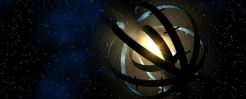
Dyson_Sphere_-_00_jpg.jpegThe Dyson Sphere177 visiteA Dyson Sphere is a hypothetical megastructure that encompasses a star and captures a large percentage of its power output. The concept is a thought experiment that attempts to imagine how a spacefaring civilization would meet its energy requirements once those requirements exceed what can be generated from the home planet's resources alone. Because only a tiny fraction of a star's energy emissions reaches the surface of any orbiting planet, building structures encircling a star would enable a civilization to harvest far more energy.
The earliest modern imagining of such a structure was by Olaf Stapledon in his science fiction novel Star Maker (1937). The same concept was later used by physicist Freeman Dyson in his 1960 paper "Search for Artificial Stellar Sources of Infrared Radiation". Dyson speculated that such structures would be the logical consequence of the escalating energy needs of a technological civilization and would be a necessity for its long-term survival. MareKromium
|
|
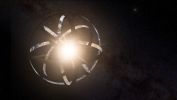
Dyson_Sphere_-_06.jpegThe Dyson Sphere177 visiteOn October 14, 2015, Planet Hunters' citizen scientists discovered unusual light fluctuations of the star KIC 8462852 raising press speculation that a Dyson sphere may have been discovered. However, subsequent analysis showed that the results were consistent with the presence of dust.
In 2024 there was press speculation that potential signs of interstellar Dyson spheres had been discovered.
The seven objects of interest – all located within a thousand light-years of Earth – were M-dwarfs, a class of stars that are smaller and less luminous than the Sun. However, the authors of the findings were careful not to make any overblown claims. Despite this, many media outlets picked up on the story.
Less fantastical explanations included a suggestion that the detected infrared was caused by distant dust-obscured galaxies.MareKromium
|
|

ZZ-ZZ-SunFromMaunaKea.jpgThe Sun from Mauna Kea: an alien landscape176 visiteDa "NASA - Picture of the Day" del 4 Luglio 2005:"Typically, views from Mauna Kea are up and dark. That's because the famous dormant volcano in Hawaii is arguably Earth's premier observing platform of the complex and ever changing night sky. However, this daytime view is across and bright. White snow and white clouds seem to blend together to make an alien landscape. Cinder cones from extinct volcanic outbursts dominate the foreground. Scrolling right will reveal structures visually incongruous even here: an armada of the largest optical telescopes on Earth. The observatories seen include Subaru and Keck. In the distance on the far left is Mauna Loa, Earth's largest volcano".
|
|

stellar_rain_1600.jpgStellar Rain176 visite
|
|

South_Polar_Eclipse.jpgSouth Polar Eclipse176 visitenessun commentoMareKromium
|
|

Moon, Venus and Jupiter from Earth.jpgThe Moon, Venus and Jupiter from Shiraz (Iran)175 visiteDa "NASA - Picture of the Day" del giorno 13.11.2004: " Early morning risers around the world have enjoyed the sight of bright planets in this week's predawn skies - further enhanced by the celestial spectacle of the waning crescent Moon. From some locations the Moon was seen to pass in front of Jupiter or Venus, a lunar occultation. Recorded near sunrise on November 10th from Shiraz, Iran, this eastern horizon view finds Jupiter (top) and a brilliant Venus in line with the Moon, a lovely conjunction of the three brightest objects in the night sky. Although the Moon has now fallen out of the early morning scene, Venus and Jupiter (along with a much fainter Mars) still precede the rising Sun above the eastern horizon". Una fotografia molto simile a quella ripresa dalla Turchia (Bursa) - già pubblicata nella Sezione dedicata a Giove - la quale ci mostra e dimostra che non è poi così difficile "cristallizzare" un particolare (e suggestivo) momento del Cielo.
|
|

lake_of_the_sun_1600.jpgDeep Thoughts175 visite
|
|

SOL067-PCF-LXTT2.jpgShining in the Sunshine...175 visitenessun commentoMareKromium
|
|
| 495 immagini su 42 pagina(e) |
 |
|
|
|
|
9 | |
|
|
|
|








