| Piú viste - The Universe Inside |

CloudsandStars.jpgIn the twilights...77 visitenessun commentoMareKromium
|
|

MilkyWayRoad.jpgThe "Milky Way Road"77 visite"...Dominus dedit, Dominus abstulit..."
(Giobbe - 1, 21)
"...Dio diede, Dio tolse..."MareKromium
|
|

Sunset~1.jpgUntitled (by Brian Cameron)77 visitenessun commentoMareKromium
|
|

Hoodoos.jpgHoodoos77 visiteDa "NASA - Picture of the Day", del giorno 3 Luglio 2008:"The strange-looking rock formations in the foreground of this skyscape are called "Hoodoos".
Towers of weathered, eroded sedimentary rock, Hoodoos are found in arid regions of planet Earth and are particularly abundant in an area known as Bryce Canyon National Park in southern Utah, USA.
The more familiar night sky pictured here was recorded early Monday morning and includes bright star Capella, alpha star of the constellation Auriga, left of center.
On the far right, a very over exposed crescent Moon dominates the sky in close conjunction with the sister stars of the Pleiades Cluster. The curious shapes of the two tall, illuminated Hoodoos suggest their popular monikers: Thor's Hammer (right) and The Temple of Osiris".
Nota Lunexit: e se le Cuspidi di Blair (a.k.a.: The Lunar Spires) fossero, in realtà, qualcosa del genere?!?... Questo solo per dire e per dirVi: ATTENZIONE quando si parla di "strutture artificiali"! Se questa foto fosse stata scattata su Marte (ad esempio), quanti Eso-Archeografi (Eso-Archeologi) ed Appassionati (assieme ai soliti Scrittori immaginifici e furbetti) avrebbero immediatamente pensato e parlato di "possibili - se non certi... - Artifacts"?
Pensateci sopra...MareKromium
|
|

Venus___Jupiter.jpgChilean Skyscape77 visitenessun commentoMareKromium
|
|

FaithFullMoon090409_westlake.jpgObscuring the Moon...77 visiteCaption NASA:"October's bright Full Moon is also known as the "Harvest Moon".
Traditionally, the Harvest Moon is the Full Moon closest to the Autumnal Equinox. But in this snapshot, the Full Moon could be called the "Old Faith-Full Moon".
Taken on September 4, 2009, the picture combines the regularly occurring lunar phase with Old Faithful Geyser in Yellowstone National Park, named for its dependable eruptions.
Shining on the well-known geyser's towering pillar from behind, the moonlight creates an eerie halo surrounding convoluted shapes.
Faithfully, the Full Moon itself is bright enough to be seen through the dense swirling steam near the top".MareKromium
|
|

SOL219-MF-LXTT.jpgWinter Sunset (by Dr M. Faccin - Lunexit Team)77 visitenessun commentoMareKromium
|
|

M-42_and_Milky_Way.jpgGalactic Rainbow77 visite"...In Science, read, by preference, the newest works; in Literature, the oldest..."
Edward George Bulwer-Lytton (1803-1873) - "Caxtoniana - Hints of mental Culture" (1863)MareKromium
|
|

Phobos_Eclipsing_Victoria.jpgPhobos eclipsing Victoria Crater's Region (elab. Lunexit)76 visitenessun commentoMareKromium
|
|
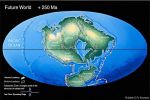
PangeaUltima_scotese_big.jpgA VERY far, distant and yet possible Future: Pangea Ultima76 visiteIs this what will become of the Earth's surface? The surface of the Earth is broken up into several large plates that are slowly shifting.
About 250 MY ago, the plates on which the present-day continents rest were positioned quite differently, so that all the landmasses were clustered together in one supercontinent now dubbed Pangea. About 250 MY from now, the plates are again projected to reposition themselves so that a single landmass dominates.
The above simulation from the PALEAOMAP Project shows this giant landmass: Pangea Ultima.
At that time, the Atlantic Ocean will be just a distant memory, and whatever beings inhabit Earth will be able to walk from North America to Africa.MareKromium
|
|

Triton.jpgLord of the Abyss (by Roberto Tremolada)76 visitenessun commentoMareKromium
|
|

ISS-011e12343.jpgAtmospherical Hole76 visitenessun commentoMareKromium
|
|
| 496 immagini su 42 pagina(e) |
 |
|
|
|
|
37 | |
|
|
|
|








