| Piú viste - The Universe Inside |
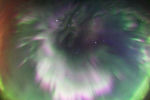
Aurora_Borealis-Coronal_Aurora-sep11aurora_moussette_f.jpgNorthern Lights over Canada78 visiteSo far, the Aurora Borealis - or "Northern Lights" - have made some remarkable visits to September's Skies. The reason, of course, is the not-so-quiet Sun. In particular, a large solar active region now crossing the Sun's disk has produced multiple, intense flares and a large Coronal Mass Ejection (CME) that triggered wide spread auroral activity just last weekend. This colorful example of spectacular curtains of aurora was captured with a fish-eye lens in skies over Quebec, Canada, on September 11, 2005.
Also featured is the planet Mars, the brightest object above and left center. Seen near Mars (just below and to the right) is the tightly knit Pleiades star cluster.
Although they can appear to be quite close, the Northern Lights actually originate at extreme altitudes, 100 Km or so above the Earth's surface.
|
|

M 31 and Hale Bopp.jpgTemporary Sky...78 visiteDa "NASA - Picture of the Day" del 13 Agosto 2006:"The Moon almost ruined this photograph. During late March and early April 1997, Comet Hale-Bopp passed nearly in front of the Andromeda Galaxy.
Here the Great Comet of 1997 and the Great Galaxy in Andromeda were photographed together on 1997 March 24th. The problem was the brightness of the Moon. The Moon was full that night and so bright that long exposures meant to capture the tails of Hale-Bopp and the disk of M31 would capture instead only moonlight reflected off the Earth's atmosphere. By the time the Moon would set, this opportunity would be gone. That's why this picture was taken during a total lunar eclipse".
|
|

Vortex.jpgInside the Vortex...78 visiteFix your camera to a tripod, lock the shutter open, and you can make an image of star trails - graceful concentric arcs traced by the stars as planet Earth rotates on its axis. Of course, the length of the star trails will depend on the exposure time. While exposures lasting just five minutes produce a significant arc, in about 12 hours a given star would trace out half a circle. But in any long exposure, the background glow from light-polluted skies can build up to wash out the trails. Still, astronomer Josch Hambsch produced this stunning composite of star trails around the South Celestial Pole with an effective "all night" exposure time of almost 11 hours. To do it, he combined 128 consecutive five minute long digital exposures recorded in very dark night skies above Namibia. In his final image, the background glow on the right is due in part to the faint, arcing Milky Way.
|
|
|

The-MoonSlide.jpgFrom Light, to Light (by Stefan Seip)78 visiteCaption NASA:"No special filters - or even a telescope - are required to enjoy a leisurely Lunar Eclipse. In fact, watched from all over the night side of planet Earth, these regular celestial performances have entertained many casual skygazers.
Still, this eye-catching picture of a Lunar Eclipse may look unfamiliar.
To make it, astroimager Stefan Seip set his camera on a tripod and locked the shutter open during the Total Lunar Eclipse of March 3, 2007.
The resulting image records the trail of the Moon (and narrower trails of stars) sliding through the night. Reddish hues common during the total phase of a Lunar Eclipse, are evident along the darker, slimmer portion of the Moon trail. (...)".MareKromium
|
|

Darkness-0.jpgMidnight-Sun over Vastitas (by Dr Marco Faccin)78 visiteDue ricostruzioni della "gelida - e buia - alba" sopra Vastitas Borealis le quali, con tutto il rispetto per la NASA e le sue "elaborazioni", sono semplicemente splendide. Forse le due più belle interpretazioni mai realizzate sino ad ora.
Un grande complimento ed un abbraccio al sempre più "magico" Dr Marco Faccin!MareKromium
|
|

SOL208-2R144843263FFL8400P1313L0M1-A208R1.jpgSmiling Sun...78 visitenessun commentoMareKromium
|
|

Colourful_Earth.jpgEarth, from Monochrome to Polychrome (by Roberto Tremolada)78 visitenessun commentoMareKromium
|
|
STS-30-NightLaunch.jpgReaching for the Stars...78 visitenessun commentoMareKromium
|
|

Retrograde_Mars-TT-2010.jpgRetrograde Mars78 visiteDa "NASA - Picture of the Day" del giorno 13 Giugno 2010:"Why would Mars appear to move backwards? Most of the time, the apparent motion of Mars in Earth's Sky is in one direction, slow but steady in front of the far distant stars. About every two years, however, the Earth passes Mars as they orbit around the Sun. During the most recent such pass late last year and early this year, Mars as usual, loomed large and bright.
Also during this time, Mars appeared to move backwards in the sky, a phenomenon called "Retrograde Motion".
Pictured above is a series of images digitally stacked so that all of the stars images coincide. Here, Mars appears to trace out a loop in the sky. At the center of the loop, Earth passed Mars and the retrograde motion was the highest. Retrograde Motion can also be seen for other Planets of the Solar System". MareKromium
|
|

The_Moon_and_Saturn.jpgSo close, and yet, so far...77 visite"...A Verbal Art like Poetry is reflective: it stops to think. Music is immediate: it goes on to become..."
W.H. Auden (1907 - 1973) - "Music and Imagination" (1952)MareKromium
|
|

Saturn_Venus.jpgEvening Friends77 visite"...Sanctum hoc poetae nomen quod nulla umquam barbaria violavit..."
(Cicerone - "Pro Archia")
"...Venerato è il nome di Poeta, poichè nessuna barbarie potè violarlo..."MareKromium
|
|
| 496 immagini su 42 pagina(e) |
 |
|
|
|
|
36 | |
|
|
|
|