| Piú viste - The Universe Inside |
The_Moon~0.jpgThe Moon80 visitenessun commentoMareKromium
|
|

SOL694-2P187972203EFFAKBAP0050L7M1~0.jpgDawn on Mars79 visitenessun commento
|
|

Aurora_Borealis_-_01.jpgRed Space-Waterfall79 visitenessun commentoMareKromium
|
|

Venus_Jupiter.jpgVenus and Her Father, in the Morning Skies...79 visite"...Ut desint vires, tamen laudanda Voluntas est..."
(Ovidio)
"...Sebbene gli sforzi (per arrivare a conseguire qualcosa) possano non bastare, la Volontà (di raggiungere l'obbiettivo) va comunque apprezzata..."MareKromium
|
|

Mist-of-Time.jpgThe Mist of Time (by Roberto Tremolada)79 visitenessun commentoMareKromium
|
|

Spacer.jpgHappy Easter 2008! (by Giorgio Picciau)79 visiteUn Saluto ed un Augurio "UFO-Roboticamente Spaziali" di Buona Pasqua 2008, a Tutti gli Amici di Lunar Explorer Italia, da parte del bravissimo ed immaginifico "Artista del Cosmo", Giorgio Picciau!
Un grande complimento a Lui, per questa bella e romantica "Visione" che - ne siamo certi - ci riporterà tutti indietro di qualche anno, "...quando le cose erano (forse) più semplici ed i cieli (di certo) erano più limpidi".
MareKromium
|
|

Solar_Eclipse.jpgFull Solar Eclipse79 visitenessun commentoMareKromium
|
|

The_Indwellers.jpgThe Indwellers (by Roberto Tremolada)79 visitenessun commentoMareKromium
|
|

ColorfulReality.jpgEmissions (by Marco Faccin)79 visitenessun commentoMareKromium
|
|

Meteor_Strike.jpgBetween Cosmic Clouds... (by Victor van Wulfen)79 visitenessun commentoMareKromium
|
|

The_Faces_of_Mars.jpgSo different and yet always the same...79 visiteDa "NASA - Picture of the Day" del giorno 5 Maggio 2010:"Enthusiastic astro-artists ranging from expert to beginner, the youngest age 10, all contributed their work to this entertaining panel featuring different faces of Mars. Their sketches are all based on telescopic views of the Red Planet from earlier this year, near its 2010 Opposition.
Mars offers the best telescopic views at opposition, since that's when it is closest and opposite the Sun in planet Earth's sky. Arranged in a spiral pattern, the sketches are positioned to follow the Planet's rotation.
No canals are visible(!), but large surface markings such as the dramatic, dark Syrtis Major are easily identified. As often seen through an astronomical telescope eyepiece, the Planet's orientation is inverted, with Mars' north polar cap at the bottom".
Nota Lunexit: dunque, se leggete attentamente "tra le righe" (ma nemmeno tanto: il concetto formulato dalla NASA a noi appare chiaro), anche il Grande Schiaparelli era un cretino ed i "Canali" se li è sognati. Piuttosto triste come considerazione. Silente è la NASA, invece, allorchè si nota come la colorazione globale di Marte vari non solo da occhio ad occhio, ma anche - e abbastanza ovviamente - da stagione a stagione. Ah, già, ma questo tipo di considerazione non si può fare: la NASA ha già detto (e mostrato) che Marte è SEMPRE color salmone e giallastro (con tratti verdognoli) e quindi l'unica conclusione che possiamo trarre è che quasi tutti gli artisti che hanno ritratto il Pianeta Rosso in questo collage devono necessariamente soffrire di un qualche disturbo nella percezione del colore. Come noi, del resto...MareKromium
|
|
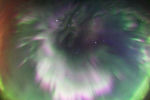
Aurora_Borealis-Coronal_Aurora-sep11aurora_moussette_f.jpgNorthern Lights over Canada78 visiteSo far, the Aurora Borealis - or "Northern Lights" - have made some remarkable visits to September's Skies. The reason, of course, is the not-so-quiet Sun. In particular, a large solar active region now crossing the Sun's disk has produced multiple, intense flares and a large Coronal Mass Ejection (CME) that triggered wide spread auroral activity just last weekend. This colorful example of spectacular curtains of aurora was captured with a fish-eye lens in skies over Quebec, Canada, on September 11, 2005.
Also featured is the planet Mars, the brightest object above and left center. Seen near Mars (just below and to the right) is the tightly knit Pleiades star cluster.
Although they can appear to be quite close, the Northern Lights actually originate at extreme altitudes, 100 Km or so above the Earth's surface.
|
|
| 496 immagini su 42 pagina(e) |
 |
|
|
|
|
35 | |
|
|
|
|








