| Piú viste - The Universe Inside |

EonsMark-GB-LXTT.jpgThe Eons' Mark (Natural Colors; credits: Dr G. Barca - Lunexit Team)82 visitenessun commentoMareKromium
|
|

CometHale-Bopp-970401C_lodriguss.jpgOn the edge of Oblivion...81 visite"...Mi dispiace vedere che gran parte delle persone vivano la loro Vita non secondo un modello personale - magari discutibile, ma proprio -, bensì secondo il modello creato solo ed esclusivamente dalla televisione (o da chi per essa).
Un modello orrendo e della razza peggiore.
Certo, non esiste un modello predefinito di "Vita" e allora ognuno di noi cresce assieme a quello che gli sta attorno, aiutandosi con quanto si trova in giro. Però...
Però vedo sempre più maiali inconsapevoli di viaggiare verso il mattatoio e, anche se dovrei (forse) preoccuparmi più di me stesso, questa visione - un pò - mi duole..."
Giorgio Picciau - "Lettere"MareKromium
|
|

TitanianLake_Fog-VSS00100.jpgTitanian Lake and Fog (by Calvin Hamilton)81 visitenessun commentoMareKromium
|
|

Sun-ISS.jpgIn the Sunshine...81 visitenessun commentoMareKromium
|
|

Minds-MF.jpgA Beautiful Mind (by Marco Faccin)81 visitenessun commentoMareKromium
|
|

Setting_Moon.jpgSetting Moon81 visiteIt's a mystery to me - the game commences
For the usual fee - plus expenses
Confidential information - I send a diary - this is my investigation - it's not a public inquiry...
I go checking out the reports - digging up the dirt
You get to meet all sorts in this line of work
Treachery and treason - there's always an excuse for it
And when I find the reason I still can't get used to it...
And what have you got at the end of the day?
What have you got to take away?
A bottle of whisky and a new set of lies
Blinds on the windows and a pain behind the eyes
Scarred for life - no compensation
Private investigations...
Dire Straits - "Private Investigations"MareKromium
|
|

Sun Halo-2.jpgBright Sun, Dark Sky80 visiteCaption originale:"Have you ever seen a halo around the Sun? This fairly common sight occurs when high thin clouds containing millions of tiny ice crystals cover much of the sky. Each ice crystal acts like a miniature lens. Because most of the crystals have a similar elongated hexagonal shape, light entering one crystal face and exiting through the opposing face refracts 22 degrees, which corresponds to the radius of the Sun Halo. A similar Moon Halo may be visible during the night. The picture was taken in Gunlock, Utah, USA. A flock of birds was caught by chance in the foreground. Exactly how ice-crystals form in clouds remains under investigation".
Nota: si tratta di un'immagine molto bella, senza alcun dubbio, ma una piccola annotazione va fatta. Vedete il colore del cielo attorno al Sole? Vi sembra naturale? No, ovviamente: non è affatto naturale.
Esso è molto scuro, di colore incerto (grigio), molto simile al cielo di Marte (come si vede nei frames NASA). Ma perchè questo "strano cielo" anche sulla Terra? Diciamo che si tratta di una combinazione di fattori (su tutti il - probabile - filtro/colore usato e la circostanza per cui, scattando foto come questa e quindi sovraesponendo il Sole, automaticamente si rende più scuro tutto il resto del paesaggio).
Morale: se non si vedessero degli uccelli in transito, questa bella immagine potrebbe tranquillamente rappresentare un tramonto (o un'alba) su Marte.
La nostra deduzione è che il fatto di credere a quello che si vede in una fotografia (terrestre, marziana o lunare) e commentarlo, sta diventando sempre più una questione di "Fede" e non - purtroppo - di effettiva oggettività.
|
|

SunDogs.jpgSuomi's Sundogs80 visiteWhat's happened to the Sun? Sometimes it looks like the Sun is being viewed through a large lens. In the above case, however, there are actually millions of lenses: ice crystals. As water freezes in the upper atmosphere, small, flat, six-sided, ice crystals might be formed. As these crystals flutter to the ground, much time is spent with their faces flat, parallel to the ground. An observer may pass through the same plane as many of the falling ice crystals near sunrise or sunset. During this alignment, each crystal can act like a miniature lens, refracting sunlight into our view and creating phenomena like parhelia, the technical term for sundogs. The above image was taken during early 2006 February near Helsinki, Finland with a quickly deployed cellular camera phone. Visible in the image center is the Sun, while two bright sundogs glow prominently from both the left and the right. Also visible is the 22° halo also created by sunlight reflecting off of atmospheric ice crystals.
|
|
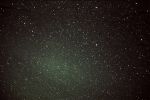
Counter-glow.jpgThe Gegenshein (or "Counter Glow") Effect in Pisces80 visiteDa "NASA - Picture of the Day", del 26 Dicembre 2006:"If you look carefully enough, you can even see the glow of the Sun in the opposite direction. At night this glow is known as the Gegenschein (German for "Counter Glow"), and can be seen as a faint glow in an extremely dark sky. The Gegenschein is sunlight back-scattered off small interplanetary dust particles. These dust particles are millimeter sized splinters from asteroids and orbit in the ecliptic plane of the planets.
Pictured above, the gegenschein is seen superposed toward the constellation of Pisces. The Gegenschein is distinguished from Zodiacal Light by the high angle of reflection. During the day, a phenomenon similar to the Gegenschien - called "The Glory" - can be seen in reflecting air or clouds opposite the Sun from an airplane".MareKromium
|
|

Once_upon_a_Time.jpgOnce Upon A Time... (by Roberto Tremolada)80 visite"...Fortuna immoderata est: in bono, atque in malo..."
(Laberio)
"...La Buona Sorte (al pari della Cattiva Sorte) non conosce misura: né nel bene, né nel male..."MareKromium
|
|

Spacer.jpgHappy Easter 2008! (by Giorgio Picciau)80 visiteUn Saluto ed un Augurio "UFO-Roboticamente Spaziali" di Buona Pasqua 2008, a Tutti gli Amici di Lunar Explorer Italia, da parte del bravissimo ed immaginifico "Artista del Cosmo", Giorgio Picciau!
Un grande complimento a Lui, per questa bella e romantica "Visione" che - ne siamo certi - ci riporterà tutti indietro di qualche anno, "...quando le cose erano (forse) più semplici ed i cieli (di certo) erano più limpidi".
MareKromium
|
|

Partial_Lunar_Eclipse.jpgEarth's Shadow80 visitenessun commentoMareKromium
|
|
| 496 immagini su 42 pagina(e) |
 |
|
|
|
|
34 | |
|
|
|
|








