| Piú viste - The Universe Inside |

Sunrise.jpgCrepuscular Rays Over Utah86 visiteDa "NASA - Picture of the Day", del 31 Agosto 2005:"What could cause such rays of dark? Dark sky rays were caught in spectacular fashion earlier this month above Utah, USA. The cause is something surprisingly familiar: shadows. Clouds near the horizon can block sunlight from reflecting off air, making columns outward from the Sun appear unusually dark. Cloud shadows can be thought of the complement of the more commonly highlighted crepuscular rays, also visible above, where sunlight pours though cloud holes. Sometimes, on the opposite side of the sky, anticrepuscular rays can also be seen".
|
|

Sun Pillars.jpgLight Pillars' Parade86 visiteDa "NASA - Picture of the Day" del 5 Marzo 2006:"How can an aurora appear so near the ground? Pictured above are not aurora but nearby light pillars, a local phenomenon that can appear as a distant one. In most places on Earth, a lucky viewer can see a Sun-pillar, a column of light appearing to extend up from the Sun caused by flat fluttering ice-crystals reflecting sunlight from the upper atmosphere. Usually these ice ice crystals evaporate before reaching the ground. During freezing temperatures, however, flat fluttering ice crystals may form near the ground in a form of light snow, sometimes known as a crystal fog. These ice crystals may then reflect ground lights in columns not unlike a Sun-pillar. In the above picture, the colorful lights causing the light pillars surround a ice-skating ring in Fairbanks, Alaska".
|
|

Aurora_Borealis_-_03.jpgAurora in the Northern Skies86 visiteUn frame davvero molto bello ma che, a parere del nostro Esperto di Fotografia, è stato "taroccato" nelle colorazioni. In realtà la nostra non è una "conclusione scientifica" quanto, piuttosto, il frutto di una sensazione basata sia sull'esperienza (le Aurorae "rosse" sono rare, quelle "fucsia e rosa"...di fatto inesistenti...), sia sull'incoerenza cromatica dei particolari della fotografia una volta che essa è stata scomposta nei suoi canali principali.
Comunque sia...una bella immagine!MareKromium
|
|

AuroraBorealis-Alaska.jpgAurora over Alaska86 visiteCaption NASA:"Higher than the highest mountain, higher than the highest airplane, lies the realm of the aurora. Aurora rarely reach below 60 Km, and can range up to 1000. Aurora light results from solar shockwave causing energetic electrons and protons to striking molecules in the Earth's atmosphere. Frequently, when viewed from space, a complete aurora will appear as a circle around one of the Earth's magnetic poles. The above digitally enhanced photograph was taken in 2005 January shows a spectacular aurora borealis above the frozen landscape of Bear Lake, Alaska, USA.
The above image was voted Wikipedia Commons Picture of the Year for 2006".
|
|

Venus_Moon.jpgNight Lovers86 visitenessun commentoMareKromium
|
|
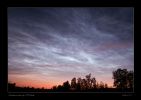
NoctilucentClouds.jpgNoctilucent Clouds over Sweden86 visiteCaption NASA:"Sometimes it's night on the ground but day in the air. As the Earth rotates to eclipse the Sun, sunset rises up from the ground.
Therefore, at sunset on the ground, sunlight still shines on clouds above. Under usual circumstances, a pretty sunset might be visible, but unusual noctilucent clouds float so high up they can be seen well after dark.
Pictured above last month (September 2007), a network of noctilucent clouds cast a colorful but eerie glow after dusk near Vallentuna, Sweden.
Although noctilucent clouds are thought to be composed of small ice-coated particles, much remains unknown about them. Satellites launched to help study these clouds includes Sweden's Odin and NASA's AIM.
Recent evidence indicates that at least some noctilucent clouds result from freezing water exhaust from Space Shuttles".MareKromium
|
|

UnknownOrigin.jpgUnknown Origin (by Dr Marco Faccin)86 visite"...We are not, what we are;
And we are not, what we seem to be.
We are not, what we do;
And we are not, what we feel and fight for.
We are not, what we say;
And we are not, what we think.
We are not, what we are;
And we are not, what we pretend to be..."
Paolo C. Fienga - "Repetita Iuvant"MareKromium
|
|

Sands-20070801_Spirit-1.jpgWorking in the Sand...86 visitenessun commentoMareKromium
|
|

AlphaCentauriOne.pngUnder Alpha Centauri...86 visitenessun commentoMareKromium
|
|

Venus~0.jpgNight-flight to Venus (by Roberto Tremolada)86 visitenessun commentoMareKromium
|
|

EyesInTheSky.jpgEyes in the Sky86 visitenessun commentoMareKromium
|
|

Earth.pngMother Earth86 visiteDalla Rubrica "NASA - Picture of the Day", del giorno 23 Novembre 2009:"Goodbye Earth!
Earlier this month, ESA's interplanetary Rosetta Spacecraft zoomed past the Earth on its way back across the Solar System.
Pictured above, Earth showed a bright crescent phase featuring the South Pole to the passing rocket ship. Launched from Earth in 2004, Rosetta used the gravity of the Earth to help propel it out past Mars and toward a 2014 rendezvous with Comet Churyumov-Gerasimenko.
Last year, the Robot Spacecraft passed asteroid 2867 Steins, and next year it is scheduled to pass enigmatic asteroid 21 Lutetia. If all goes well, Rosetta will release a probe that will land on the 15-Km diameter comet in 2014". MareKromium
|
|
| 496 immagini su 42 pagina(e) |
 |
|
|
|
|
30 | |
|
|
|
|








