| Piú viste - The Universe Inside |
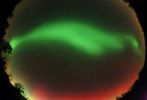
Aurora_Borealis-Coronal_Aurora.jpgCoronal Aurora near Warrensbourg - Missouri (USA)93 visiteIn relazione a quanto detto e scritto solo pochi giorni fa, ecco una nuova Aurora la quale, oltre ad essere stata particolarmente intensa (come potete ben vedere), è accaduta ad un latitudine che di Polare o presso-Polare non ha proprio nulla. La NASA dice che è un fenomeno inusuale ma "normale", vista l'attività solare di questi giorni. Permetteteci, a questo riguardo, una battuta: è proprio il fatto che sia la NASA a dire di non preoccuparci che ci fa preoccupare... EccoVi il commento originale da "NASA - Picture of the Day" del giorno 12.11.2004: "(...) Amazing! Unbelievable!, The best I've ever seen! ... They aren't talking about a movie, though. Instead, even casual sky critics are remarking on November's stunning auroral displays, visible with surprising intensities well beyond the confines of high latitudes where auroral activity is normally observed (...)". Vedete?!? Entusiasmo, eccitazione, linguaggio più da show che da Scienza e dintorni: è il nuovo corso della NASA...
|
|

Through the clouds.jpgThrough the clouds...93 visite"Dovremmo saper parlare, dobbiamo vedere
La differenza fra le azioni e le intenzioni;
Suggerisci l’attimo e la circostanza
Osservi, ma senza spiare, e sai distinguere
Le speranze dalle illusioni,
E se è il Tempo a dare la saggezza
Tu che lo possiedi tutto, allora sai...
Il Tuo volto nasconde, i segni delle ere
Ed il colore della Tua pelle è luce ed ombra
Osservi le nostre vicende e sorridi
Immutata ed immutabile
Non riesci a dire una parola
E lasci che gli uomini parlino per Te...
Ho letto dei Tuoi momenti e dei Tuoi mari
Delle Tue apparizioni e delle Tue scomparse
Dal Tuo momento possono cogliersi presagi;
Sei il grigio del baratro, ma puoi splendere
E, se lo desideri, quando giunge l’istante,
Puoi gettare la Terra nell’ombra...
La Tua bellezza è figlia della distanza
Ed è con questa pallida e cinerea luce
Che spieghi le ragioni del Tuo silenzio
Eppure, contraddittoria, lasci che sia io a parlare
Ed io so che nulla può sfuggire all’Occhio Infinito
Ed io so che l’Occhio Infinito sfugge ad ogni cosa...
Luna Maligna, insegnami a tacere
Insegnami a custodire i segreti che raccolgo
Guardami con benevolenza e perdonami
Guidami verso il Tuo lato nascosto
Laddove il cielo pullula di pulsanti stelle
Aiutami a guardare e, guardando, a vedere...
Paolo C. Fienga – “Luna Maligna”
|
|

Counterlight.jpgCounterlight (by Roberto Tremolada)93 visitenessun commentoMareKromium
|
|

ZP-Mercuryandfriends.jpgMercury, Venus and Saturn in the Western Sky...Again!92 visiteDa "NASA - Picture of the Day" del 30 Giugno 2005:"Venus, Mercury, and Saturn wandered close together in western evening skies last week. On Saturday, June 25, astronomer R. Jay GaBany recorded this snapshot of their eye-catching planetary conjunction, from historic Lick Observatory on Mt. Hamilton, California, USA. The view looks toward the Pacific shortly after sunset with the lights of San Jose and the southern San Francisco Bay area in the foreground. Of course, Venus is the brightest of the trio. Mercury is nearby on the right and Saturn is below and left, closest to the horizon. Farther to the right of the planetary triangle are Pollux and Castor, twin stars of Gemini, with Regulus, bright star of the constellation Leo, at the very upper left corner of the picture. In the coming days, Venus and Mercury remain close, while Saturn continues to drop below them, toward the horizon".
|
|

South Polar Halo.jpgSouth Polar Halo92 visiteWhen Sunlight reflects and refracts off of tiny ice crystals in the atmosphere, the result can be ice crystal halos, which are related to rainbows (the latter being produced when Sunlight reflects and refracts from water droplets).
In Antarctica the temperatures are cold and the air is dry, so snow crystals grow very slowly. This slow growth tends to produce very clean hexagonal prisms, which are well suited for producing beautiful atmospheric displays. The example here is a South Pole halo, showing a rich variety of arcs and halos.
Halos arise from the way minute ice crystals in the atmosphere scatter Sunlight (or Moonlight!) into different angles.
The quality of a halo depends on the type and quality of the ice crystals that produce it.
|
|

Voyagers-02.jpgMessage in a "Bottle"...92 visiteCaption NASA:" Launched 30 years ago, NASA's Voyager 1 and 2 Spacecraft are now respectively 15 and 12,5 BKM from the Sun, equivalent to about 14 and 11,5 Light-Hours distant. Still functioning, the Voyagers are being tracked and commanded through the Deep Space Network. Having traveled beyond the outer planets, they are only the third and fourth spacecraft from planet Earth to escape toward interstellar space, following in the footsteps of Pioneer 10 and 11.
A 12" gold plated copper disk (a phonograph record) containing recorded sounds and images representing human cultures and life on Earth, is affixed to each Voyager - a Message in a Bottle, cast into the Cosmic Sea.
The recorded material was selected by a committee chaired by astronomer Carl Sagan. Simple diagrams on the cover symbolically represent the Spacecraft's origin and give instructions for playing the disk. The exotic construction of the disks should provide them with a long lifetime as they coast through the interstellar space". MareKromium
|
|

Titan-Huygens Lens.jpgThe Discovery of Titan91 visiteIl 25 Marzo 1655 l'Astronomo Olandese Christiaan Huygens scopriva "Luna Saturni" - ossia Titano. In questo frame vediamo tutto ciò che resta del telescopio che egli usò (nota: telescopio concepito e costruito in collaborazione con suo fratello, Constantijn Huygens): la lente.
Essa ha un diametro di 57 mm e reca sul bordo la dicitura "X 3 FEBR. MDCLV": si tratta della lunghezza focale e della data di completamento del lavoro (e cioé la "lucidatura" della lente stessa): il 3 February 1655.
Si leggono altresì (in alto) questi versi di Ovidio, "Admovere Oculis Distantia Sidera Nostris".
Un pizzico di romanticismo? No, solo la porzione di un anagramma: un semplice gioco enigmistico (molto comune ai suoi tempi) che riportava alcuni dettagli della sua scoperta (data inclusa).
Decodificato e tradotto l'anagramma di Huygens recita "Una luna orbita intorno a Saturno in 16 giorni e 4 ore".
Oggi sappiamo che il periodo orbitale di Titano è pari a poco meno di 16 giorni.
|
|

Civilization.jpgCivilization (by Roberto Tremolada)91 visitenessun commentoMareKromium
|
|

ShatterDay.jpgShatterday (by Roberto Tremolada)91 visitenessun commentoMareKromium
|
|

Aurora Borealis~0.jpgAurora Borealis over North Dakota90 visiteDa "NASA - Picture of the Day" del 20 Novembre 2005:"This aurora was a bit of a surprise. For starters, on this Friday morning in August 2002, no intense auroral activity was expected at all. Possibly more surprising, however, the aurora appeared to show an usual structure of green rays from some locations. In the above image, captured from North Dakota, USA, a picket fence of green rays stretches toward the horizon. Mirroring the green rays is a red band, somewhat rare in its own right. Lights from the cities of Bismarck and Mandan are visible near the horizon. Large sunspot groups indicate that activity from an active Sun is relatively likely, possibly causing other streams of energetic particles to cascade onto the Earth and so causing more auroras".
|
|

ALANBEAN-LUNARROVER.jpgLunar "Grand Prix"90 visiteApollo 16 Commander John Young is putting the Lunar Rover through a full test. This was the second mission with the Rover onboard and this Lunar Grand Prix would allow John to evaluate the performance of the Rover in the light gravity and the dusty, cratered, and rocky surface of the Moon.
His companion, Charlie Duke, is photographing it all with the 16-mm Data Acquisition Camera normally mounted on the Rover, but hand-held temporarily to document the Rover motion.
John later said:"The tendency was to drive wide open or very close to that and take what you got. The best reference to speed control was the speedometer, as I really didn't have a feel for the difference between 7 and 10 Km per hour."
Later, he demonstrated a sharp turn at ax speed, about 10 Km per hour. I made the Rover end break out to show the engineers how it looked.
It is no problem as all I had to do was cut back like I do when driving in snow...I didn't get up to any great speed, maybe 10 clicks at the most, but the terrain around there was too rough and rocky for that kind of foolishness..."
Charlie, who was filming it all, told Houston, "...man, Indy has never seen a driver like this."
|
|

Polar Flash.jpgPolar "Flash"90 visitenessun commento
|
|
| 496 immagini su 42 pagina(e) |
 |
|
|
|
|
27 | |
|
|
|
|








