| Piú viste - The Universe Inside |

SN 1006-1.jpgSN 1006: A New Sun over the Ocean...96 visite...Si tratta soltanto di una - riuscita - ricostruzione/falsificazione, ma il risultato finale è comunque molto bello e ci dimostra, una volta ancora, che se si è capaci di "giocare" con le immagini, si può creare qualsiasi cosa e si può ingannare chiunque...
Caption originale:"A new star, likely the brightest supernova in recorded human history, appeared in planet Earth's sky about 1000 years ago, in 1006 AD. The expanding debris cloud from the stellar explosion is still visible to modern astronomers, but what did the supernova look like in 1006? In celebration of the millennial anniversary of SN1006, astronomer Tunc Tezel offers this intriguing suggestion, based on a photograph he took on February 22, 1998 from a site overlooking the Mediterranean Sea, south of Antalya, Turkey. On that date, bright Venus and a waning crescent Moon shone in the early morning sky. Adopting calculations which put the supernova's apparent brightness between Venus and the crescent Moon, he digitally superposed an appropriate new star in the picture. He placed the star at the supernova's position in the southerly constellation of Lupus and used the water's reflection of moonlight in the final image".
|
|

Helene-PIA10544.jpgDistant Sun and Helene (by Lunar Explorer Italia)96 visitenessun commentoMareKromium
|
|

Almahata-Sitta15_2048.jpgAlmahata Sitta 1596 visiteDa "NASA - Picture of the Day", del giorno 28 Marzo 2009:"Small Asteroid 2008 TC3 fell to Earth at dawn on October 7, 2008, tracking through the skies over the Nubian Desert in Northern Sudan. That event was remarkable because it was the first time an asteroid was detected in space before crashing into planet Earth's Atmosphere.
It was generally assumed the asteroid itself had completely disintegrated to dust. But, based on satellite and ground observations of the atmospheric impact event, Dr. Mauwia Shaddad of the University of Khartoum, aided by Dr. Peter Jenniskens of the SETI Institute and NASA Ames Research Center, led an expedition of students and staff to the area, combing the desert for surviving fragments.
On December 6, 2008, 2 hours after their search began, the first meteorite was found. The team ultimately collected some 280 small meteorites, now called Almahata Sitta, with a total mass of about 5 kilograms -- the first material recovered from a known asteroid. In stark contrast to the lighter-colored stones, the black fragment in the picture is Almahata Sitta meteorite number 15. About 4 centimeters in diameter, it is seen as it came to rest on the desert floor".
Nota Lunexit: la fotografia, sebbene suggestiva, presenta - a nostro parere - delle notevoli incongruenze di texture e colore. In altre parole, sembra più un image-composite che un vero e proprio single still.
Abbiamo quindi leggermente modificato la colorizzazione del frame, adattando il suolo al colore tipico della superficie del Deserto Sudanese (la "fotografia" originale sembra essere parecchio sovrasaturata) ed il colore blu del cielo è stato leggermente abbassato di tonalità ed intensificato (così ricreando - in visione - le condizioni atmosferiche tipiche dei cieli che sovrastano regioni desertiche in cui l'Atmosfera è estremamente secca e l'Opacità - Atmosferica - bassissima o nulla).MareKromium
|
|

False_Impression.jpgFalse Impression (by Dr Gianluigi Barca)96 visitenessun commentoMareKromium
|
|

ZZ-Sun Halo.jpgA Sun "Halo" in Tennessee95 visiteDal "NASA - Picture of the Day" del 9 Marzo 2005:"Sometimes it looks like the Sun is being viewed through a large lens. In the above case there are actually millions of lenses: ice crystals. As water freezes in the upper atmosphere, small, flat, six-sided, ice crystals might be formed. As these crystals flutter down, much time is spent with their faces flat, parallel to the ground. An observer may pass through the same plane as many of the falling ice crystals near sunrise or sunset. During this alignment, each crystal can act like a miniature lens, refracting sunlight into our view. Dramatically visible behind neighborhood houses and trees and above the cloud deck is the 22° halo created by sunlight reflecting off of atmospheric ice crystals".
L'alone è spiegato in modo preciso ed accurato, ma esso non è l'unico fenomeno visibile in questa foto: alla Vostra Sx si vedono - e bene! - 2 scie chimiche. E quelle come le spieghiamo? Vapori e cristalli?!?
|
|

ZZ-ZZ-ZZ-Venus, Mercury and Saturn.jpgVenus, Mercury and Saturn from Cerro Paranal (Chile)95 visiteDa "NASA - Picture of the Day" del 17 Agosto 2005:"Very bright planets and very large telescopes are part of this sunset view of Paranal Observatory. The observatory's four, massive 8,2 meter telescope units are situated on top of the 2.600 meter high mountain, Cerro Paranal, in the dry Atacama Desert in northern Chile. The individual unit telescopes can be used separately or in combination and are named Antu, Kueyen, Melipal and Yepun. Together they are fittingly known as the European Southern Observatory's Very Large Telescope. Of course, the very bright planets are Venus (near center), joined by Mercury (below) and Saturn (left) in late June's western evening skies".
|
|

Skylab-1973.jpgThe "unforgettable" Skylab...95 visiteDa "NASA - Picture of the Day", del 29 Aprile 2006:"Skylab was an orbiting laboratory launched by NASA in May 1973. Skylab, pictured above, was visited 3 times by NASA Astronauts who sometimes stayed as long as two and a half months. Many scientific tests were performed on Skylab, including astronomical observations in ultraviolet and X-ray light. Some of these observations yielded valuable information about Comet Kohoutek, our Sun and about the mysterious X-ray Background Radiation that (apparently) comes from all over the sky.
Skylab fell back to Earth on July, 11, 1979".
|
|
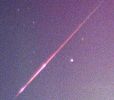
Perseid-2.jpgShooting Star (2) - detail mgnf95 visiteOsservate questo ingrandimento della Perseide immortalata dal nostro Amico Jimmy Westlake e poi provate a riguardare il (presunto) bolide che Cassini potrebbe aver fotografato nello Spazio di Saturno: noterete con semplicità che le caratteristiche delle due "strisciate di luce" (streaks) sono MOLTO simili.
Peccato che la NASA si affanni a dare credito solo ad alcuni personaggi e ad alcune (sempre più discutibili o insulse) "scoperte" (come il presunto colorito "rosato" di Iperione), senza mai prendere atto che anche in Italia esistono Ricercatori attenti e competenti i quali, di tanto in tanto, sono i primi a notare l'esistenza di qualcosa di veramente raro...
Peccato.
|
|

SolarHalo-2-MF.jpgSolar Halo (credits: Dr Marco Faccin)95 visitenessun commentoMareKromium
|
|

Tomorrow.jpgTomorrow never dies...94 visitenessun commento
|
|

M-45~0.jpgM 45 and Venus94 visite"...L'Opium agrandit ce qui n'a pas de bornes,
Allonge l'Illimité,
Approfondit le Temps, creuse la Volupté,
Et de plaisirs noirs et mornes
Remplit l'ame au-delà de sa capacité..."
Charles Baudelaire (1821 - 1867) - "Le Poison" (1857)
|
|

ToTheHumanMind.gifA Tribute To The Human Mind (by Marco Faccin)94 visiteBellissimo. Ed incommentabile...MareKromium
|
|
| 496 immagini su 42 pagina(e) |
 |
|
|
|
|
26 | |
|
|
|
|








