| Piú viste - The Universe Inside |

HUMANMARK-MF_LXT.jpgThe Human Mark (by Dr Marco Faccin)98 visitenessun commentoMareKromium
|
|

Lenticular_Clouds.jpgLenticular Clouds' Cluster98 visiteCaption NASA:"Are those UFOs near that mountain?
No! They are Multilayered Lenticular Clouds.
Moist air forced to flow upward around mountain tops can create lenticular clouds. Water droplets condense from moist air cooled below the dew point, and clouds are opaque groups of water droplets. Waves in the air that would normally be seen horizontally can then be seen vertically, by the different levels where clouds form.
On some days the city of Seattle, Washington, USA, is treated to an usual sky show when lenticular clouds form near Mt. Rainier, a large mountain that looms just under 100 Km South-Eeast of the city.
This image of a spectacular cluster of lenticular clouds was taken last December (2008)".MareKromium
|
|
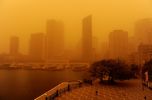
Sidney_in_the_Sand.jpgSidney, under a Dust Storm98 visiteDal bellissimo blog "Irgendwo", curato dal nostro Amico, Dr Stefano Cicetti, un'immagine che non potrà non interessare tutti gli Appassionati dell'ormai annosa querelle che discute circa i (sempre "misteriosi") "Colori di Marte".
Ne avevamo accennato in un articolo di qualche tempo fa ("True Colors"), avevamo già speso qualche parola al riguardo in sede di commento ad alcuni frames Marziani colorizzati dalla NASA, ma adesso abbiamo un'immagine - davvero - INEQUIVOCABILE: guardate che cosa succede alla meravigliosa ed ultramoderna città di Sidney, durante una tempesta che ha sollevato sino ad una quota - ritaniamo - significativa (forse oltre i 1500/2000 metri) le sabbie giallo-arancio-ocra del Deserto.
Che dire? A volte Marte assomiglia alla Terra ed a volte la Terra assomiglia a Marte.
Ma una cosa, a nostro avviso, è certa: queste condizioni di Tau sono una rarità. Sia sulla Terra e sia - molto probabilmente - su Marte (le Grandi Tempeste di Sabbia, sul Pianeta Rosso, occorrono con una certa frequenza, ma la loro intensità (almeno per quanto ne sappiamo) raramente giunge a risultati cromatici così spettacolari.
Secondo la NASA, invece, Marte dovrebbe essere COSTANTEMENTE in queste condizioni (così come le fotografie processate in True ed Approximately True Colors dai Ragazzi di Pasadena sembrano voler dimostrare).
La Verità? Noi non la conosciamo. Ma questo frame, ne siamo certi, Vi può aiutare a capire tantissime cose...
Nota: questa foto non è stata digitalmente interpolata o esaltata nei colori e nei contrasti.MareKromium
|
|

Lunar_Rover.jpgLuna-1 (Special Processing by Dr Marco Faccin)98 visitenessun commentoMareKromium
|
|

Sun pillar.jpgAnother light Sun Pillar97 visitenessun commento
|
|

MOON OVER VIENNA.jpgSolar eclypse over Vienna97 visiteUn'immagine bellissima: non servono altri commenti.
|
|

Aurora Borealis - Norway.jpgBlack Aurora over Norway97 visiteDa "NASA - Picture of the Day" del 29 Marzo 2006:"What causes gaps between aurora curtains? These unusual gaps can make auroral displays appear more detailed and intricate. Research using data from four Cluster Spacecraft orbiting the Earth has likely found the secret: auroral gaps, sometimes knows as "black auroras", are actually anti-auroras. In normal auroras, electrons and/or predominantly negatively charged particles fall toward Earth along surfaces of constant magnetic field. They ionize the Earth's atmosphere on impact, causing the bright glows. In auroral gaps, however, negatively charged particles may be sucked out from the Earth's ionosphere along adjoining magnetic field lines. These dark anti-auroras can climb to over 20.000 Km and last for several minutes. Pictured above, a series of well-defined auroral gaps is seen dividing green aurora curtains high above Harstad, Norway, earlier this month".
|
|

Ice-5.JPGIcy Corals... (by Dr M. Faccin)97 visitenessun commentoMareKromium
|
|

Terra_03.jpgTerra! (additional process. by Giorgio Picciau)97 visitenessun commentoMareKromium
|
|

InLovingMemory.jpgIn Loving Memory97 visitenessun commentoMareKromium
|
|

Moon and Companions~1.jpgMoon and Venus from Missouri96 visiteUn'immagine carina che ci mostra un quarto di Luna (diremmo più che ampiamente sovraesposto) che si "incontra" con la Stella della Sera (e cioè Venere), il tutto in un quadretto autunnale. Anche questa immagine è stata estrapolata dalla rubrica "NASA - Picture of the Day" la quale, a nostro parere, sta iniziando a diventare leggermente ripetitiva anche nella proposizione di fotografie artistiche, sìano esse professionali o amatoriali.
|
|

ALANBEAN-LASTMAN.jpgThe Last of the "Twelve"...96 visitenessun commento
|
|
| 496 immagini su 42 pagina(e) |
 |
|
|
|
|
25 | |
|
|
|
|








