| |

| Piú viste - The Universe Inside |

Moon from Hawaii.jpgHaleakala's Moon101 visiteDa "NASA - Picture of the Day" del 10 Giugno 2006:"A waxing crescent Moon shines over the caldera of dormant volcano Haleakala and observatory domes in this dramatic view from above the clouds.
Looking West from Maui, Hawaii on May 31st, the scene also records the lights of Honolulu on the horizon. Near the strongly overexposed crescent, is bright planet Saturn, but included in the skyscape are planet Mars and the Gemini stars Castor and Pollux.
Of course, skywatchers also found star cluster M 44, The Beehive Cluster, in this early evening sky, wedged between Saturn and the Moon. In fact, as it closes with Saturn, Mars will pass in front of the Beehive on June 15, so just keep looking West".
|
|
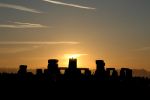
Solstice over Stonehenge.jpgSolstice on Stonehenge101 visiteDa "NASA - Picture of the Day" del 21 Giugno 2006:"Today the Sun reaches its northernmost point in the planet Earth's sky.
Called a "solstice", the date traditionally marks a change of seasons -- from Spring to Summer in Earth's Northern Hemisphere and from Fall to Winter in Earth's Southern Hemisphere. Pictured above is the 2005 Summer Solstice celebration at Stonehenge in England. The event was rare because Stonehenge was not always open to the public, and because recent Summer Solstices there had been annoyingly cloudy.
In 2005, however, thousands of people gathered at sunrise to see the sun rise through the 4000 year old solar monument.
Due to the precession of the Earth's orbital axis over the millennia, the Sun no longer rises over Stonehenge in an astronomically significant way, although the photographer was able to find a good spot where the rising Sun appeared over one of Stonehenge's massive standing stones".
|
|

Infrafoglia.jpgInfraLeaf (by Marco Faccin)101 visitenessun commentoMareKromium
|
|

Mist-of-Time~0.jpgIn Loving Memory101 visiteToday, now four years ago, my beloved Father, Dr Ugo Fienga, died, after a long and debilitating disease that consumed him for over five years. He was born in Salerno, on June, 6th, 1926.
Today, March 16, 2015, is raining over the town where I live, just like it did, four years ago, when my Father passed away.
I look around, and then I look inside myself and, sometimes, I think I can still find some Joy and Peace, while I am thinking about the days that my Father and I spent together. But one day, He already knew then, and I do know now, everything will become like ashes, and the Winds of Time shall sweep everything away, including us, our Memories, our Dreams and, God willing, our Sins too.
May God give rest to my Dad's Soul. Amen
Dr Paolo C. Fienga (PhD)
"...Omnia fert Aetas: animum quoque..."
(Virgilio)
MareKromium
|
|

Earth_Eclipse.jpgThe "Diamond Ring"...from the Moon!100 visiteUno splendido montaggio che ci mostra una ipotetica veduta dalla Luna di un Eclisse Totale di Sole. Bellissima ricostruzione, davvero, ma...c'è un errore davvero grande in questa "Scena di fantasia": durante una eclissi totale di Sole (ed anche nel momento in cui si forma l'Anello di Diamante - come in questa immagine) la superficie della Luna si troverebbe immersa nella più totale oscurità e quindi risulterebbe ai nostri occhi solo appena distinguibile, in forma di vaghe e quasi indefinibili ombre scure, con le stelle ben visibili nel cielo.
Ma va bene lo stesso...
Caption NASA:"Parts of Saturday's (March 3) lunar eclipse will be widely visible. For example, skywatchers in Europe, Africa, and western Asia will be able to see the entire spectacle of the Moon gliding through Earth's shadow, but in eastern North America the Moon will rise already in its total eclipse phase. Of course if you traveled to the Moon's near side, you could see the same event as a solar eclipse, with the disk of our fair planet Earth completely blocking out the Sun. For a moon-based observer's view, graphic artist Hana Gartstein (Haifa, Israel) offers this composite illustration. In the cropped version of her picture, an Apollo 17 image of Earth is surrounded with a red-tinted haze as sunlight streams through the planet's dusty atmosphere. Earth's night side remains faintly visible, still illuminated by the dark, reddened Moon, but the disk of the Earth would appear almost four times the size of the Sun's disk, so the faint corona surrounding the Sun would be largely obscured. At the upper left, the Sun itself is just emerging from behind the Earth's limb".MareKromium
|
|

ZZ-ZZ-The Sun over K.jpgIs this Earth?99 visiteAvevamo proposto un'immagine altrettanto enigmatica nella Sezione dedicata al Pianeta Venere, allorché la "Stella della Sera" veniva ripresa dalla sommità di una montagna in compagnia della Luna, così generando un effetto davvero molto particolare.
Ora è la volta di un'alba, vista dal Monte Kilimanjaro. Sono stati usati filtri speciali? Forse i colori sono stati ritoccati al computer? No, su tutta la linea. Questa è una foto scattata dalla Terra, in colori reali, che riprende l'alba.
Adesso capite meglio perché la problematica dei 'Colori dello Spazio' non è accademica né peregrina? Se, in determinate condizioni di illuminazione, ergo a diverse ore del giorno, anche la Terra può apparire un Mondo Alieno (tipo Marte o Venere) allora, date le medesime variabili, anche un Mondo Alieno potrebbe, a diverse ore del giorno, apparire come la Terra e non ci sarebbe nulla di straordinario nel dirlo e nel mostrarlo. Ma, a quanto pare, la NASA non "vede" (ed é proprio il caso di dirlo...) le cose come le vediamo noi..
|
|

Aurora.jpgGreen Aurora99 visiteDa "NASA - Picture of the Day" del 6 Settembre 2006:"What if your horizon was green? If you've got a camera, take a picture! That was the experience of Jeff Hapeman last week when visiting the Pictured Rocks National Lakeshore in Michigan. On a quiet night toward the Northern Horizon over Lake Superior was a long lasting diffuse green aurora. The above image was taken in an effort to capture the sense of wonder one gets when watching an auroral display. Auroras are sparked by energetic particles from the Sun impacting the magnetic environment around the Earth. Resultant energetic particles such as electrons and protons rain down near the Earth's poles and impact the air. The impacted air molecules temporarily lose electrons and when oxygen molecules among them reacquire these electrons, they emit green light. Auroras are known to have many shapes and colors".
|
|

ZQ-MercuryTransit.jpgThe "Transit" of Mercury99 visiteDa "NASA - Picture of the Day" del 14-11-2006:" What's that dot on the Sun? If you look closely, it is almost perfectly round. The dot is the result of an unusual type of solar eclipse that occurred last week. Usually it is the Earth's Moon that eclipses the Sun. Last week, for the first time in over three years, the planet Mercury took a turn. Like the approach to New Moon before a solar eclipse, the phase of Mercury became a continually thinner crescent as the Planet progressed toward an alignment with the Sun. Eventually the phase of Mercury dropped to zero and the dark spot of Mercury crossed our parent star. The situation could technically be labeled a Mercurian Annular Eclipse with an extraordinarily large ring of fire. From above the cratered planes of the night side of Mercury, the Earth appeared in its fullest phase. Hours later, as Mercury continued in its orbit, a slight crescent phase appeared again. The next Mercurian solar eclipse will occur in 2016". MareKromium
|
|

HighwaysToForever090306_6229-32.jpgHighways to Forever99 visitenessun commentoMareKromium
|
|
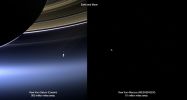
Us.jpgIn loving Memory99 visiteToday, July 15, 2026, my father Ugo and my mother Jolanda would have celebrated 65 years of marriage. However, they've been gone for years. I like to think that, one day, I'll see them again. Happy and together again.
For now, I send a prayer for them into the Cosmos, with all the Love in the Universe.
Dr. Paolo C. FiengaMareKromium
|
|

Umbra Fugax-1.jpgUmbra Fugax98 visiteSiamo al termine della spettacolare eclissi totale del 29 Marzo 2006 e l'ombra della Luna sta già lasciando il posto al Sole. Se osservate il frame a schermo pieno e con una certa attenzione dovreste riuscire a notare che, in alcune zone del cielo - già quasi del tutto libere dalla "notte" - si intravedono ancora dei corpi luminosi puntiformi che, ad una prima e sommaria occhiata, potrebbero sembrare delle stelle molto luminose che stanno per svanire nella luce del giorno. Ma non è così: si tratta, a nostro parere, di un abbastanza consueto e caratteristico photoartifact.
In ogni caso, un frame davvero molto bello.
Caption originale:"During the March 29, 2006 total Solar Eclipse, the Moon's dark central shadow (or "umbra") is vanishing beyond the horizon in this dramatic view of the landscape a few km South-East of Incesu, Anatolia, Turkey. The large, snow covered mountain in the distance is 3.250 mt high volcano Hasan Dag. The foreground is growing brighter as eclipse watchers are just beginning to see rays of sunlight peek around the lunar limb, while the mountains on the horizon, left of Hasan Dag, are still completely shadowed by the Moon. For the watchers along this part of the shadow track, the total phase of the eclipse lasted less than 4', as the umbra raced over them at more than 3000 Km per hour".
|
|

Over Titan_s Clouds.jpgOver-clouds98 visitenessun commento
|
|
| 496 immagini su 42 pagina(e) |
|
|
|
|
|
24 | |
|
|
|
|
|
|








