| Piú viste - The Universe Inside |

The_Wall.jpgThe Wall and the Shell (by Roberto Tremolada)121 visitenessun commentoMareKromium
|
|

Aurora Borealis.jpgAurora over Wisconsin120 visiteLo "spettacolo" delle Aurore Boreali che stanno manifestandosi un pò ovunque in Nord America non accenna a diminuire: questa si è verificata nel Wisconsin. Ecco la caption originale da "NASA - Picture of the Day" del 17 Novembre 2004:"The auroral displays of the past week are being reported as some of the most beautiful in memory. In particular, impressive auroral bands fanned out over much of eastern North America after sunset on November 8. The multicolored aurora pictured above was caught reflecting in one of the many small lakes in central Wisconsin near that time. Continued solar activity might create more aurora visible over the next few nights as the Leonids meteor shower peaks". Non comprendiamo, a dire il vero, la curiosa relazione implicita che ci sembra essere stata fatta tra il verificarsi di queste Aurore ed i prossimo picco delle Leonidi.
Forse non abbiamo capito bene o magari ci sta semplicemente sfuggendo qualcosa...
|
|

ancients_legacy_1600.jpgUniversal Legacy120 visite
|
|

Tempus.jpgOut there...120 visite“…Ecco i doni del Dio:
Iniziare alle danze dei tiasi,
Mescolare le risa al suono dei flauti,
Troncare gli affanni,
Quando lo splendore dei grappoli
Rallegra le mense in onore degli Dei,
E nei conviti ornati di edera
Il vino delle coppe avvolge gli uomini
Nell'abbraccio del sonno.
Bocche senza freno, stoltezza senza limiti
Hanno per esito solo sventura:
Ma la quieta esistenza e il saggio pensare
Resistono saldi e sicuri, tengono unita la casa.
Perché anche di lontano i celesti
Dalle sedi dell'Etere
Vedono le opere degli uomini.
Il semplice sapere non è saggezza,
Non lo è il pensare cose
Che non spettano ai mortali.
Breve è il tempo della vita:
E chi aspira a grandi mète
Non ottiene neppure
Le gioie del presente.
Penso che vivere così
Sia da folli,
Da dissennati.
Vorrei raggiungere Cipro, l'isola di Afrodite,
Dove abita l'Amore che incanta
Le menti dei mortali,
E Pafo, dove le acque di un fiume straniero
Dalle cento bocche
Fecondano una Terra senza Pioggia.
E la regione più bella,
La Pieria, sede delle Muse,
Sacro pendìo dell'Olimpo,
Là conducimi, Bromio, Bromio,
Dio che tra festosi evoè
Guidi e precedi le Baccanti.
Là stanno le Grazie e il
Desiderio: là alle Baccanti è lecito
Celebrare i Sacri Misteri.
Il Dio figlio di Zeus
Si allieta dei banchetti, è amico della pace,
La Dea che nutre gli uomini e dona ricchezza.
Al povero, al ricco
Il Dio, imparziale, concede
Il piacere del vino che allontana il dolore.
Ma odia chi non si cura
Di vivere felice
Nel giorno luminoso e nelle notti amiche,
Serbando nell’Anima e nel Cuore
Una Saggezza intatta dalla superbia degli uomini.
La Fede dei semplici,
La Vita della folla più umile:
Questa è la mia Legge…”
Euripide – “Baccanti” (380 – 432)
MareKromium
|
|

The_Moon_and_Venus_3.jpgVenus and the Moon (Credits: Giorgia Hofer)120 visite“Beato chi non si aspetta nulla, perché non resterà mai deluso”
Alexander PopeMareKromium
|
|

ALANBEAN-MOONLIGHT.jpgThe Moon119 visitenessun commento
|
|

CloudsandClouds.jpgClouds and Clouds119 visiteThe clouds in the foreground are much different than the clouds in the background. In the foreground are a photogenic deck of Earth-based water clouds. The long exposure used to create the above photograph makes the light from the left, reflected from Phoenix, Arizona, USA, appear like a sunset. Far in the distance, however, are star clouds from the disk of our Milky Way Galaxy. Billions of stars like our Sun live there, circling our Galactic center every 200 million years. Contrast between the water clouds and the star clouds has been digitally enhanced. Between the two, visible on the upper right, is the planet Jupiter.
|
|

Polygons.jpgMartian Polygons (by Michael Hager)119 visitenessun commentoMareKromium
|
|

Infinity_plus_One.jpgInfinity plus One (by Larry Landolfi)119 visitenessun commentoMareKromium
|
|

IHS.jpgIn Hoc Signo... (by Dr M. Faccin)119 visitenessun commentoMareKromium
|
|

The_Lion_sleeps_tonight.jpgJust leave me alone...119 visite"...You thought the lion was sleeping just because he didn't roar?..."
Friedrich SchillerMareKromium
|
|
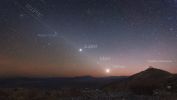
Planets_zodiac_beletsky_labels.jpgMorning Planets119 visiteCanis Major (Overdog)
The great Overdog,
That heavenly beast
With a star in one eye,
Gives a leap in the east.
He dances upright
All the way to the west
And never once drops
On his forefeet to rest.
I'm a poor underdog,
But tonight I will bark
With the great Overdog
That romps through the dark.
By Robert Frost (1874-1963)
MareKromium
|
|
| 496 immagini su 42 pagina(e) |
 |
|
|
|
|
19 | |
|
|
|
|








