| Piú viste - The Universe Inside |
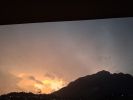
TB-03-20260619_203336.jpgFire in the Sky (Image Crtedits: Tatiana Balbiani)132 visite"La Morte è una sfida.
Ci dice di non sprecare il Tempo.
Ci dice di crescere, ci dice di divenire!
Ci suggerisce di dire ora gli uni agli altri che ci amiamo.
Ci dice di donarci ora!"
Leo Buscaglia (Vivere, Amare, Capirsi - 1982)MareKromium
|
|
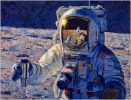
ALANBEAN-CORETUBE.jpgCore-Tube131 visiteDalla Galleria Pittorica dell'Astronauta Alan Laverne Bean: un Omaggio alla Luna ed a quei pochi che ebbero il coraggio, la fortuna ed il privilegio di camminarci sopra.
Ma lasciamo che sia "Alan" a raccontarci questa storia: la "Sua Storia"...
"...When my book, "Apollo, An Eyewitness Account", was published in October of 1998, I felt an overall sense of satisfaction. I was, in fact, preserving some of my special memories of the Apollo Program. This was the reason I resigned from NASA to become an artist.
I was moving right along but I noticed my goals for the future were even more ambitious. I wanted to paint the Moon more beautifully than I had done so far, as colorful as it could be painted, and still look like the Moon to me, a worthy but elusive goal.
I stopped painting commissions and began painting several series of studies to explore and develop new color techniques and combinations. This intense and dedicated effort consumed me for the better part of a year with the resulting changes first coming to full fruition in this painting.
Sometimes when I look at this painting I wonder if the changes were all that much. I question if anyone other than me can see them or even care? I don't know. Was it worth the time? I hope so...".
|
|

CollidingGalaxies-PIA02180_modest.jpgHearts of Glass131 visiteThis artist's concept shows delicate greenish crystals sprinkled throughout the violent core of a pair of colliding galaxies. The white spots represent a thriving population of stars of all sizes and ages. NASA's Spitzer Space Telescope detected more than 20 bright and dusty galactic mergers like the one depicted here, all teeming with the tiny gem-like crystals.
When galaxies collide, they trigger the birth of large numbers of massive stars. Astronomers believe these blazing hot stars act like furnaces to produce silicate crystals in the same way that glass is made from sand. The stars probably shed the crystals as they age, and as they blow apart in supernovae explosions.
At the same time the crystals are being churned out, they are also being destroyed. Fast-moving particles from supernova blasts easily convert silicates crystals back to their amorphous, or shapeless, form.
How is Spitzer seeing the crystals if they are rapidly disappearing? Astronomers say that, for a short period of time at the beginning of galactic mergers, massive stars might be producing silicate crystals faster than they are eliminating them. When our own galaxy merges with the Andromeda galaxy in a few billion years, a similar burst of massive stars and silicate crystals might occur.
Crystal Storm in Distant Galaxy
The graph (see inset above) of infrared data from NASA's Spitzer Space Telescope tells astronomers that a distant galaxy called IRAS 08752+3915 is experiencing a storm of tiny crystals made up of silicates. The crystals are similar to the glass-like grains of sand found on Earth's many beaches.
The data were taken by Spitzer's infrared spectrograph, which splits light open to reveal its rainbow-like components. The resulting spectrum shown here reveals the signatures of both crystalline (green) and non-crystalline (brown) silicates.
Spitzer detected the same crystals in 20 additional galaxies, all belonging to a class called ultraluminous infrared galaxies. These extremely bright and dusty galaxies usually consist of two galaxies in the process of smashing into each other. Astronomers believe massive stars at the hearts of the galaxies are churning out clouds of silicate crystals. This phenomenon may represent a short-lived phase in the evolution of galactic mergers.
|
|
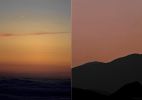
Sunrises.jpgPoints of View...130 visitenessun commentoMareKromium
|
|

FireRainbow_Harbig_960.jpgNice...129 visite“La Guerra di Religione: in pratica vi siete uccisi, vi state uccidendo e vi ucciderete per decidere chi abbia l'Amico Immaginario migliore"
Richard JeniMareKromium
|
|

Freedom.jpgFreedom (credits: Dr Marco Faccin)127 visite"...Un Regno che non conosce la Pietà, è un Regno effimero..."MareKromium
|
|

Fractal_Tree.jpgFractal Tree (by Dr Gianluigi Barca)127 visitenessun commentoMareKromium
|
|

Upsilon_Andromedae.jpgUpsilon Andromedae127 visiteVivamus mea Lesbia, atque amemus,
Rumoresque senum severiorum
Omnes unius aestimemus assis!
Soles occidere et redire possunt:
Nobis cum semel occidit brevis lux,
Nox est perpetua una dormienda.
Da mi basia mille, deinde centum,
Dein mille altera, dein secunda centum,
Deinde usque altera mille, deinde centum.
Dein, cum milia multa fecerimus,
Conturbabimus illa, ne sciamus,
Aut ne quis malus invidere possit,
Cum tantum sciat esse basiorum.
G. V. CatulloMareKromium
|
|

The_Lion_Sleeps_Tonight.jpgA-Weema-Weh!127 visite"...Simba inaweza kubadilika Dunia...".
Kujitolea kwa Afrika.
MareKromium
|
|
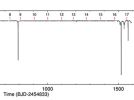
Kardashev-01.jpgThe Kardashev Scale: the Case of "KIC 8462852" (1)127 visiteSo far, there is no valid scientific explanation for the dimming of a star 1,480 light-years away. Some have advanced the hypothesis of an extraterrestrial system capturing energy. Have you ever heard of a Type II Kardashev civilization? Human civilization has not yet reached Type I (0.73) and will (perhaps) get there in 200-300 years.
A Type II Kardashev civilization is a technologically advanced society capable of harnessing all the energy emitted by its star through enormous orbiting systems. Science fiction?
Great authors such as Isaac Asimov, Carl Sagan, and Arthur C. Clarke have discussed it, among others.
In 1964, Soviet scientist Nikolai Kardashev devised a scale that linked the level of development of potential extraterrestrial civilizations with their ability to harness the entire energy of a planet (type I), a solar system (type II), or an entire galaxy (type III).
An important corollary of his studies is that to find a highly advanced alien civilization, you don't need to try to pick up a radio signal (as the Arecibo radio telescope has been doing for 45 years without—yet—finding anything), but rather observe whether a star's light appears much dimmer than it should be, whether it experiences sudden and inexplicable drops in light energy, or—in extreme cases—whether its light is completely absent. This would mean that "someone" or "something" is "harvesting" the star's energy.MareKromium
|
|

Supernova.jpgSupernova (a Fantasy - by Dr Paolo C. Fienga - based on an Alex Cherney's picture)126 visiteChe cosa accadrebbe e, soprattutto, che cosa vedremmo se una stelle di grandi dimensioni esplodesse e, dal nostro punto di vista, si trovasse nei pressi del "Centro" della Via Lattea?
Probabilmente assisteremmo ad uno spettacolo quale è quello che vedete qui, in questo splendido frame di Alex Cherney (rappresentativo di una "Visione Galattica" ottenuta dall'Australia - Loch Ard Gorge), da me liberamente - ma solo in piccola parte - modificato.
Una sorta di "Piccolo Sole" illuminerebbe (in maniera maestosa!) la notte, forse per una settimana o poco più, ma senza trasformarla in giorno o in crepuscolo.
Si, sarebbe un Grande Spettacolo...Davvero.MareKromium
|
|

LiveWire.jpgLive Wire (by Roberto Tremolada)125 visitenessun commentoMareKromium
|
|
| 496 immagini su 42 pagina(e) |
 |
|
|
|
|
17 | |
|
|
|
|








