| Piú viste - The Universe Inside |

Railway to the Moon.jpgLet's go to the Moon!...137 visite"...Ricordati che la Strada che porta al Cielo, passa sempre per questa Terra..."
P.C. Floegers - "Memories"
|
|

Earthly Sky.jpgNot a "Nebular Cloud"...Just a "cloud"!137 visitenessun commento
|
|

Lonelyness.jpgRiver of Oblivion (by Roberto Tremolada)137 visite"...Omnia fert Aetas: animum quoque..."
(Virgilio)
"...Il Tempo porta via ogni cosa, inclusa la Memoria..." (trad. libera)MareKromium
|
|

Cerchio.jpgWhat is a "Circle"?136 visiteLa domandina è semplice: quando un angolo si riduce ad un "punto", quale sarà mai la dimensione dell'angolo/punto stesso, esprimendola in gradi?MareKromium
|
|

Goldrake_Red_Moon.jpgForever Young, I wanna be...135 visiteUn indimenticabile Personaggio, noto soprattutto a quelli che, oggi, non sono più "ragazzi", ritorna ad affacciarsi nei nostri Cieli Immaginari, grazie al Grande Lavoro dell'Amico Giorgio Picciau e dei Suoi Colleghi e Collaboratori.
Goldrake, imponente come la Luna che splende alle sue spalle, ha rappresentato un momento alquanto particolare della Storie e della Cultura (non solo cartonistica e cinematografica) del nostro Paese e, forse, dopo il Mito di "Godzilla", egli ha sancito il ritorno in Europa ed in Italia (a questo punto in pianta stabile) del Fantasy Orientale.
I Sogni, come gli Eroi, non muoiono mai, anzi: si rinnovano e rinvigoriscono (come questa "Visione" di Goldrake, a nostro avviso, ne è una evidente conferma), pur rimanendo fedeli a se stessi.
Complimenti, ancora una volta, a Giorgio Picciau e congratulazioni per il Suo Sito "Ufo Robot Project" (http://www.uforobots.net/), che Vi invitiamo a visitare e che sponsorizziamo con infinito affetto!MareKromium
|
|

TB-04-20260619_203336.jpgFire in the Sky (Image Crtedits: Tatiana Balbiani)135 visite"L'Amore agisce come una malattia, ma funziona al contrario: fa bene quando infetta, fa morire quando guarisce".
Paolo Crepet (I figli non crescono più - 2005)MareKromium
|
|

MoonoverAntarctica.jpgAlien Landscape (Moon over Antarctica)134 visiteDa "NASA - Picture of the Day" del 25 Novembre 2005:"Last week, the nearly Full Moon set along the Northern Horizon - as seen from Davis Station, Antarctica. The squashed orange pumpkin shape just silhouettes the peak of a distant iceberg in this stunning view.
The Moon's apparently squashed shape is due to atmospheric bending of light or refraction - an effect which is more severe closer to the horizon. Skimming low along the stark features of the frozen landscape, the Moon's lower edge appears noticeably more distorted than the upper limb. Along with about 70 others present at Davis Station, Dr. Jim Behrens had a chance to enjoy the view while studying the ongoing detachment of a large iceberg known as "Loose Tooth".
|
|

cove_of_dreams_1600.jpgTell me the Truth...134 visite
|
|

The_Moon_and_Venus_2.jpgSetting Moon and Venus (Credits: Dott.ssa Tatiana Balbiani)134 visite“I dolori, le delusioni e la malinconia non sono fatti per renderci scontenti e toglierci valore e dignità, ma per maturarci”
Herman HesseMareKromium
|
|

The_Moon-EB-MF-LXTT-IPF.jpgMoon-Rising (by Elisabetta Bonora and Marco Faccin/LXTT/IPF)133 visite"...It takes an instant to erase a Life; but it takes a Lifetime to erase an instant..."
Jim MorrisonMareKromium
|
|
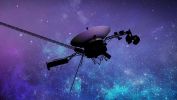
Voyager_1A.jpgFarewell...133 visiteOn April 17, 2'26, engineers at NASA’s Jet Propulsion Laboratory (JPL) in Southern California sent commands to shut down an instrument aboard Voyager 1 called the Low-energy Charged Particles experiment, or LECP. The nuclear-powered spacecraft is running low on power, and turning off the LECP is considered the best way to keep humanity’s first interstellar explorer going.
The LECP has been operating almost without interruption since Voyager 1 launched in 1977 — almost 49 years. It measures low-energy charged particles, including ions, electrons, and cosmic rays originating from our solar system and galaxy. The instrument has provided critical data about the structure of the interstellar medium, detecting pressure fronts and regions of varying particle density in the space beyond our heliosphere. The twin Voyagers are the only spacecraft that are far enough from Earth to provide this information.
Like Voyager 2, Voyager 1 relies on a radioisotope thermoelectric generator, a device that converts heat from decaying plutonium into electricity. Both probes lose about 4 watts of power each year. After almost a half-century in space, power margins have grown razor thin, requiring the team to conserve energy by shutting off heaters and instruments while making sure the spacecraft don’t get so cold that their fuel lines freeze.
During a routine, planned roll maneuver on Feb. 27, Voyager 1’s power levels fell unexpectedly. Mission engineers knew any additional drop in power could trigger the spacecraft’s undervoltage fault protection system, which would shut down components on its own to safeguard the probe, requiring recovery by the flight team — a lengthy process that carries its own risks.
The Voyager team needed to act first.
“While shutting down a science instrument is not anybody’s preference, it is the best option available,” said Kareem Badaruddin, Voyager mission manager at JPL. “Voyager 1 still has two remaining operating science instruments — one that listens to plasma waves and one that measures magnetic fields. They are still working great, sending back data from a region of space no other human-made craft has ever explored. The team remains focused on keeping both Voyagers going for as long as possible.”
Far-out plan
The choice of which instrument to turn off next wasn’t made in the heat of the moment. Years ago, the Voyager science and engineering teams sat down together and agreed on the order in which they would shut off parts of the spacecraft while ensuring the mission can continue to conduct its unique science. Of the 10 identical sets of instruments that each spacecraft carries, seven have been shut off so far. For Voyager 1, the LECP was next on that list. The team shut off the LECP on Voyager 2 in March 2025.
Because Voyager 1 is more than 15 billion miles (25 billion kilometers) from Earth, the sequence of commands to shut down the instrument will take 23 or so hours to reach the spacecraft, and the shutdown process itself will take about three hours and 15 minutes to complete. One part of the LECP — a small motor that spins the sensor in a circle to scan in all directions — will remain on. It uses little power (0.5 watts), and keeping it running gives the team the best chance of being able to turn the instrument back on someday if they find extra power.
What comes next
Engineers are confident that shutting down the LECP will give Voyager 1 about a year of breathing room. They are using the time to finalize a more ambitious energy-saving fix for both Voyagers they call “the Big Bang,” which is designed to further extend Voyager operations. The idea is to swap out a group of powered devices all at once — hence the nickname — turning some things off and replacing them with lower-power alternatives to keep the spacecraft warm enough to continue gathering science data.
The team will implement the Big Bang on Voyager 2 first, which has a little more power to spare and is closer to Earth, making it the safer test subject. Tests are planned for May and June 2026. If they go well, the team will attempt the same fix on Voyager 1 no sooner than July. If it works, there is even a chance that Voyager 1’s LECP could be switched back on.MareKromium
|
|

TB-03-20260619_203336.jpgFire in the Sky (Image Crtedits: Tatiana Balbiani)133 visite"La Morte è una sfida.
Ci dice di non sprecare il Tempo.
Ci dice di crescere, ci dice di divenire!
Ci suggerisce di dire ora gli uni agli altri che ci amiamo.
Ci dice di donarci ora!"
Leo Buscaglia (Vivere, Amare, Capirsi - 1982)MareKromium
|
|
| 496 immagini su 42 pagina(e) |
 |
|
|
|
|
16 | |
|
|
|
|








