| Piú viste - The Universe Inside |
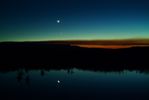
Inner_Worlds-jul8_westlake_f.jpgInner Worlds, in the Sunset...142 visiteDa "NASA - Picture of the Day" del 15 Luglio 2005:" Only Mars is missing from this reflective view of the major rocky bodies of the Inner Solar System. Captured on July 8th, the serene, twilight picture looks out over the Flat Tops Wilderness area from near Toponas, Colorado, USA and includes planets Mercury, Venus, Earth and Earth's large natural satellite, the Moon. The Moon is in a young crescent phase about 3° above bright planet Venus. Forest fires contribute to a layer of smoke in Earth's sky that almost hides planet Mercury, still visible very near the horizon.
Just a week earlier Venus and Mercury were joined by Saturn, forming a notable grouping in the West also enjoyed by skygazers across planet Earth".
|
|

Multiuniverse.jpgThe "Universe", inside...142 visite...Tutto avremmo potuto immaginare, tranne che il Sito "NASA - Picture of the Day" giungesse a mostrare un fantasyframe che esprime il medesimo concetto della nostra Sezione "The Universe Inside". Ora i casi sono due (se ci passate la battuta): o gli Ideatori e Curatori del Sito NASA ci hanno copiato in maniera palese, o - come peraltro è già accaduto in passato - gli Ideatori ed i Curatori di "Lun-Ex-It" e di "NASA - Picture of the Day", talvolta (ma sempre più spesso), hanno proprio le stesse idee ed intuizioni...
Caption originale:"Do nearly exact copies of you exist in other universes? If one or more of the multiverse hypotheses is correct, then quite possibly they do. In the above computer-enhanced illustration, independent universes are shown as independent circles or spheres. Spheres may be causally disconnected from all other spheres, meaning no communications can pass between them. Some spheres may contain different realizations of our universe, while others may have different physical laws. An entire set of parallel universes is called a multiverse. The human eye might represent the possibility that realizations of some multiverse hypotheses might only exist in the human mind. One criticism of multiverse hypotheses is that they are frequently difficult to test. Some multiverse hypotheses may therefore be great fun to think about but not practically falsifiable and therefore have no predictive scientific value".
|
|
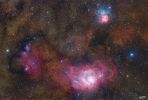
Sagittarius_M-8_and_M-20.jpgSagittarius Region142 visite"In order for Life to have appeared spontaneously on Earth, there first had to be hundreds of millions of protein molecules wandering in the Universe. The Ninth Configuration.
But given the size of the planet Earth, and the one of the Universe, do you know how long it would have taken for just one of these protein molecules to appear entirely by chance?
Roughly ten to the two hundred and forty-third power billions of years. And I find that far, far more fantastic than simply believing in God".MareKromium
|
|

ZZ-Venus from Space.jpgVenus from the Earth's orbit141 visiteCaption NASA originale:"Venus can appear as a brilliant evening star. Besides the Sun and Moon, Venus is the brightest object visible in Earth's sky. Because it is closer to the Sun than Earth, Venus never strays far from the Sun in its apparent position and is seen during the year as either a bright morning or evening star. This beautiful sunset imaged from low earth orbit by the Atlantis space shuttle crew in May 1989 also reveals the planet Venus blazing above Earth's horizon. It is a fitting image for this mission and crew. It was recorded following the successful release of the robot Venus-explorer Magellan, the first planetary probe to be deployed from a space shuttle".
|
|

Earth_and_Moon.gifMother and Daughter...140 visiteA NASA camera aboard the Deep Space Climate Observatory (DSCOVR) satellite captured a unique view of the Moon as it moved in front of the sunlit side of Earth last month.
The series of test images shows the fully illuminated “dark side” of the Moon that is never visible from Earth.
The images were captured by NASA’s Earth Polychromatic Imaging Camera (EPIC), a four megapixel CCD camera and telescope on the DSCOVR satellite orbiting 1 MMs from Earth. From its position between the Sun and Earth, DSCOVR conducts its primary mission of real-time solar wind monitoring for the National Oceanic and Atmospheric Administration (NOAA).MareKromium
|
|

Sun_Pillar_in_blue_and_violet.jpgSun Pillar from Lake Tahoe - Nevada State Park (USA)139 visiteCaption originale NASA: "Sometimes the unknown is beautiful. In 2000 February near Lake Tahoe, Nevada, two amateur photographers noticed an unusual red column of light rise mysteriously from a setting sun. During the next few minutes, they were able to capture the pillar and a photogenic sunset on film. Pictured above, the red column is seen above a serene Lake Tahoe and snow-capped mountains across from Lake Tahoe-Nevada State Park. The mysterious column, they learned later, is a Sun Pillar, a phenomenon where sunlight reflects off of distant falling ice crystals".
|
|
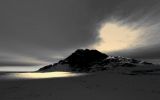
BeforeTheMigration-02.jpgMars before the Great Migration (by Roberto Tremolada)139 visitenessun commentoMareKromium
|
|

EOD.jpgShards of a Planet139 visiteComunicazione ai Lettori di Lunar Explorer Italia: a partire - formalmente - da oggi, 22 Giugno 2011, è cessata ogni collaborazione tra la nostra Fondazione ed il Sito "PianetaMarte.net", gestito dal Sig. Matteo Fagone.
La decisione, triste ma necessaria, è divenuta inevitabile a causa della - ormai - profondissima diversità di vedute, approcci, stili, argomenti e collaborazioni esistente fra le due Entità in questione. Rammentiamo, per onor del vero, oltre che per Correttezza (Virtù sempre più rara), che fu lo stesso Sig. Fagone, circa due mesi fa, a chiedere la cancellazione (come Partner e come "link" in uscita) del Suo nome e del Suo Sito da Lunar Explorer Italia.
I motivi della Sua richiesta non vennero precisati, ma questo non ha più importanza.
Per quanto attiene i nostri motivi, possiamo solo dire che una Partnership, piccola o grande che sia, per mantenersi e sostenersi necessita, come sanno tutti, di alcuni elementi essenziali, tra cui evidenziamo, ad esempio: la Comunione di Intenti e di Vedute, la Compatibilità degli Approcci adottati e dei Fini perseguiti nonchè una sostanziale "affinità" di Sensibilità e Culture.
Ebbene, tutto questo, da ormai molto tempo, non esisteva più tra PianetaMarte.net e Lunar Explorer Italia e quindi la decisione di cancellare anche formalmente la predetta Partnership a noi sembra, oltre che inevitabile, anche giusta e corretta.
Auguriamo (ed auguro, personalmente) il meglio al Sig. Fagone ed alla Sua "Creatura" PianetaMarte.net, e siamo/sono certi/o che le Sue scelte e filosofie, recenti e meno recenti, lo ripagheranno adeguatamente e pienamente.
Dr Paolo C. Fienga - Lunar Explorer Italia
Presidente e Socio co-FondatoreMareKromium
|
|

Apollo_Class.jpgApollo Class139 visite"La Verità non è mai visibile. E' solo un'idea. Ed un'idea la si può vedere?!?"
Paolo C. FiengaMareKromium
|
|

Moon River.jpgThe Moon over St. Lawrence River137 visiteDa "NASA - Picture of the Day" del 9 Settembre 2005:"Shortly after sunset on September 6th, sky gazers around the world were treated to a lovely crescent Moon in western skies - joined by bright planets Venus and Jupiter.
In this colorful telephoto view from near Quebec City, Canada, the Moon is nestled just above the wide St. Lawrence River. Lights on the horizon are along the river's southern shore. Also known as the evening star, Venus is at the upper left and Jupiter at the upper right, while another prominent celestial beacon, Spica, can be seen shining through the twilight below Venus.
Spica, actually a very close pair of hot blue stars some 260 LY away, is the brightest star in the constellation Virgo".
|
|

hideaway_nielsen_big.jpgHideaway137 visite"...On the day I called, you answered me,
You increased my strength of soul..."
Psalm 138:3
|
|

Earthly Sky.jpgNot a "Nebular Cloud"...Just a "cloud"!137 visitenessun commento
|
|
| 496 immagini su 42 pagina(e) |
 |
|
|
|
|
15 | |
|
|
|
|








