| Piú viste - The Universe Inside |

Night_Beauties-ES.jpgNight Beauties (by Ermes Sansottera)155 visite"...A man can be destroyed but not defeated..."
Ernest HemingwayMareKromium
|
|
Kardashev-00.jpgThe Kardashev Scale (Theory) - so named after Nikolaj Semënovič Kardašëv (Семёнович Кардашёв - Москва город, Aпрель 25, 1932 – Москва город, Август 3, 2019)155 visiteThe Kardashev scale (шкала Кардашёва – shkala Kardashova) is a method of measuring a civilization's level of technological advancement based on the amount of energy it is capable of harnessing and using.
The measure was proposed by Soviet astronomer Nikolai Kardashev in 1964, and was named after him.
Kardashev first outlined his scale in a paper presented at the 1964 conference that communicated findings on BS-29-76, Byurakan Conference in the Armenian SSR, which he initiated, a scientific meeting that reviewed the Soviet radio astronomy space listening program.
The paper was titled "Передача информации внеземными цивилизациями" ("Transmission of Information by Extraterrestrial Civilizations").
Starting from a functional definition of civilization, based on the immutability of physical laws and using human civilization as a model for extrapolation, Kardashev's initial model was developed.
He proposed a classification of civilizations into three types, based on the axiom of exponential growth:
• A Type I civilization (planetary) is able to access all the energy available on its planet and store it for consumption.
• A Type II civilization (stellar) can directly consume a star's energy.
• A Type III civilization (galactic) is able to capture all the energy emitted by its galaxy, and every object within it, such as every star, black hole, etc.
Under this scale, the sum of human civilization does not reach Type I status, though it continues to approach it.
Extensions of the scale have since been proposed, including a wider range of power levels (Types 0, IV, and V) and the use of metrics other than pure power, e.g., computational growth or food consumption.
In a second article, entitled "Strategies of Searching for Extraterrestrial Intelligence", published in 1980, Kardashev wonders about the ability of a civilization, which he defines by its ability to access energy, to sustain itself, and to integrate information from its environment.
Two more articles followed: "On the Inevitability and the Possible Structure of Super Civilizations" and "Cosmology and Civilizations", published in 1985 and 1997, respectively; the Soviet astronomer proposed ways to detect super civilizations and to direct the SETI (Search for Extra Terrestrial Intelligence) programs.
A number of scientists have conducted searches for possible civilizations, but with no conclusive results.
However, in part thanks to such searches, unusual objects, now known to be either pulsars or quasars, were identified.
MareKromium
|
|

Sundogs.jpgThe "Sundogs", again154 visiteCaption NASA originale da "NASA - Picture of the Day" del 23 Agosto 1999 :"What if you woke up one morning and saw more than one Sun in the sky? Most probably, you would be seeing Sundogs, extra-images of the Sun created by falling ice-crystals in the Earth's atmosphere. As water freezes in the atmosphere, small, flat, six-sided, ice crystals might be formed. As these crystals flutter to the ground, much time is spent with their faces flat, parallel to the ground. An observer may pass through the same plane as many of the falling ice crystals near sunrise or sunset. During this alignment, each crystal can act like a miniature lens, refracting sunlight into our view and creating parhelia, the technical term for sundogs. Sundogs were photographed here in a cloudy sky above the Very Large Array of radio telescopes. A bright Sundog is visible on the far right, and a dim one on the far left. Ice-crystals can create other strange illusions of the Sun and Moon including halos and pillars".
|
|

Solar_Eclipse~2.jpgFeeding on the Sun...154 visite"Essere immortale è cosa da poco: tranne l'uomo, infatti, tutte le Creature lo sono, giacché ignorano la Morte. Ma la cosa Divina, Terribile ed Incomprensibile, è nel sapersi immortali..."
Jorge Luis BorgesMareKromium
|
|

Waterworld.jpgTherefore... Solaris, Miller and Waterworld DO exist! Here is the Exoplanet "TOI-1452b"154 visiteCome immaginato nel 1972 dal Grande Regista Russo Andrej Tarkovskij nel film "Solaris" o, nella cinematografia più recente, in Interstellar per il pianeta oceanico "Miller," situato a circa a 100 Anni Luce da noi, sembra che esista un esopianeta alquanto più grande della Terra che potrebbe essere interamente coperto d'acqua. Denominato TOI-1452b, ruota intorno a due piccole stelle ed è stato scoperto da un gruppo di ricerca internazionale guidato da Charles Cadieux, studente di dottorato dell'università di Montréal, in Canada, e descritto sulla rivista The Astronomical Journal.
Il nuovo pianeta è stato identificato per la prima volta grazie al telescopio spaziale Tess, ideato proprio per scansionare la nostra galassia alla ricerca di pianeti extrasolari. Una volta individuato, il nuovo oggetto è stato analizzato nel dettaglio da un nuovo potente strumento installato sull'Osservatorio di Mont-Megantic in Canada che ha permesso di scoprirne le interessanti caratteristiche. È stato così possibile appurare che TOI-1452b orbita attorno a un sistema di stelle binarie più piccole del Sole, distanti tra loro solo 97 U.A. (Unità Astronomiche), ossia poco più del doppio della distanza tra Sole e Plutone.
Il pianeta risulta essere circa il 70% più grande della Terra (in termini di diametro) e la sua densità potrebbe essere coerente con l'ipotesi che su di esso esista un oceano molto profondo costituito da acqua allo stato liquido, che lo ricopre interamente. I dati indicano la presenza di un nucleo solido, mentre l'acqua rappresenterebbe ben il 20% della sua massa (Nota: sulla Terra, la massa d'acqua è pari ad appena l'1%) della massa globale del Pianeta. Nuovi dettagli di questo nuovo e interessante pianeta potranno essere rilevati a breve grazie alle osservazioni con il Telescopio Spaziale "James Webb", operativo da pochi mesi.MareKromium
|
|
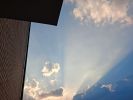
TB-00-20260619_203336.jpgCrepuscular Rays (Image Crtedits: Tatiana Balbiani)154 visite"É impossível explicar as preferências humanas.
Embora sejam construídos com materiais absolutamente idênticos e ambos sejam belos (ninguém consegue dizer qual é mais bonito), o pôr do sol sempre teve, e ainda tem, uma audiência maior do que o nascer do sol."
(traduzione)
"È impossibile spiegare le preferenze umane.
Anche se costruiti con materiali assolutamente identici, ed entrambi bellissimi (nessuno può dire quale dei due è più bello), il Sole che tramonta ha sempre avuto, ed ha, più pubblico di quello che sorge".
Millor FernandesMareKromium
|
|

RingOfFire.jpgThe "Ring of Fire"153 visite"...Fides facit Fidem..."
(Binder)
"...La Fede genera la Fede..."MareKromium
|
|

Grigna-WhatsApp_Image_2019-11-16_at_22_27_10_(4).jpgEternity does not mean Forever (by Giovanni Casile)153 visite"...C'é chi crede di sapere, c'é chi sa di non sapere, c'é chi dice di sapere e non sa, e c'é chi veramente sa e non lo dice...".
Luciano Meran DonatoniMareKromium
|
|

BlackSun in Antarctica.jpgBlack Sun in Antarctica (November 2003)152 visitenessun commento
|
|

Martian_Sunset-MF-LXTT.jpgCold Sunset152 visitenessun commentoMareKromium
|
|
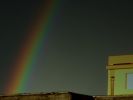
Eternity_in_the_Rainbow.jpgEternity in a Rainbow (by Dr Gianluigi Barca)152 visitenessun commentoMareKromium
|
|

The_Mono_Lake.jpgThe "Mono" Lake151 visitenessun commentoMareKromium
|
|
| 496 immagini su 42 pagina(e) |
 |
|
|
|
|
13 | |
|
|
|
|








