| Piú viste - The Universe Inside |

Solaris-3.jpgSolaris164 visite"I only know one thing. When I... When I sleep, I know no fear, no hope, no trouble, no bliss, Blessings on him he who invented sleep. The common coin that purchases all things, the balance that levels shepherd king, fool and wise man. There is only one bad thing about sound sleep. They say it closely resembles death".MareKromium
|
|

Sundogs1.jpgThe "Dogs of the Sun"163 visiteI "Cani del Sole", un evento naturale decisamente curioso e, purtroppo, piuttosto raro dalle nostre parti (diciamo purtroppo poichè si tratta di un fenomeno alquanto suggestivo). Secondo i Navajo, l'apparizione dei due (apparenti) Soli Minori (i "cani", appunto) accanto al Sole Maggiore, costituiva di regola un presagio favorevole e, per i guerrieri/cacciatori, il verificarsi di questa "apparizione" costituiva l'annuncio di una stagione di caccia (o anche di una semplice "battuta", magari) particolarmente favorevole. I "Cani del Sole" e la relativa leggenda vennero anche - incidentalmente - ripresi nel film (ormai entrato nella Storia del Cinema) "The Deer Hunter", con R. de Niro.
|
|

Moonlight.jpgDistortions... (Image Credit & Copyright: Giacomo Venturin)163 visite"...L'usanza comune a molti letterati di disprezzare il mondo moderno e' una maniera dissimulata di presumersi degni di un altro migliore..."
Aristide GabelliMareKromium
|
|

True_Colors.jpgTrue Colors (Credits: Eric Houck)162 visite"Human salvation lies in the hands of dissatisfied creatives"
(Traduzione)
"La salvezza umana giace nelle mani dei creativi insoddisfatti"
Martin Luther KingMareKromium
|
|

Equinox.jpgEquinox161 visite
|
|

lake_of_legends_1600.jpgNevermore...161 visite
|
|

RingOfFire.jpgThe "Ring of Fire"161 visite"...Fides facit Fidem..."
(Binder)
"...La Fede genera la Fede..."MareKromium
|
|

Moon and Companions~0.jpgMoon, Mars and Venus159 visiteDa "NASA - Picture of the Day" del 19 Ottobre 2005:"On another October 19, in 1899, a 17 year-old Robert Goddard climbed a cherry tree on a beautiful autumn afternoon in Worcester, Massachusetts. Inspired by H.G. Wells' "War of the Worlds" and gazing out across a meadow, young Goddard imagined it would be wonderful to make a device that had the possibility of ascending to Mars. Forever more he felt his life had a purpose and in the following years his diary entries record October 19th as "Anniversary Day", the anniversary of his ascent into the cherry tree. By 1926 he had designed, built, and flown the world's first liquid fuel rocket. Mars is just visible through the trees at the lower right in this dramatic sky view that also features the Moon and Venus - all visited by liquid fuel rockets constructed on principles developed by Goddard".
|
|
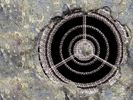
Pseudo-Crater.jpgPseudo-Crater <-- or --> True-Crater159 visite"...Laddove non c'è Verità non ci può neppure essere Bellezza..."
P.C. Floegers
|
|

sky_splash_1600.jpgSky-Splash!159 visite
|
|

Sundogs.jpgThe "Sundogs", again158 visiteCaption NASA originale da "NASA - Picture of the Day" del 23 Agosto 1999 :"What if you woke up one morning and saw more than one Sun in the sky? Most probably, you would be seeing Sundogs, extra-images of the Sun created by falling ice-crystals in the Earth's atmosphere. As water freezes in the atmosphere, small, flat, six-sided, ice crystals might be formed. As these crystals flutter to the ground, much time is spent with their faces flat, parallel to the ground. An observer may pass through the same plane as many of the falling ice crystals near sunrise or sunset. During this alignment, each crystal can act like a miniature lens, refracting sunlight into our view and creating parhelia, the technical term for sundogs. Sundogs were photographed here in a cloudy sky above the Very Large Array of radio telescopes. A bright Sundog is visible on the far right, and a dim one on the far left. Ice-crystals can create other strange illusions of the Sun and Moon including halos and pillars".
|
|
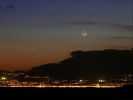
MoonMercMonaco_jacques_full.jpgThe Moon and Mercury, from Monaco (FRA)158 visiteUna falce di Luna ed una piccola scintilla, piuttosto alta nel cielo della sera: Mercurio.
Una bella immagine che ci arriva dalla Francia e che ha trovato spazio anche nella Rubrica "NASA - Picture of the Day".
Questa la caption originale:"Low on the western horizon after sunset, a slender crescent Moon and wandering planet Mercury join the lights of Menton and Monaco along the French Riviera. Astronomer Vincent Jacques took advantage of this gorgeous photo opportunity a week ago on March 11, when the Moon and Mercury were separated in the sky by just 3°. Of course, the Moon in a slender crescent phase is always seen near the horizon, as is Mercury - a bright planet which can be difficult to glimpse as it never strays far from the Sun in Earth's sky. In the coming days good views of Mercury will indeed be fleeting as the Solar System's innermost planet is rapidly dropping closer to the glare of the setting Sun".
|
|
| 496 immagini su 42 pagina(e) |
 |
|
|
|
|
12 | |
|
|
|
|








