| Piú viste - Mariner, Viking & MGS's Maps & Mars in the '70s |
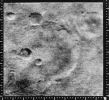
N-Mariner4-64-PIA02979.jpgMariner Crater from Mariner 4154 visiteCaption NASA originale:"Mariner 4 image of the crater named after it, the 151 Km diameter Mariner Crater at 35°S, 164°W. Running from the lower left corner of the frame through the bottom of the crater is a linear ridge which is part of Sirenum Fossae. The image was taken from 12.600 Km and covers 250 Km by 254 Km. North is up. (Mariner 4, frame 11E).
Mariner 4 was the first spacecraft to get a close look at Mars. Flying as close as 9.846 Km (6.118 miles), Mariner 4 revealed Mars to have a cratered, rust-colored surface, with signs on some parts of the planet that liquid water had once etched its way into the soil. Mariner 4 was launched on November 28, 1964 and arrived at Mars on July 14, 1965". Il commento NASA originale ed una semplice occhiata alle date della Missione dovrebbe esserci sufficiente per capire che la repentina interruzione dello "Human Space Program" deve aver avuto la sua reale ragione in motivi - a nostro avviso - diversi dai "budget cuts"...
|
|

O-Mariner9-71-PIA02989_modest.jpgSouth Polar Cap from Mariner 9 and 7154 visiteCaption NASA originale:"This mosaic of Mariner 9 frames (top), taken during the first orbit, shows the remnants of the South Polar Cap of Mars dimly through the great dust storm. Mariner 7 photographed the same area in August, 1969 (bottom) at which time the entire region was covered with dry ice. The strange quasilinear features of 1969 have been replaced by a number of bright curved appendages never before seen on Mars and, at this time, unexplained. Mariner 9 was the 1st spacecraft to orbit another planet. The spacecraft was designed to continue the atmospheric studies - begun by Mariners 6 and 7 - and to map over 70% of the Martian surface from the lowest altitude (1500 Km [approx. 900 miles]) and at the highest resolutions (1 Km per pixel to 100 meters per pixel) of any previous Mars mission".
Eccezionale, semplicemente: Mariner 9 venne lanciato il 30 Maggio 1971 ed arrivò a destinazione il 14 Novembre dello stesso anno.
|
|

ZE-I-Viking1-12f010.jpgFrom the "Viking Archive" - Viking 1: Sunset152 visiteComposizione a colori dei Viking Lander frames n. 12f010.red, 12f010.grn, and 12f010.blu.
Come potete vedere, negli istanti che seguono la scomparsa del Sole dietro l'orizzonte Marziano, il cielo di Marte appare di un colore "blu-scuro" piuttosto cupo, decisamente intenso e, apparentemente, "soffocato" da una incombente oscurità.
Si tratta di un ennesimo effetto collaterale del cosiddetto "dimming"? Forse, ma anche questa istantanea entra nella galleria dei "frames belli ma discutibili", specialmente se la mettiamo a confronto con altre immagini similari (cioè relative a tramonti Marziani), riprese sempre a colori veri o quasi/veri, ed ottenute dalle Sonde Soujourner/Pathfinder e Spirit (le troverete pubblicate nella Sezione "Mars in Colors").
Guardate, fate i confronti e poi provate a dare qualche risposta agli interrogativi che inevitabilmente emergeranno.
|
|

ZE-I-Viking1-vl1_12a240.jpgFrom the "Viking Archive" - Viking 1: Sunrise152 visiteCiascuno dei Viking Landers era equipaggiato con una corposa serie di "science packages" la quale includeva un kit per l'effettuazione di rilevamenti meteo, un sismometro, un kit per analisi chimiche del suolo e dell'aria, due macchine fotografiche ed un kit per l'effettuazione di (non meglio precisati) esperimenti biologici. La prima immagine del suolo di Marte venne ripresa e trasmessa a Terra immediatamente dopo il landing (caso mai accadesse qualcosa come era accaduta ai Russi...). L'immagine in questione mostrava un suolo sabbioso e polveroso, ricoperto di rocce di varie dimensioni, ma complessivamente piuttosto piccole (sino a circa 10 cm di diametro). Le 2 macchine fotografiche erano state installate su versanti opposti della Sonda, in maniera tale da ottenere sia una visione a 360° del panorama circostante, sia per scattare delle immagini stereo da usarsi per calcolare (approssimativamente) le distanze fra il Lander ed i rilievi individuati in ciascun frame.
|
|

ZD-Z-VikingLander1-Rocks.jpgThe surroundings of Viking 1 Lander (2)152 visiteCommenti originali:"Bedrock exposures are among the most provocative features at the Viking 1 landing site. Bedrock, of course, refers to a body of solid rock that underlies a layer of soil or unconsolidated sediment. On the Moon, bedrock is almost everywhere covered by a thick layer of impact debris. Only at the Apollo 15 site were astronauts Dave Scott and Jim Irwin able to chip off samples of bedrock from layers exposed in the wall of the Hadley Rille".
|
|

O-Mariner9-71-PIA02999_modest.jpgMars from Mariner 9: Ascraeus Lacus above the Martian Dust Storm151 visiteCaption NASA originale:"Oblique view of the crater complex near Ascraeus Lacus in the Tharsis region of Mars taken by Mariner 9. It is the northernmost of the prominent dark spots observed by Mariner during its approach to the Planet. The spot consists of several intersecting shallow crater-like depressions.
The main crater is approximately 21 Km (13 miles) across, the whole complex about 40 Km (25 miles) across.
The crater probably is in a relatively high area of the Martian surface, which accounts for its being visible above the dust storm.
The faint circular features outside the crater are probably atmospheric disturbances".
|
|
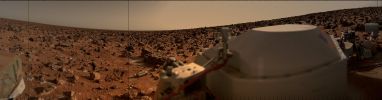
ZE-I-Viking_Lander_1-MF7-PCF-LXTT.jpgSunny Day over Chrise Planitia (Absolute Natural Colors; credits: Drr M. Faccin and Paolo C. Fienga - Lunexit Team) 151 visitenessun commentoMareKromium
|
|

ZI-Viking2-Rocks.jpgHorizon (3)149 visiteCommenti originali:"The following frames are 2 views of the same area in front of the spacecraft looking toward the North to Northeast, both taken with camera 2 but at different times of day. Linear accumulations of fine grained sediment have planar surfaces that are sharply delineated by shadow and reflected light. The small pyramidal rock in the lower left is a good example of a ventifact, a rock with multiple facets eroded by the wind".
|
|

ZEZ-I-Viking1.jpgFrom the "Viking Archive" - Viking 1: dusty day149 visiteCaption originale:"...Here we see another Viking 1 image taken on an especially dusty day, with the bright blue zone near the Sun visible as it overexposes the upper right of the frame. Notice the near lack of shadows from the rocks...".
|
|

ZE-I-Viking2-p140b.jpgFrom the "Viking Archive" - Viking 2: a few seconds before Sunrise (1)147 visite"...Early in the mission, when it became clear that there was a large amount of scattering particles in the lower atmosphere, we realized the potentially dramatic appeal of low Sun pictures. However, the first priority was to document the landscape with HR and color images. Following several weeks of successful operation on the Martian Surface we relaxed to the point of attempting exotic but high risk pictures...".
|
|

ZD-VikingLander1-p131b.jpgFrom the "Viking Archive" - Viking 1: Solar Eclypse on Mars147 visitePossibly the most unusual of all Viking Lander pictures records the passage of Phobos' shadow during a solar eclipse. On Earth the apparent size of the Moon is exactly the same as that of the much larger but more distant Sun. Consequently, direct sunlight is completely blocked out during a total solar eclipse. On Mars, Phobos covers only 1/4 of the solar disc. However, passage of the penumbral shadow causes a general drop in light level that is instrumentally detectable. This frame is a repeated line scan image looking back across Viking Lander 1. The colors have been distorted purposely to enhance detail. The blue and white horizontal stripes correspond to test chart patches. The brownish stripes in the middle represent the martian surface visible above the spacecraft. Note a decrease in light levels in the sky midway through the imaging event. The darkening, caused by the passage of the penumbral shadow of Phobos, is present over approx. 100 vertical lines. Moving at about 2 Km/sec, the shadow took about 20 sec to pass over the Lander.
|
|

ZE-I-Viking1Sky.jpgFrom the "Viking Archive" - Viking 1: late afternoon147 visiteThis is a Viking One late afternoon view on a fairly clear day. The bright sky near the Sun is apparently a lighter bluish color due to 'forward scattering'. The blue seen here is probably more camera induced than real. On Mars the 'Raleigh Scattering' which colors our sky blue is greatly diminished by the low atmospheric pressure. Although no obvious clouds were reported, The horizontal texture in the sky to the left of the overexposed region might just be some weak cloud detail.
|
|
| 115 immagini su 10 pagina(e) |
 |
3 | |
|
|
|
|
|
|








